
£30/m² benchmark: 2026 UK exterior painting costs and quote checklist
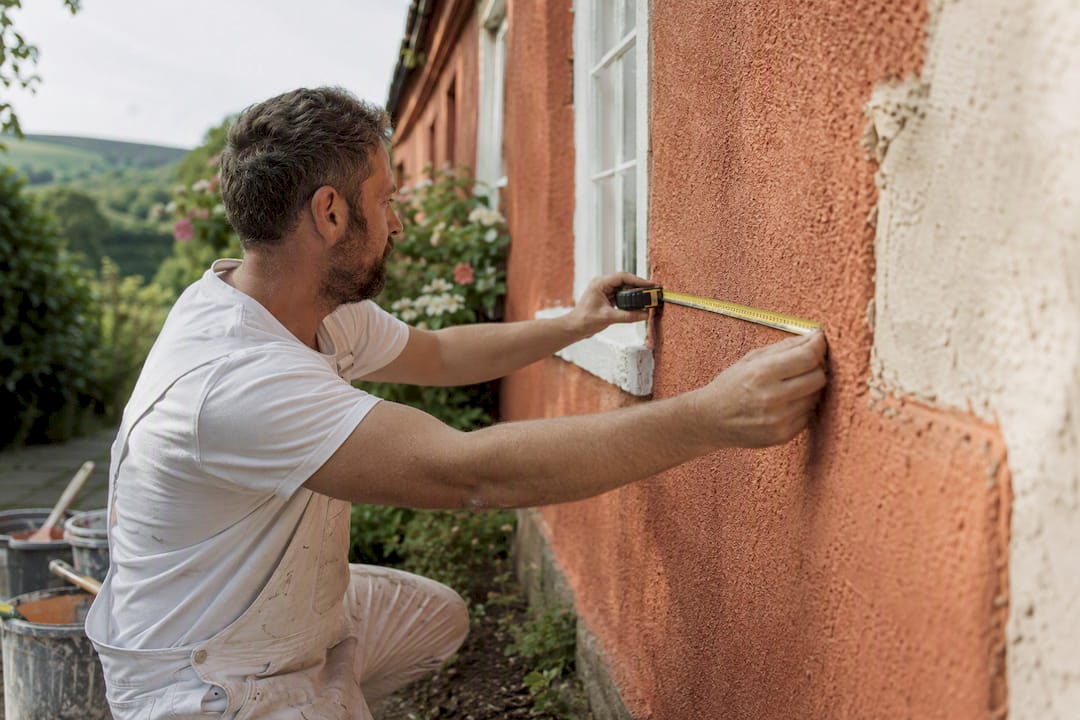
Expect to pay around £30 per square metre of paintable surface for a professional exterior repaint in 2026, with quotes typically landing between £20 and £40 per m² depending on prep and paint quality. A typical three-bed semi runs in the mid thousands all-in, a terrace often comes in lower, and a detached or three-storey property can push significantly higher once scaffolding and repair work are added. Scaffolding, surface condition, and coat count are what actually separate the cheap quote from the honest one.
TL;DR:
Scaffold costs typically add several hundred pounds and vary significantly depending on the property’s height, complexity, and access requirements.
Larger and more ornate properties, like detached or three-storey houses, can easily reach £6,000 to over £12,000, influenced by detailed architecture and scaffold needs.
Different surface types require specific paints and preparation, with textured or pebble-dashed finishes costing up to £45/m², and lower costs for smooth masonry at around £20–£32/m².
Preparation work such as pressure washing, crack repairs, and primer application accounts for most of the variance in quotes, often doubling the cost compared to paint alone.
Using premium, long-lasting masonry paints can extend repaint intervals to 10-15 years, offering better long-term value than cheaper acrylic options that last 5-7 years.
Table of Contents
What does exterior house painting cost in the UK?
The headline figure worth remembering is £30 per square metre, with a realistic market range of £20 to £40 per m² depending on your property’s surface and how much repair work it needs. That per-m² rate covers labour and materials for a standard prep-and-paint job on masonry, but it moves sharply once you add scaffolding, render repairs, or a premium coating system.
Most guides converge on a similar picture for whole-job pricing. A three-bed semi typically averages around £3,650, with full project ranges stretching from lower amounts for a small terrace to higher amounts for larger detached homes with complex access.
Property type | Typical total cost | Approx. job duration |
Mid-terrace (front only) | £900–£3,200 | 2–3 days |
Terrace (full exterior) | £900–£3,200 | 3–5 days |
Semi-detached | £2,800–£6,800 | 4–7 days |
Detached | £4,500–£9,500 | 6–10 days |
Bungalow | £1,600–£3,500 | 3–5 days |
3-storey / large Victorian | £6,000–£12,000+ | 8–10 days |
Beyond the headline total, a handful of items tend to appear as separate lines on nearly every quote:
Scaffold or tower hire, usually billed for a fixed hire period rather than by the day.
Waste disposal and site protection for windows, drives, and planting.
uPVC spraying for fascias, soffits, and window frames, if you want a matched finish.
Render or masonry repairs identified once the surface is pressure washed and inspected.
A written specification confirming primer type and number of topcoats.
Timescales depend heavily on weather. A settled fortnight in spring or early autumn gets a semi-detached house done comfortably; the same job dragged through a wet August can take twice as long.
How much different property types typically cost and why
Trade estimators generally work from an assumed paintable surface area per property type, then apply the per-m² rate and adjust for complexity. A typical mid-terrace with a front-only repaint might have 30 to 45 m² of paintable wall, whereas a detached house with all elevations exposed can easily reach 150 to 220 m².
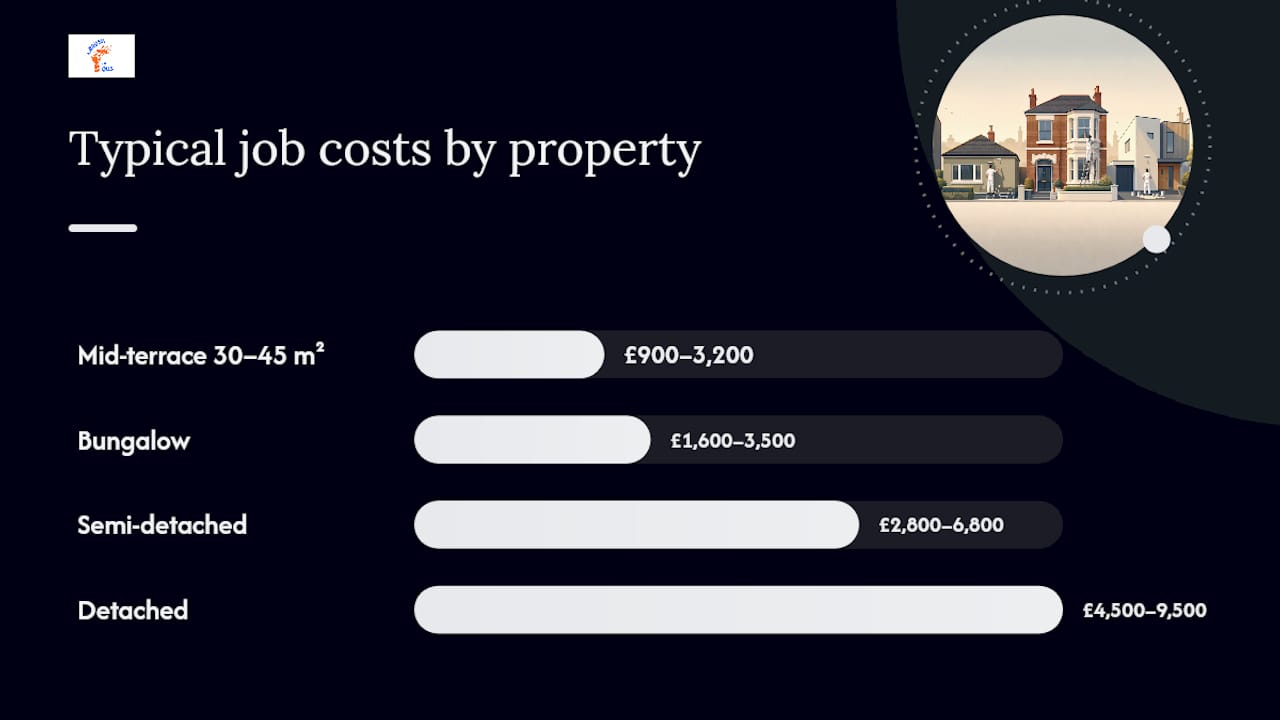
Terraces and front-only jobs sit at the affordable end, generally £900 to £3,200 depending on whether you’re doing just the frontage or the full perimeter. Access is usually straightforward from ground level or a small tower, which keeps labour costs down.
Bungalows are often cheaper per job than their footprint suggests, because single-storey properties rarely need scaffolding at all. Expect £1,600 to £3,500 for a full repaint, with most of that going on surface area rather than access.
Semi-detached houses are the most common job type UK decorators quote for, and the £2,800 to £6,800 bracket reflects a wide spread in property size, render condition, and whether scaffold is needed on both flank walls or just the rear.
Detached houses climb to £4,500 to £9,500 because every elevation is exposed and paintable, often with more architectural detail such as bay windows or dormers.
Three-storey and tall Victorian or Georgian properties are where costs jump hardest, frequently £6,000 to £12,000 or more. Height alone forces full scaffold rather than towers, and older properties often carry ornate stonework, decorative corbelling, or lime render that needs specialist handling rather than a standard masonry system.
A handful of features reliably push any property into the next price band up:
Bay windows and dormers, which add cutting-in time and awkward angles.
Conservatories or lean-to extensions requiring careful masking.
Pebbledash or roughcast render, which soaks up more paint than smooth surfaces.
Exposed stone detailing or quoins that need brush work rather than spray application.
Cost per square metre by surface type
The £30/m² benchmark is a useful starting point, but it assumes reasonably smooth masonry in fair condition. Different substrates absorb paint differently, take longer to prepare, and sometimes need entirely different coating systems.
Smooth masonry (render or brick, painted before): £20–£32/m². The easiest and cheapest surface to work with, assuming no major cracking.
Textured or roughcast render: £28–£40/m². Texture eats more paint per coat and slows down rolling and cutting-in.
Pebbledash: £30–£45/m². Among the most paint-hungry finishes, often needing a thicker masonry paint to bridge the stones properly.
Timber cladding or weatherboarding: £25–£38/m². Requires more prep sanding and often a different paint system entirely (wood stain or exterior wood paint rather than masonry paint).
Metalwork (railings, gates, downpipes): priced separately, typically £8–£20 per linear metre depending on rust and detail.
Porosity matters as much as texture. A chalky, absorbent render can drink through a full extra coat of primer before it stops soaking paint straight in, which is exactly the kind of variable a fixed per-m² quote sometimes fails to account for.
Coating choice changes the long-term maths too. A trade-grade silicone masonry paint typically lasts 10 to 15 years against 5 to 7 years for a basic acrylic, which matters more than the sticker price once you divide total cost by years of service. Our guide to choosing masonry paint covers how the different formulations behave on UK weather-exposed walls.
What actually drives the price of your quote
Preparation, not paint, is usually what separates a £2,800 quote from a £5,500 one for the same house. Anyone who has stood at the bottom of a ladder scraping blown render knows the topcoat is the fast part; getting the wall ready to take it properly is where the hours go.
A fair specification generally includes:
Pressure washing to remove algae, moss, and general grime before any paint touches the wall.
Scraping and treating flaking or chalking areas, sometimes with a fungicidal wash first.
Stabilising primer on porous or powdery masonry to consolidate the surface before topcoats go on.
Filling hairline cracks and repairing small areas of blown or cracked render.
Two full coats of masonry paint over the primer, not one thick coat masquerading as two.
Access changes the bill more than most homeowners expect. A single-storey extension needs nothing more than a ladder; a three-storey Victorian terrace needs full scaffold, and that scaffold has to come down and go back up if the job spans more than a couple of weeks.
Paint quality and coat count are where corners get cut hardest. Skipping a stabilising primer on a chalky or previously distempered wall is a common shortcut, and it’s the single fastest route to peeling within two winters, regardless of how good the topcoat is.
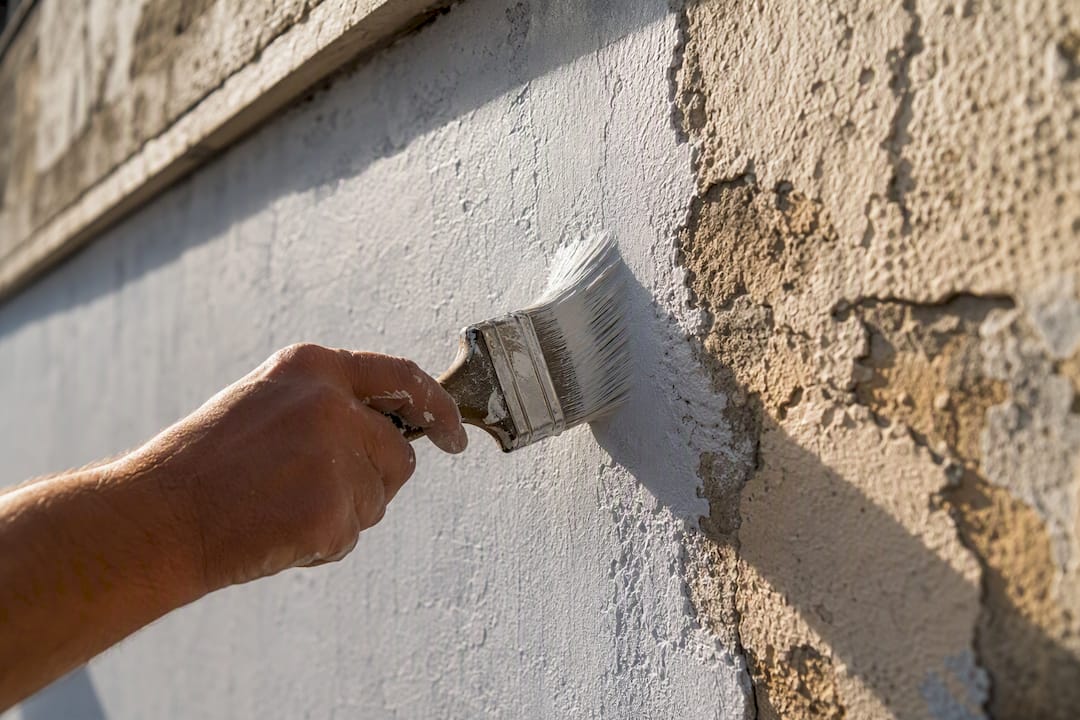
Trim work is often quoted separately rather than bundled into the headline figure. Fascias, soffits, bargeboards, and uPVC window frames may need their own line item, particularly if they’re being sprayed rather than brushed.
Pro Tip: Ask for the primer and topcoat products to be named on the written quote, not just described as “masonry paint”. If a contractor won’t specify the product, they probably haven’t decided what they’re using yet.
For a fuller breakdown of what pushes quotes up or down, see our piece on cost factors in home painting.
How scaffolding and access affect your final bill
Scaffold hire is usually the single biggest cost after labour and prep, and it’s frequently billed as a separate line rather than folded into the per-m² rate. That separation is actually useful for you: it lets you compare access costs across quotes directly.
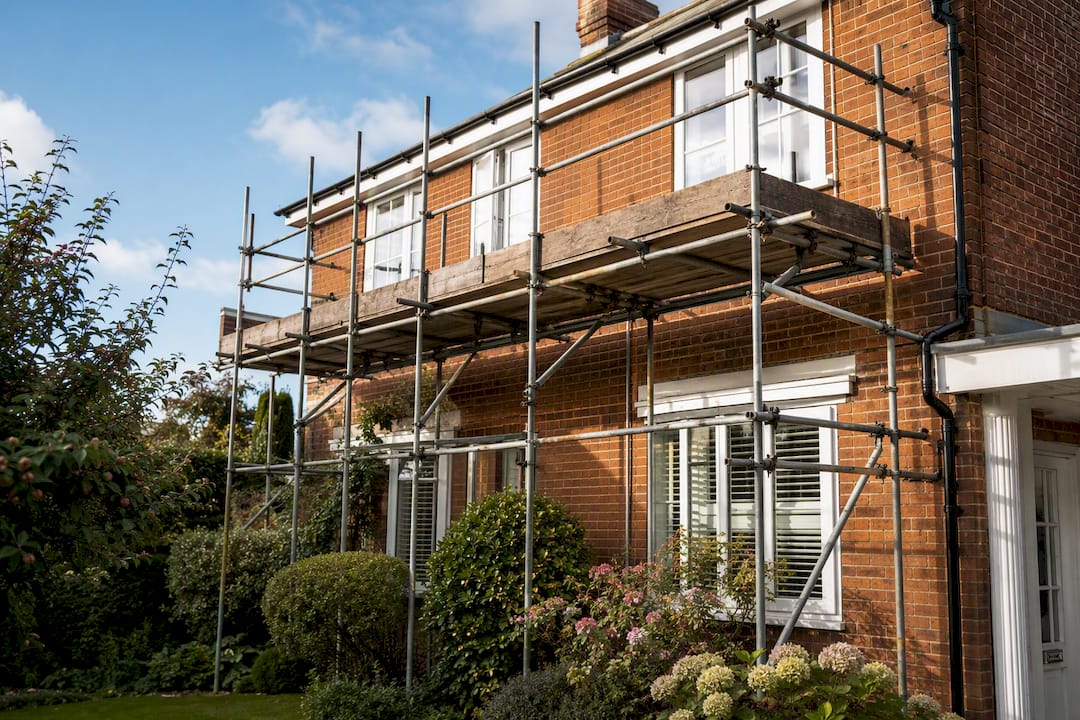
For a standard two-storey semi, a two-week scaffold hire commonly falls in a moderate cost range. Taller or more complex properties, or jobs needing scaffold on multiple elevations, can push that considerably higher for a longer hire on a large detached house.
Not every job needs full scaffold. A mobile tower is often perfectly adequate for single-storey extensions, bungalows, or spot repairs on a two-storey gable end, and it costs a fraction of a scaffold hire. Cherry-pickers occasionally make sense for isolated high work where erecting scaffold would be disproportionate.
A few local factors worth checking before you accept a quote:
Whether a pavement licence or highways permit is needed, which adds cost and lead time in built-up areas.
Whether scaffold needs to straddle a shared boundary, which may require a neighbour’s consent.
London and South East postcodes often carry a hire premium compared with rural Cornwall or the wider South West.
Labour rates and how long the job takes
Decorator day rates in the UK generally sit between £100 and £400 per day, with the wide spread reflecting experience, location, and whether you’re hiring a solo tradesperson or a small crew. London and the South East sit at the top of that range; rural areas including the South West tend to land closer to the middle.
Property type | Typical labour-only cost | Realistic duration |
Terrace (front only) | £400 | 2 days |
Semi-detached | £1,600–£3,500 | 4–6 days |
Detached | £2,800–£6,800 | 6–9 days |
Complex/tall Victorian | £3,650–£6,800 | 8–12 days |
These figures assume a two-person crew and reasonably straightforward masonry. Textured render, extensive repair work, or awkward access adds days rather than pounds.
Weather is the wildcard that written quotes rarely price in properly. Masonry paint typically needs the surface dry and temperatures above around 8°C to cure correctly, which narrows the practical UK painting season to roughly April through September in most regions. A job scheduled for late October can stretch well beyond its quoted duration if rain keeps pushing drying times back, which is worth factoring into your own timeline expectations. Our seasonal guide on the best time of year to paint exteriors goes into this in more detail.
What should be in a professional painting quote?
A proper quote reads like a specification, not a single number. If yours doesn’t break down into distinct line items, that’s your first red flag.
Preparation scope — pressure washing, scraping, fungicidal treatment, and any render or crack repairs, stated explicitly rather than lumped into “prep included.”
Primer and topcoat specification — named products, not generic descriptions, confirming a stabilising primer plus two full topcoats.
Access and scaffold costs — quoted separately, including hire duration and who’s responsible for erection and dismantling.
Trim and detail work — fascias, soffits, bargeboards, downpipes, and window frames priced individually if they’re not included in the main figure.
Materials versus labour split — enough detail to see roughly what you’re paying for paint against time on tools.
Written warranty or guarantee — most reputable trades offer something between 2 and 5 years on workmanship; ask what it actually covers.
Public liability insurance confirmation — a legitimate contractor should produce this without hesitation.
Before signing anything, ask a few pointed questions on-site: is the render structurally sound or does it need repointing, is there any evidence of damp coming through from inside, and has the surface been tested for previous distemper or lime coatings that need a different primer system? These questions are exactly where hidden costs tend to surface after work has started rather than before. Our step-by-step piece on hiring a painter and getting a great result covers the full vetting process.
How to reduce the cost without cutting corners
A few sensible adjustments bring the bill down without touching the specification that actually protects your walls.
Handle simple prep yourself: clearing gutters, moving garden furniture, and cutting back climbing plants saves your contractor time you’d otherwise pay for.
Choose a longer-life trade coating over a cheaper acrylic. A silicone masonry paint costing more upfront often works out cheaper per year of service, since you’re repainting every 10 to 15 years rather than every 5 to 7.
Bundle jobs together. If you need gutters cleared, fascias sprayed, and walls painted, doing it all in one mobilisation avoids paying for scaffold or site setup twice.
Book during shoulder months (April, May, September) when contractors have more flexibility and scaffold hire firms aren’t at peak demand.
Pro Tip: *If your render is generally sound but tired-looking, ask whether a wash-and-recoat without heavy repair work is realistic.
For more on how coating choice affects long-term cost, see factors affecting exterior paint longevity.
Why trade experience matters for exterior projects
Abrushwithgus is a family-run painting and decorating business covering Cornwall and the wider South West, offering exterior painting alongside uPVC spraying, airless spraying, and exterior cleaning as part of the same job. Combining these services under one mobilisation is exactly the kind of bundling that keeps scaffold and setup costs down rather than paying for separate contractors on separate days.
The firm, run by brothers Gus and Rhys, builds quotes around the same prep-first standard covered throughout this guide: proper washing and stabilisation before primer, followed by two full topcoats rather than a thin single layer. Their portfolio of completed transformations and client reviews gives homeowners a way to check finish quality and reliability before committing, which is exactly the kind of proof point worth asking for from any contractor you’re considering.
Weather, moisture and seasonal cost add-ons
Rainfall and humidity are the two variables most likely to add unplanned cost to an exterior job, and they rarely appear as a line on the original quote. Masonry paint needs a dry substrate and stable temperatures to cure properly, so a run of wet weather during the job can force a contractor to pause, which sometimes means scaffold sitting idle on hire while the crew waits it out.
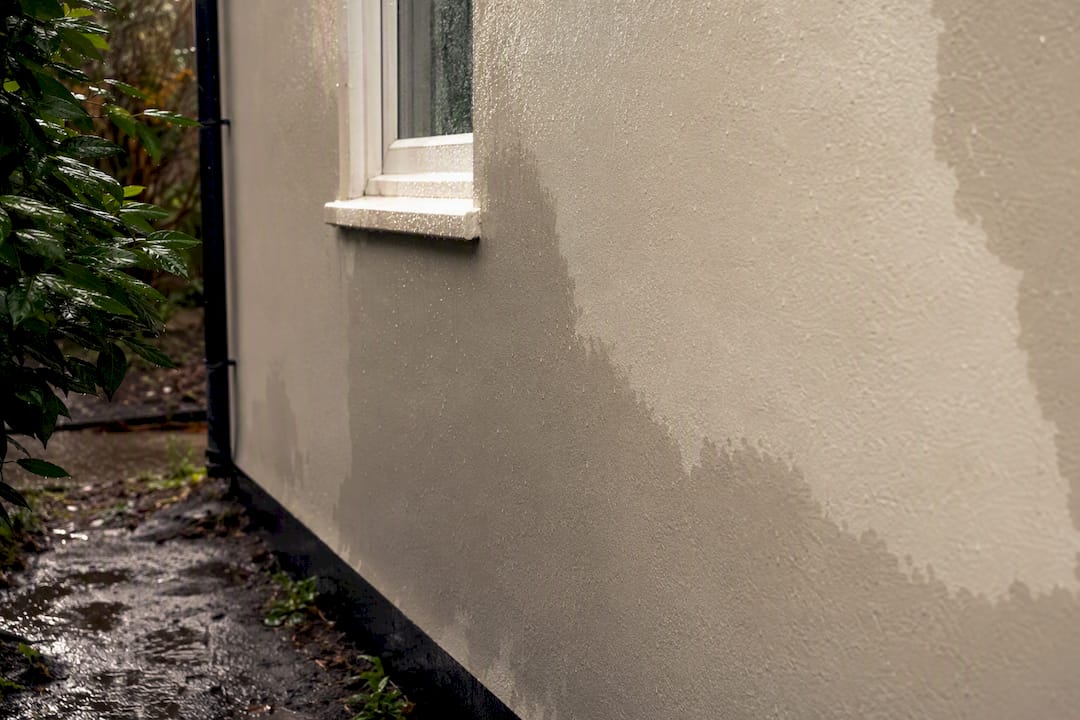
Coastal and exposed properties, common across Cornwall and the South West, face an additional challenge: salt-laden air accelerates weathering on render and metalwork, which can mean more frequent stabilising primer or a marine-grade coating recommendation that adds to the material cost. Properties on exposed hillsides or near the coast sometimes need a full extra day of drying time built into the schedule purely as a buffer against unpredictable weather windows.
Damp penetration discovered mid-job is another common source of extra cost. If pressure washing reveals damp patches that turn out to be a blocked gutter or failed pointing rather than surface dirt, that’s a repair conversation that happens on-site, not one that’s priced into the original quote. Asking your contractor how they handle unexpected findings, and whether there’s a day rate for additional work versus a fresh quote, avoids an awkward conversation later. Booking work for spring or early autumn, when drying windows are more reliable, remains the simplest way to avoid weather-related delays inflating your final bill.
Does the paint brand actually change the price?
Paint brand affects your quote in two ways: the material cost itself, and how many coats or how much prep the product demands to perform properly. A budget trade acrylic might cost £25 to £40 per 5-litre tin, while a premium silicone masonry paint from a recognised trade brand can run £60 to £90 for the same volume.
That price gap looks larger than it is once you account for coverage and lifespan. Silicone-based masonry paints are typically self-cleaning and breathable, which reduces algae growth and repeat maintenance, and their 10 to 15 year service life against 5 to 7 years for basic acrylic means you’re not repainting nearly as often. Divide total cost by years of protection and the premium product usually wins.
Quality level also affects how much prep a job needs. Cheaper paints tend to be less forgiving of minor surface imperfections, sometimes requiring an extra coat to achieve even coverage, which adds labour hours that erase whatever you saved on the tin. For London homeowners specifically, this guide to premium paint brands is a useful reference point on how brand choice interacts with regional pricing. Our own rundown of top exterior paint brands for UK homes covers which trade ranges perform best across different substrates.
Ultimately, the brand named on your quote tells you almost as much about the contractor’s standards as the price does. A specification built around a recognised trade brand and a proper coat count is worth more than a slightly lower number with vague product descriptions.
What the numbers don’t tell you
The conventional advice on this topic obsesses over per-m² rates and treats them as gospel, but that figure is only ever a starting point. What the data actually supports is a different conclusion: the gap between a good quote and a bad one has almost nothing to do with the headline price and everything to do with what’s included in it.
Homeowners consistently get burned not by paying too much, but by accepting a quote that quietly drops the stabilising primer, halves the topcoat count, or leaves scaffold as an unpleasant surprise halfway through the job. A £2,400 quote that skips proper prep isn’t cheaper than a £3,200 quote that includes it; it’s a repaint deferred by two years at most.
If there’s one thing to prioritise above the number itself, it’s the specification behind it. Ask what primer is being used, insist on two full topcoats in writing, and treat scaffold as its own line item you can compare directly across contractors. Get that right and the price becomes a genuinely useful comparison tool rather than a number that hides what actually matters.
— Angus
Get a proper quote for your exterior repaint
Abrushwithgus is the trade-led alternative to piecing together separate contractors for painting, uPVC spraying, and exterior cleaning. Working across Cornwall and the South West, Gus and Rhys build every quote around the prep-first standard covered throughout this guide: full wash-down, stabilising primer where the surface needs it, and two proper topcoats rather than a thin single layer that fails within a couple of winters.

Where this saves you money is bundling. Need your uPVC windows sprayed alongside a full exterior repaint? Doing both in one mobilisation avoids paying for scaffold and site setup twice, which is exactly the kind of saving the cost-saving section above points to. The exterior home services page covers the full range, from masonry painting to airless spraying and window frame restoration.
If your home also needs a wash-down before anyone touches a paint brush, the exterior cleaning service handles that as a standalone job or as part of the same visit. Get in touch for a written, itemised quote before booking anything.
Sources
These figures draw on current UK trade cost guides rather than a single source: Checkatrade’s exterior painting cost guide for the core per-m² benchmark, MyJobQuote’s pricing data for worked property examples, and BestBuilders’ cost breakdown for scaffold bands and specification standards. For deeper prep advice specific to your property, our guide on external structure painting tips is worth a read.
Recommended
Comments