
Step-by-step wall painting checklist for South West homeowners
- WM Creative Designs Limited
- Aug 7
- 8 min read

TL;DR:
Preparing the room and obtaining a detailed, itemized quotation help keep painting projects on time and within budget.
Confirm access, colours, and repairs in writing well before work begins and prepare the space thoroughly.
Before professional painters arrive, three things must be in place: the room is cleared, your written quotation itemises labour, materials, number of coats and preparation level, and access arrangements are confirmed in writing. Get those right and the job starts on time, finishes cleanly, and costs what you were quoted.
At a glance:
Confirm a fully itemised written quotation before any work begins
Decide on colours and finishes at least a week ahead
Clear the room of small items; move larger furniture to the centre
Remove curtains, blinds and wall art
Vacuum skirting boards and wipe down dusty surfaces
Confirm parking, key handover and working hours with the contractor
Table of Contents
What does your step-by-step wall painting checklist look like before the painters arrive?
Work through this list in the days leading up to the job. Skipping steps here is the single most common reason a professional job runs late or costs more than quoted.
One week before:
Confirm the written quotation. Check it covers itemised labour, materials, timescales, number of coats, preparation level and exclusions, as the PDA code of practice requires of member contractors.
Communicate known issues. Tell the team about damp patches, peeling paint, previous leaks or any repairs you are aware of. Flagging these before the visit helps the contractor quote accurately and avoids surprises on site, according to preparation guidance for homeowners.
The day before:
Remove ornaments, electronics, pictures and wall art. Dulux recommends clearing small items entirely and moving larger furniture to the room’s centre so painters have unobstructed access to every wall.
On the morning:
Pro Tip: Test paint colours on a large piece of lining paper and move it around the room at different times of day. South West light, particularly in coastal properties, shifts dramatically between morning and afternoon, and a shade that looks perfect at noon can read very differently by 4 PM.
What must your written quotation actually include?
A lump-sum price tells you almost nothing. A proper quotation, as outlined in the Painting & Decorating Association code of practice, breaks the job into components so you can compare quotes fairly and hold the contractor to an agreed scope.
Every written quotation should state:
Itemised labour costs (by room or phase)
Materials: paint brand, product name, and quantity
Number of coats per surface
Preparation level: filling, sanding, priming, and treatment of any damp or staining
Start date, estimated duration, and daily working hours
Exclusions (e.g. moving heavy furniture, electrical fittings)
Payment schedule, with staged payments linked to progress
Public liability insurance details and any workmanship guarantee
A transparent quote looks something like this:
Item | Detail | Estimated cost |
Labour | Two decorators, three days | Itemised per day |
Materials | Dulux Trade Vinyl Matt, 10L x 2 | Itemised per product |
Preparation | Fill, sand, spot prime (two walls) | Included in labour |
Number of coats | Two full coats per wall | Stated in scope |
Exclusions | Ceiling, woodwork, moving fitted furniture | Listed clearly |
Payment schedule | — | Stated in writing |
If any of these items are missing, ask for an amended quotation before signing. A contractor who resists providing this level of detail is worth questioning, as professional hiring guides consistently note.
What will professional painters actually do on the day?
Understanding the on-site sequence helps you spot whether the work is being done properly, and whether the timeline you were quoted is realistic. A typical professional workflow runs as follows:
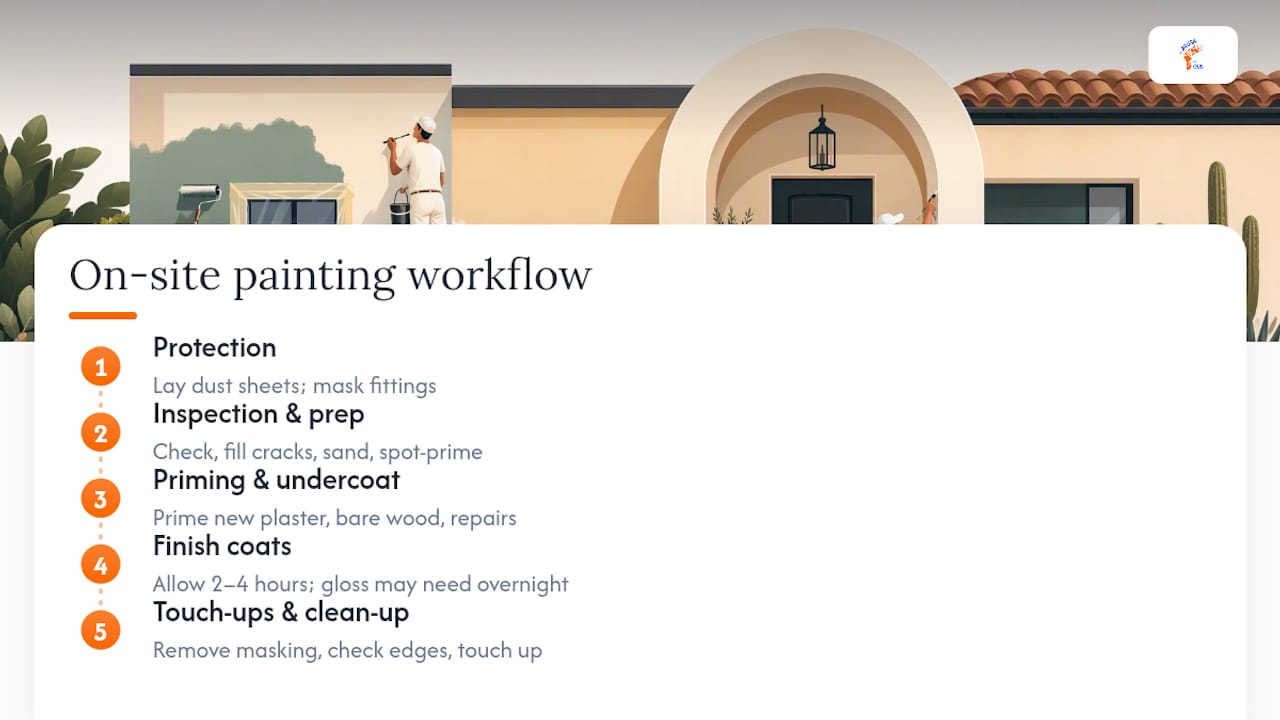
Protection first. The team lays dust sheets over floors and any remaining furniture, then masks skirting boards, window frames and light switches before touching a brush.
Surface inspection and preparation. Walls are checked for cracks, holes and any areas of poor adhesion. Filling and sanding follow, then spot priming on bare or stained patches. This stage takes longer than most homeowners expect, and rightly so. Preparation is the main determinant of finish quality, as NearbyTraders’ hiring guide makes clear.
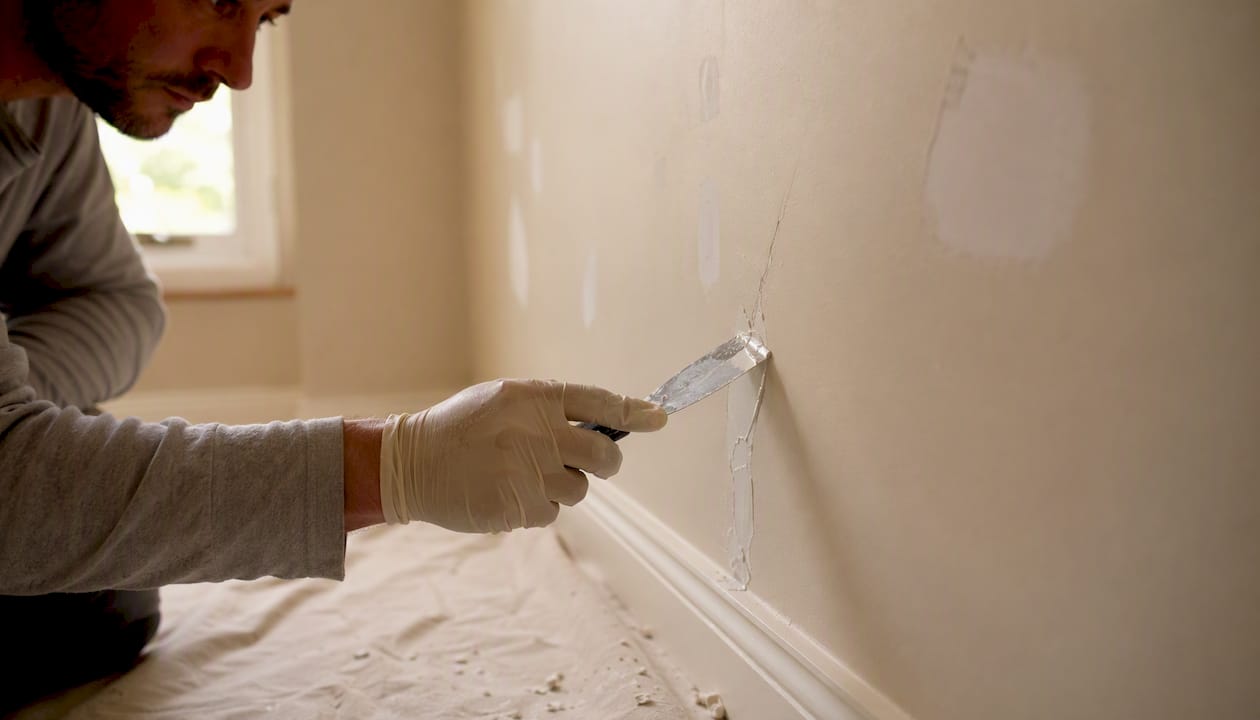
Priming and undercoat. New plaster, bare wood and any repaired areas receive a suitable primer before the finish coats go on.
First and second coats. Trade emulsion typically needs 2–4 hours between coats; gloss and eggshell finishes may need overnight curing. Rushing this stage is one of the most common professional pitfalls and produces visible lap marks or uneven sheen.
Touch-ups and clean-up. The team removes masking tape, checks edges and joins, and completes any touch-ups before clearing their materials.
What the contractor should supply: dust sheets, masking tape, ladders, brushes, rollers and all application tools. You should not be expected to provide any of these.
How do you agree access and logistics before work starts?
Practical arrangements are worth confirming in writing, not just verbally. Access problems are a leading cause of late starts, particularly across South West towns where parking restrictions vary considerably.
Agree the following before the start date:
Parking: confirm whether a permit is needed, or whether the contractor can use your driveway
Key handling: who holds a key, what the handover process is, and who to call if there is a problem
Working hours: agreed start and finish times, and whether weekend work is included
Power and water access: the team will need both on site
Toilet facilities: confirm whether they may use yours or whether alternative arrangements are needed
Material storage: where paint and equipment will be kept overnight if the job runs across multiple days
Neighbour communication: if scaffolding, noise or access to shared areas is involved, notify neighbours in advance
For property managers overseeing multiple units or restricted-access buildings, nominate a single site contact and share their number with the contractor before day one.
Pro Tip: Check your local council’s website for parking suspension or loading-bay restrictions before the job starts. In towns like Truro, St Ives or Exeter, a contractor who cannot park near the property will lose an hour or more each morning.
Record all agreed arrangements in the written quotation or a separate schedule of works. Verbal agreements are difficult to enforce if a dispute arises.
What timescales and costs should you expect, and what causes delays?
Timing to know: Trade emulsion needs 2–4 hours between coats; gloss and eggshell finishes may require overnight curing. A standard room with preparation and two coats typically takes 2–3 days from start to finish.
Delay cause | Why it happens | How to prevent it |
Late colour changes | Client changes mind after work starts | Finalise colours at least one week before start date |
Moisture or damp | Wet walls cannot be painted | Flag damp in advance; allow drying time after any repairs |
Unexpected repairs | Hidden damage found on site | Communicate known issues before quoting |
Paint availability | Specialist colours on back order | Order paint before the start date; confirm stock with supplier |
Access problems | Parking, keys or site restrictions | Confirm all logistics in writing before day one |
Cost drivers to be aware of: additional surface preparation (particularly on older South West properties with lime plaster), specialist primers for damp or stained walls, high-specification paints, hard-to-access areas such as stairwells, and any rush requests that require overtime or weekend working.
What questions should you ask, and what are the red flags?
Questions to ask at quotation or on day one
What preparation will you carry out before the first coat goes on?
Which paint brand and product will you use, and what sheen level?
How many coats are included, and what is the drying time between them?
Who carries out the sanding and filling — your team or a subcontractor?
Can you provide proof of public liability insurance?
Can you supply at least three recent client references?
What is your payment schedule, and do you offer a workmanship guarantee?
Asking these questions is not awkward; it is standard practice. Hiring guides recommend treating preparation specifics as the primary quality indicator, not price.
Red flags that warrant a pause
No written, itemised quotation — only a verbal price or a single lump sum
Promises of completion in an unrealistically short time
Refuses to provide proof of insurance or references
Vague about preparation: “we’ll just give it a coat” with no mention of filling or priming
Requests full payment upfront. Staged payments linked to progress are standard practice
If you spot any of these, pause before signing. Request a corrected written quotation and check at least two references before proceeding. A reputable contractor will not object.
How do you carry out a final inspection and sign off the job?
Inspection checklist
Inspect the finished walls in natural daylight, not artificial light
Check skirting boards, joins, edges and corners for missed patches or bleed-through
Confirm that all agreed repairs and filled areas were completed
Note any touch-ups required and agree a fix-by date in writing
Sample sign-off template
Field | Detail |
Property address | [Address] |
Inspection date | [Date] |
Inspected by | [Homeowner / property manager name] |
Contractor representative | [Name] |
Agreed snags | [List each item] |
Agreed fix-by date | [Date] |
Signature | [Both parties] |
After the job: ventilate the room for at least 24 hours. Avoid hanging pictures or moving furniture back for 48–72 hours to allow the paint film to harden fully. Keep condensation low in the first week, particularly in kitchens and bathrooms where steam can soften a fresh emulsion finish.
Key takeaways
A well-prepared room and a fully itemised written quotation are the two factors that most reliably keep a professional painting job on time and on budget.
Point | Details |
Confirm an itemised quote | The quotation must state labour, materials, number of coats, preparation level and payment schedule. |
Clear and protect the room | Remove small items, take down curtains and blinds, and vacuum skirting boards before the team arrives. |
Finalise colours early | Lock in paint colours and order from the same batch at least one week before the start date. |
Agree access in writing | Confirm parking, key handling and working hours in the written quotation or schedule of works. |
Inspect in daylight and sign off | Check all surfaces in natural light, record any snags, and agree a fix-by date before final payment. |
Abrushwithgus | Abrushwithgus covers the South West, handling preparation, painting and final sign-off as a managed service. |
Why preparation makes the difference, from Angus
Most of the problems we see on site trace back to the same two or three things: a quote that did not specify preparation, colours that were not confirmed until the morning of the job, or access arrangements that nobody wrote down. None of those are complicated to fix in advance, but they are genuinely difficult to fix once a team is standing in your hallway.
The South West throws up its own quirks, too. Older properties in Cornwall and Devon often have lime plaster that behaves differently under modern emulsions, and coastal humidity means drying times can stretch beyond what the tin states. A team that knows the region knows to account for that in the schedule.
If you want to see the standard of finish we deliver before committing, the portfolio and client reviews on the Abrushwithgus website are the honest place to start. Get in touch to discuss your project.
Ready to hand the checklist to a local team?
Abrushwithgus offers South West homeowners and property managers a fully managed painting and decorating service, so you do not have to coordinate every step yourself. The team handles preparation, filling, priming, finish coats and final inspection, and every job is backed by public liability insurance and a workmanship guarantee.

Services available across Cornwall and the South West:
Domestic painting and decorating for rooms, whole properties and rental portfolios
Airless spraying for large or specialist surfaces
References are available on request, and the team provides written, itemised quotations as standard. To discuss your project or request a quote, visit the Abrushwithgus domestic services page.
Useful sources and further reading
Recommended
Comments