
Unexpected benefits of repainting your kitchen
- WM Creative Designs Limited
- 4 days ago
- 12 min read

Repainting your kitchen delivers far more than a colour change. The less obvious wins include easier daily cleaning, a measurable boost to resale appeal, a meaningfully smaller environmental footprint than replacement, and a longer cabinet lifespan when specialist coatings are used. Most homeowners focus on the visual result; the practical, financial and sustainability gains tend to come as a genuine surprise.
Here is a quick summary of what you can expect beyond the obvious:
Easier cleaning — specialist kitchen paints repel grease and steam, cutting the effort needed to wipe surfaces down
Extended cabinet lifespan — the right coating seals and protects substrate, delaying deterioration by years
Lower environmental impact — keeping existing cabinets out of landfill reduces embodied carbon compared with replacement
Resale and buyer appeal — a professionally finished kitchen changes buyer perception at a fraction of replacement cost
Improved light quality — lighter or higher-sheen finishes reflect more natural light into the room
Health gains — low-VOC and water-based kitchen paints reduce airborne chemical exposure during and after application
Hardware renewal opportunities — a repaint naturally prompts handle and fitting updates that compound the visual upgrade
Key takeaways
Repainting a kitchen with the right specialist coatings delivers practical, financial and environmental benefits that go well beyond a colour change.
Point | Details |
Specialist coatings matter | Kitchen-grade paints resist grease and steam, cutting cleaning effort and extending cabinet life. |
Resale impact is real | A professionally finished kitchen changes buyer perception at a fraction of replacement cost. |
Environmental gains are meaningful | Keeping existing cabinets avoids landfill waste and the embodied carbon of new manufacturing. |
Method determines the result | Professional airless spraying delivers the factory-smooth finish that maximises cleanability and perceived value. |
Abrushwithgus | Offers professional kitchen respraying across Cornwall and the South West, with specialist prep and coatings. |
Table of Contents
3. Your kitchen can look brighter without a single new fitting
4. Low-VOC paints improve air quality in a room you use every day
5. Repainting boosts resale appeal at a fraction of replacement cost
6. Repainting is faster and far less disruptive than a full remodel
7. Keeping existing cabinets is genuinely better for the environment
9. Specialist coatings reduce cooking odours clinging to surfaces
Which paint types and methods actually deliver these benefits?
1. Repainting gives you a cleaner kitchen with less effort
Specialist kitchen paints are formulated to resist steam, condensation, grease and food splashes in a way that standard decorative paints simply are not. That formulation matters in practice: a surface coated with a proper kitchen-grade product wipes clean with a damp cloth where a standard emulsion would stain, absorb odours, or begin to peel within months.
The mechanism is straightforward. Kitchen-specific coatings cure to a denser, less porous surface. Grease sits on top rather than soaking in, so a quick wipe replaces the scrubbing session. Over a year, that adds up to a noticeably lighter cleaning routine.
2. The right finish extends your cabinet life by years
Surface deterioration in kitchen cabinets is mostly a moisture and abrasion problem. Bare or poorly sealed MDF and timber absorb humidity from cooking, swell at the edges, and eventually delaminate. A well-applied coat of acrylic-alkyd or hard-wearing enamel seals those surfaces against moisture ingress and daily knocks.
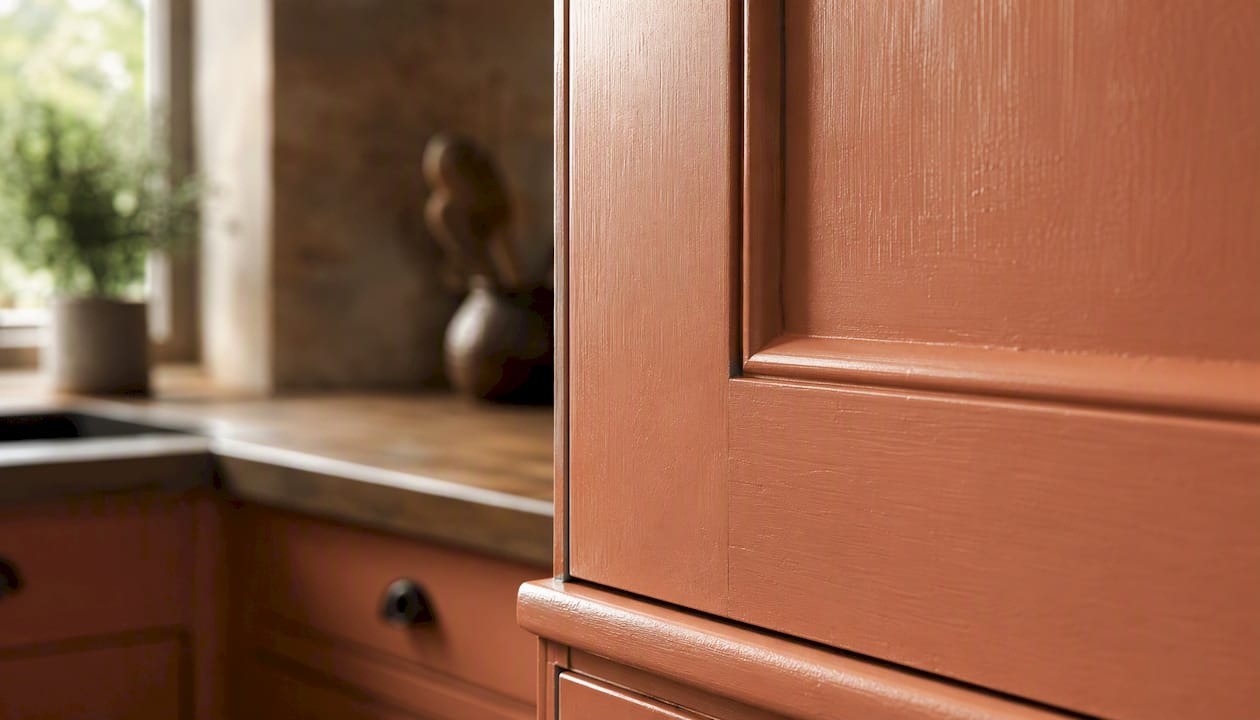
Done properly, with the right preparation and paint system, a kitchen respray can produce a finish that lasts many years — though the actual lifespan depends on preparation quality, the coating chosen, and how hard the kitchen is used. That is a meaningful extension compared with the alternative of doing nothing and watching cabinet edges soften and swell.
3. Your kitchen can look brighter without a single new fitting
Paint colour and sheen level both affect how much light a room reflects. A shift from a flat, dark finish to a satin or semi-gloss in a lighter tone can make a kitchen feel noticeably larger and airier without touching the layout or the lighting circuit. This is one of the most underestimated kitchen makeover ideas available to homeowners on a tight budget.
Lighter colours — warm whites, soft sage, pale clay — reflect natural light back into the room rather than absorbing it. Paired with a semi-gloss finish, the effect compounds: you get both the colour bounce and the sheen bounce working together. It is a genuine optical upgrade that costs nothing extra beyond the paint choice itself.
4. Low-VOC paints improve air quality in a room you use every day
Standard solvent-based paints off-gas volatile organic compounds (VOCs) during application and for weeks afterwards. In a kitchen, where ventilation is often limited and the room is used constantly, that matters. Modern low-VOC and water-based kitchen paints have reduced that exposure significantly, and many specialist kitchen formulations now carry low-VOC credentials as standard.
The practical benefit is twofold. During the job, there is less chemical smell and less need to vacate the house for extended periods. After the job, the ongoing off-gassing that can linger with older solvent-based products is largely absent. For households with young children, allergy sufferers, or anyone sensitive to chemical exposure, this is a benefit worth specifying when choosing a product.
Pro Tip: Ask your painter or supplier to confirm the VOC rating of the chosen product before work begins. Water-based acrylic kitchen paints tend to sit in the lowest VOC bands and are now available in finishes durable enough for cabinet doors.
5. Repainting boosts resale appeal at a fraction of replacement cost
Repainting cabinets is an eco-friendlier alternative to replacement and can provide significant buyer appeal. Many homeowners underestimate how strongly an updated kitchen finish influences buyer perception. A professionally finished kitchen that looks factory-fresh changes the emotional response a buyer has to a property, and that response feeds directly into offers.
The cost contrast with full replacement is stark. New kitchen cabinets, worktops and fitting typically run to thousands of pounds. A professional cabinet respray, by comparison, costs a fraction of that and can achieve a finish that is visually indistinguishable from new. For a homeowner preparing to sell, that return on spend is hard to match with any other single renovation decision.
6. Repainting is faster and far less disruptive than a full remodel
A fresh coat of paint is a faster, less disruptive and more affordable alternative to a full remodel for most homeowners. A professional kitchen respray typically takes one to three days, depending on the scope. A full kitchen replacement involves weeks of disruption, a period without a functioning kitchen, and the coordination of multiple trades.
For families, that disruption cost is real and often underweighted when comparing options. Repainting keeps the kitchen functional throughout most of the process, with only short windows where surfaces need to cure undisturbed. The practical convenience of that timeline is an unexpected benefit that only becomes obvious once you have lived through a full remodel.
7. Keeping existing cabinets is genuinely better for the environment
Replacing kitchen cabinets generates a significant volume of waste. The old units go to landfill or, at best, to a recycling facility. New cabinets require raw materials, manufacturing energy, and transport. Repainting sidesteps all of that by extending the life of what is already there.
The environmental case for respraying over replacement is straightforward: fewer new materials, no demolition waste, and a much lower carbon cost per year of kitchen life gained. When you factor in that a well-executed respray can add several years to a cabinet’s functional lifespan, the embodied carbon saving per year of use becomes meaningful. For homeowners who care about sustainability, this is often the deciding argument.
8. A repaint naturally prompts hardware and detail upgrades
There is a practical knock-on effect that rarely gets mentioned: repainting your cabinets almost always leads to updating handles, hinges and small fittings at the same time. The contrast between a freshly sprayed door and an old, tarnished handle is immediately obvious, so most homeowners replace the hardware as part of the same project.
Those small updates compound the visual result considerably. New brushed brass or matte black handles on a freshly painted cabinet look intentional and designed rather than refreshed. The total cost of the hardware upgrade is usually modest, but the combined effect of paint plus hardware is disproportionately strong, which is why targeted updates like repainting cabinets and refreshing hardware consistently appear in high-impact, lower-budget kitchen makeover ideas.
9. Specialist coatings reduce cooking odours clinging to surfaces
Porous or degraded paint surfaces absorb cooking smells over time. Grease vapour settles into micro-cracks and rough patches, and the smell builds up in a way that cleaning alone cannot fully address. A fresh coat of a dense, non-porous kitchen paint seals those surfaces and removes the substrate that odours cling to.
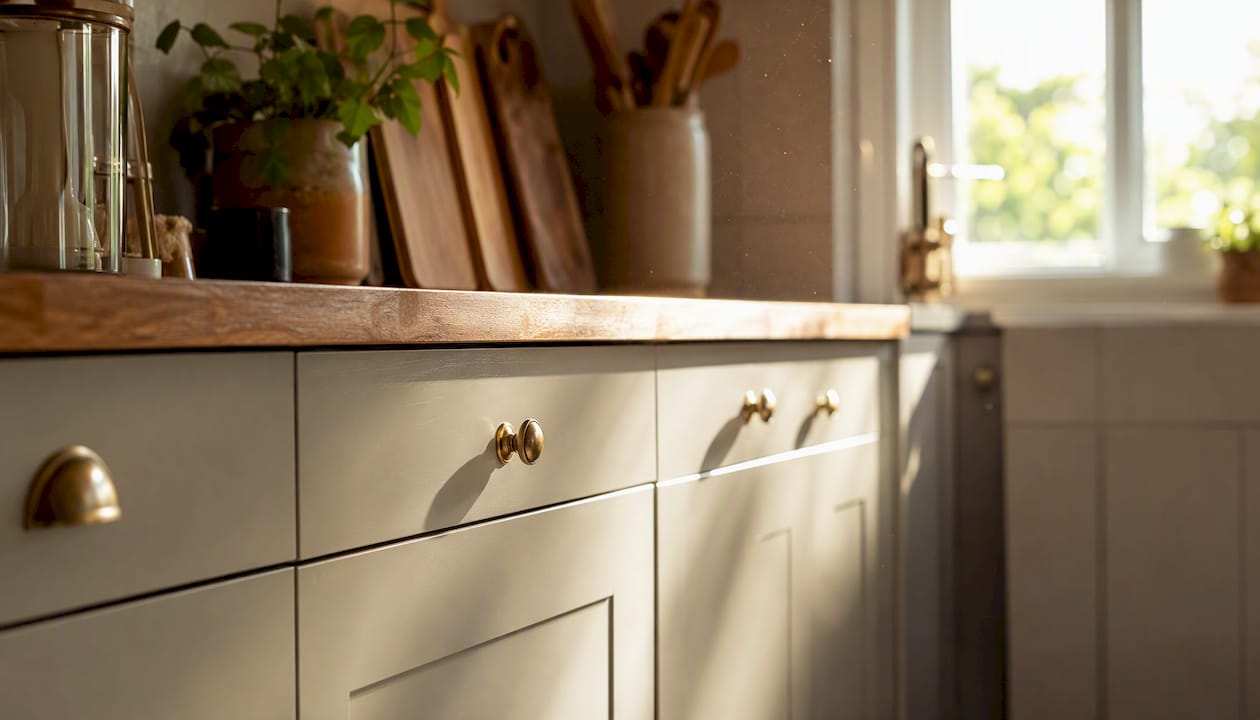
This is one of the more unexpected practical benefits of repainting, and one that homeowners notice quickly after the job is done. A kitchen that smells fresher after cooking is a small but daily quality-of-life improvement. It is also a benefit that is difficult to achieve through cleaning alone once a surface has deteriorated past a certain point.
How repainting compares with replacement on cost and return
The financial case for repainting over replacing is not subtle. Full kitchen replacement, including units, worktops, fitting and any associated plumbing or electrical work, is a major spend. A professional cabinet respray sits at a fraction of that cost and, when done well, delivers a result that is visually comparable to new.
The disruption difference is equally significant:
Replacement: weeks of work, kitchen out of use, multiple trades, potential structural changes
Repainting: one to three days, kitchen largely functional, single trade, no demolition
Refacing (replacing door fronts only): a middle option, but still more expensive and wasteful than repainting
For homeowners weighing why repaint kitchen cabinets rather than replace them, the ROI argument is strong. Industry sources note that cabinet painting can yield strong returns relative to spend, particularly when the underlying carcasses are structurally sound. The key condition is that the boxes themselves are in good shape — repainting over failing structure does not fix the structure.
Budget-conscious renovation guidance consistently prioritises cosmetic updates such as paint, hardware and lighting as high-impact, lower-cost options compared with full-scale remodels. Repainting sits at the top of that list for kitchens specifically, because the kitchen is the room where finish quality is most scrutinised by buyers and visitors alike.
Pro Tip: Spend proportionally more on surface preparation and a specialist primer than on the topcoat itself. A cheap topcoat over excellent prep will outlast an expensive topcoat over poor prep every time.
Which paint types and methods actually deliver these benefits?
The benefits described above are not automatic. They depend on choosing the right coating for the job and applying it correctly. Here is what actually matters.
Coating choices
Specialist kitchen wall paints are formulated for steam and grease resistance. They are the minimum specification for walls near a cooker or sink. Standard emulsion will not hold up.
Cabinet-grade acrylic-alkyd or hard-wearing enamel is the correct choice for door fronts and drawer faces. These cure to a hard, washable surface that standard acrylic cannot match. Satin and semi-gloss finishes offer superior washability and moisture resistance, making them the practical choice for kitchen cabinetry.
Low-VOC water-based formulations are now available in kitchen-grade durability. They are the right choice where health, ventilation, or occupancy constraints apply.
Primers and sealers are not optional. A bonding primer on previously painted or laminate surfaces is what makes the topcoat adhere properly and last. Skipping primer is the single most common cause of early paint failure on kitchen cabinets.
Application method comparison
Method | Finish quality | Durability | Disruption | Relative cost |
Brush and roller | Medium | Medium | Low | Low |
Hand spray (HVLP) | High | High | Medium | Medium |
Professional airless spray | Very high | Very high | Medium | Higher |
Spray painting produces a more uniform, factory-style finish compared with brush or roller application. For kitchen cabinets specifically, that smoothness matters: a brush-applied finish will show texture under kitchen lighting, while a sprayed finish looks factory-new. The cleanability benefit is also stronger with a sprayed finish, because there are no brush marks or texture for grease to settle into.
One caution: paint compatibility matters. Applying a water-based topcoat directly over an oil-based existing finish without the correct primer will cause adhesion failure. Always test or strip before recoating, and confirm the paint system with your supplier or applicator.
The environmental case for repainting over replacing
Keeping your existing kitchen cabinets and repainting them is a genuinely greener choice than replacement, and the reasons go beyond the obvious.
Waste avoidance: existing cabinets stay out of landfill or the recycling stream entirely
Embodied carbon: new cabinets carry the carbon cost of raw material extraction, manufacturing and transport; repainting carries almost none of those
Fewer trades and deliveries: a single painter versus a kitchen fitter, delivery driver, and waste removal contractor
Longer intervals between installations: a well-executed respray extends the cabinet lifecycle, meaning fewer full replacements over the life of the property
Low-VOC options reduce chemical release: water-based kitchen paints have a lower environmental impact during production and application than solvent-based alternatives
The environmental benefit of respraying over replacement is most pronounced when the existing carcasses are structurally sound. In that scenario, repainting is not a compromise — it is the more rational choice on both financial and environmental grounds.
Small practical wins homeowners notice first
Beyond the headline benefits, a fresh kitchen paint job delivers a set of small, daily improvements that rarely appear in renovation guides:
Faster wipe-downs: a fresh, dense surface cleans in seconds rather than minutes
Improved light reflection: a lighter or higher-sheen finish brightens the room without touching the electrics
Repaired surface damage: chips, scuffs and old hardware holes are filled and sealed as part of the prep process
Simplified cleaning routine: fewer products needed when the surface repels rather than absorbs grease
Odour reduction: sealed surfaces give cooking smells less to cling to
A quick surface check before committing to a repaint is worth doing. Run your hand across cabinet doors and look for soft edges, delamination, or deep structural damage. If the carcasses are sound and the damage is cosmetic, repainting will deliver all of the above. If the structure is failing, address that first.
Brush, roller, or spray: which method suits your situation?
The method you choose determines the finish you get, and the finish determines how many of the unexpected benefits you actually realise.
Brush and roller suits walls and less visible surfaces where a slight texture is acceptable. It is the lowest-cost option and the most DIY-accessible, but it will not produce a factory-smooth cabinet finish. Durability is adequate for walls; less so for high-contact cabinet doors.
Hand spray (HVLP gun) produces a noticeably better finish than brush and roller and is within reach of a skilled DIYer with the right equipment and preparation. Overspray management is the main challenge — masking and ventilation requirements are significant.
Professional airless spray delivers the factory-smooth result that maximises cleanability, perceived value and longevity. It requires specialist equipment, controlled conditions, and experience to execute without runs or uneven coverage. This is the method that produces the finish quality described in the resale and buyer-appeal benefits above.
The decision framework is straightforward: if the cabinets are a focal point, if you want the full cleanability and resale benefit, or if the finish will be scrutinised closely, professional spraying is worth the additional cost. For walls and less visible surfaces, brush and roller is a reasonable choice.
When to hire a professional and when DIY is realistic
Honest guidance here matters, because the wrong choice in either direction costs money.
DIY is realistic when:
The project is limited to walls rather than cabinet doors
You have access to proper preparation tools (sander, degreaser, quality primer)
You are comfortable with masking and protecting adjacent surfaces
You accept that a brush-applied finish will show some texture
Hire a professional when:
Cabinet doors are involved and you want a smooth, factory-quality finish
The existing surface is laminate, previously painted with oil-based products, or in poor condition
Spray application is required (overspray, ventilation and equipment make this genuinely difficult to DIY well)
You need the job completed quickly with minimal disruption
You want a warranty or guarantee on the finish
A professional quote should include surface preparation, priming, the topcoat system, and a clear statement of what the finish will look like. Expert kitchen painting requires proper prep above all else — any professional worth hiring will spend as much time on preparation as on the painting itself. Portfolio evidence and reviews are the most reliable way to assess whether a painter’s finish quality matches what they describe.
A perspective from Angus
The benefit homeowners most consistently underestimate is not the cost saving or the environmental gain — it is the daily convenience. After a professional respray, clients often mention that cleaning the kitchen has become noticeably quicker and easier. That is not a coincidence. It is a direct result of the coating doing what it was designed to do: seal the surface, repel grease, and make the kitchen easier to live in. The visual result gets the attention, but the functional improvement is what makes the decision feel right six months later. If you are weighing up whether to repaint or replace, the honest answer for most structurally sound kitchens is to repaint first and see how far it takes you. The role of professional painting in home renovation is consistently undervalued relative to what it actually delivers.
Kitchen respraying in Cornwall and the South West
Abrushwithgus offers professional kitchen spraying and cabinet respraying across Cornwall and the South West, using specialist coatings and airless spray equipment to deliver the factory-smooth finish that produces the cleanability, longevity and resale benefits described in this article. As a family-run business, Gus and Rhys bring the kind of care and attention to preparation that makes the difference between a finish that lasts and one that fails within a year.

The process starts with a thorough assessment of your cabinet condition, followed by proper degreasing, sanding and priming before a single drop of topcoat is applied. That preparation is what the finish quality depends on. Services cover interior cabinet resprays, kitchen wall painting, and specialist coatings for high-humidity zones. For homeowners who want a professional result without the cost and disruption of full replacement, the domestic painting service is the right starting point. Get in touch for a no-obligation quote and a clear picture of what your kitchen could look like.
Sources
Recommended
Comments