
Factors affecting exterior paint longevity: UK guide
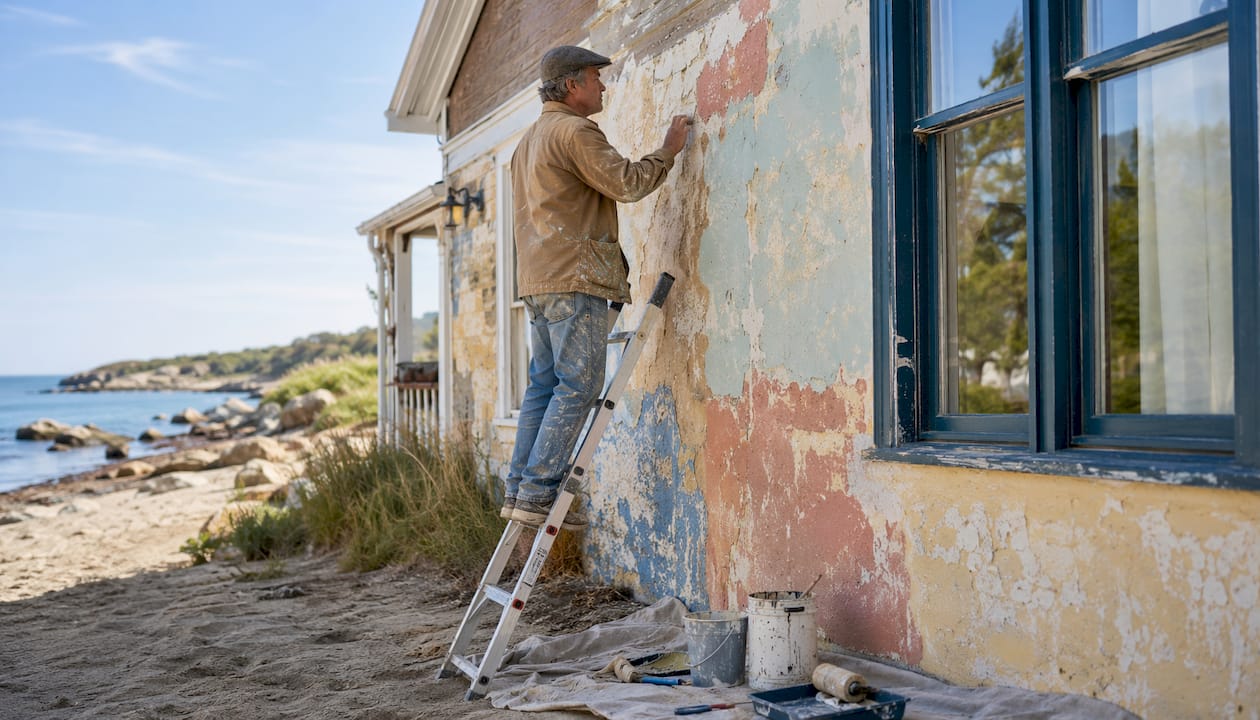
Surface preparation, climate exposure, and paint formulation are the three factors that determine how long exterior paint lasts. Get all three right and a quality paint job on UK masonry can realistically reach a long service life. Neglect any one of them and you may be repainting relatively quickly.
The most influential paint lifespan factors, in rough order of impact:
Surface preparation: cleaning, removing loose paint, priming bare areas, and repairing substrate defects
UV and sun orientation: south- and west-facing elevations receive significantly more UV and fade faster
Moisture and coastal salt: repeated wetting, high humidity, and salt-laden air all accelerate film breakdown
Substrate type: timber, masonry, metal, and uPVC each behave differently under a paint film
Paint quality and formulation: premium products containing HALS (Hindered Amine Light Stabilisers) and UV absorbers last considerably longer than economy alternatives
Number of coats and application conditions: film thickness and cure-window compliance matter as much as product choice
Ongoing maintenance: annual washing, early touch-ups, and gutter care extend service life meaningfully
Exterior paint durability across UK homes varies significantly by substrate: fibre cement and quality vinyl with premium paint often reach 10–15 years; wood siding commonly 4–7 years; masonry generally 7–10 years. Orientation and climate exposure can push the lifespan lower, especially on exposed elevations. Abrushwithgus covers all these variables on every South West project they take on.
Table of Contents
How long does exterior paint last on different surfaces?
Lifespan varies considerably by substrate. The table below gives realistic ranges for UK conditions, assuming quality paint and competent preparation.
Substrate | Typical lifespan | Key variable |
Masonry / render | 7–10 years | Moisture movement, breathability of coating |
Timber / wood siding | 4–7 years | Expansion/contraction, moisture ingress |
Fibre cement | 10–15 years | Stable substrate; prep and primer quality |
Metal (steel, iron) | 5–8 years | Corrosion risk; primer specification |
uPVC / vinyl | 8–12 years | Primer adhesion; colour choice |
Brick (painted) | 6–10 years | Moisture absorption; coating flexibility |
Why do these ranges differ so much? A few reasons:
Timber expands and contracts with every seasonal moisture cycle, stressing the paint film continuously. That movement is the primary reason wood needs repainting more often than any other substrate.
Masonry absorbs and releases moisture; the wrong coating traps it and causes blistering from behind the film.
Metal corrodes the moment the film is breached, so primer specification is critical rather than optional.
uPVC is dimensionally stable but requires correct surface preparation and adhesion primers — without them, paint simply peels away cleanly.
Orientation and local climate can shorten any of these ranges by two to three years on the most exposed elevations.
How do UV exposure and wall orientation shorten paint life?
UV radiation from sunlight is one of the dominant causes of exterior paint degradation. It breaks down the polymer binder in the paint film through a process called photooxidation, causing the resin matrix to weaken, chalk, and lose colour. South-facing walls typically receive far more UV than north-facing ones, and west-facing elevations take the brunt of afternoon sun at its most intense angle.
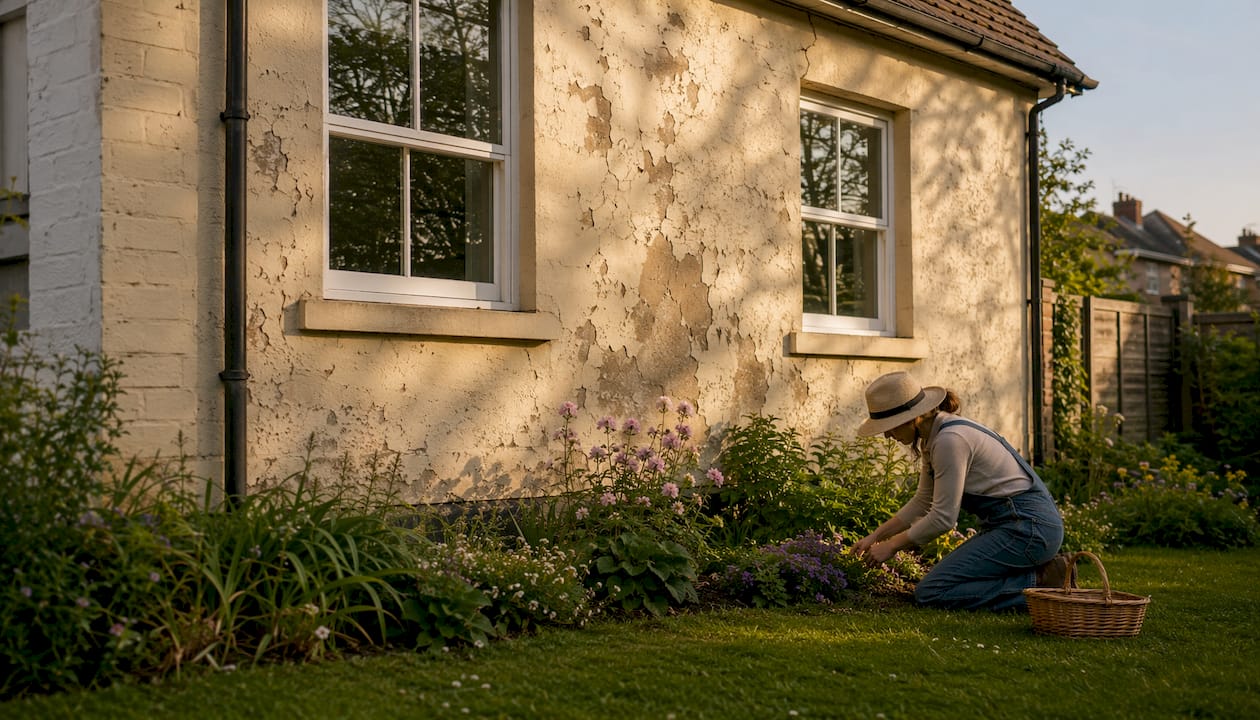
The practical consequences are visible: chalking (a powdery residue on the surface), colour fade, surface brittleness, and eventually cracking. These are not just cosmetic problems. Once the binder breaks down, the film stops protecting the substrate underneath.
What you can do about high UV exposure:
Choose paint formulations that specify UV-resistant resins or contain UV absorbers. Dulux Weathershield, for example, is formulated specifically for UK exterior conditions and carries manufacturer claims of extended weather resistance.
Avoid the darkest colours on south- and west-facing elevations unless the product’s technical data sheet (TDS) confirms high UV stability.
Apply a quality primer that seals the substrate before topcoats — bare or porous surfaces amplify UV-driven degradation.
Consider weatherproof coating systems designed for high-exposure UK climates.
Pro Tip: Assess each elevation separately. The north face of your house may hold paint for a decade while the south face needs attention at six years. Specifying the same product and schedule for every wall is a false economy.
Does coastal or wet weather really shorten paint life that much?
Yes, and the effect is more pronounced than most homeowners expect. Coastal and high-moisture environments significantly reduce paint longevity. Salt-laden air is abrasive, accelerates corrosion on metal substrates, and degrades paint films faster than inland conditions. For properties within roughly a mile of saltwater, this is not a theoretical risk — it is a routine maintenance reality.
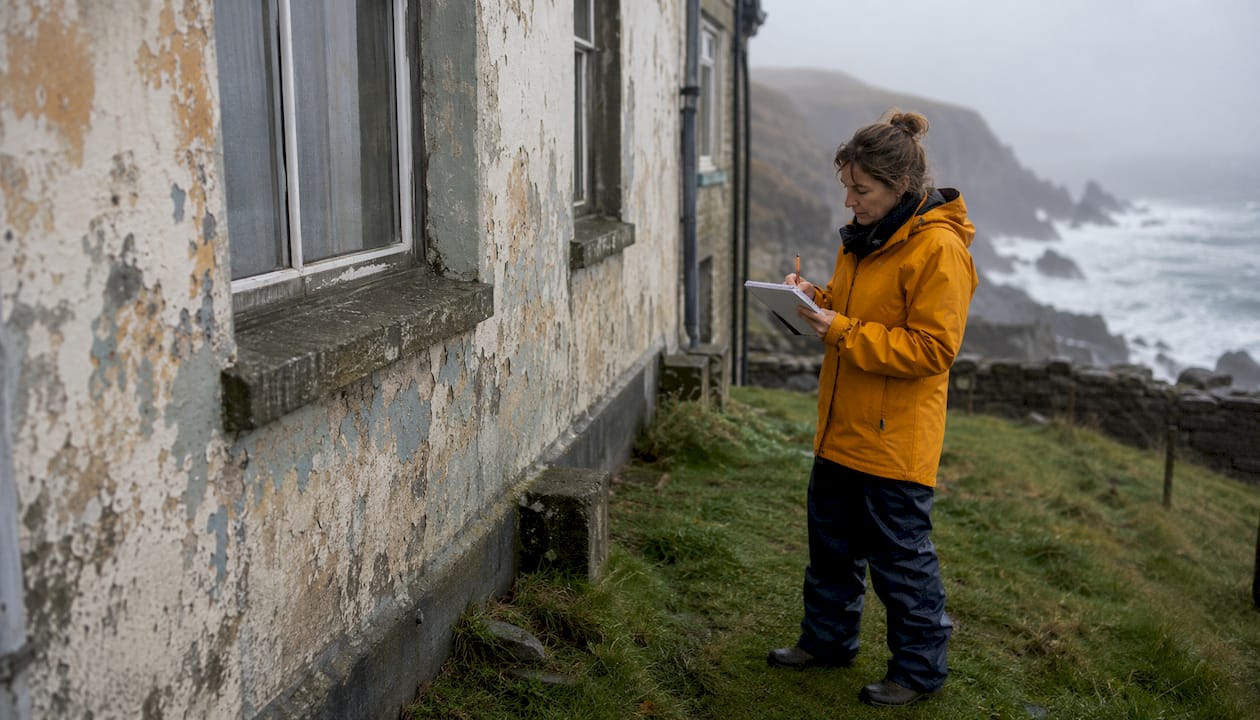
Repeated wetting and drying cycles are equally damaging. High humidity and frequent rain cause peeling and blistering even on well-prepared surfaces, sometimes within three to five years. Water finds its way behind the film through micro-cracks, caulk failures, or porous substrates, then expands and contracts with temperature changes until the film lifts.
Microbial colonisation compounds the problem. Warm, humid, and shaded conditions encourage algae, fungi, and bacteria to establish on paint films, disfiguring the surface and weakening the film over time. This is particularly common on north-facing walls and under overhanging vegetation in the South West.
Practical mitigations:
Use breathable masonry coatings on render and brick to allow moisture vapour to escape rather than build up behind the film.
Specify corrosion-resistant primers on all metal substrates, especially near the coast.
Clean exterior surfaces annually to remove salt deposits, algae, and dirt before they degrade the film.
Inspect caulking and sealant joints after every winter — these are the most common entry points for water.
Pro Tip: If your property is within a mile of the sea, budget for a maintenance inspection every two to three years rather than waiting for visible failure. Catching salt damage early costs a fraction of a full repaint.
How does substrate type affect paint durability?
The material beneath the paint determines how much stress the film faces and which coating system will perform. There is no universal answer — each substrate has its own failure mode.
Masonry and render are porous and breathe. Moisture moves in and out constantly, so the coating must allow vapour transmission. A non-breathable paint traps moisture and blisters from behind. Sandtex masonry coatings are specifically formulated for this, with flexible, breathable films designed for UK render and brick. Redecoration cycles of seven to ten years are realistic with correct specification.
Timber is the most demanding substrate. Wood expands in summer and contracts in winter, and that movement never stops. Rigid paint films crack along the grain, water enters, and rot follows. Flexible acrylic formulations and thorough priming of all bare end grain are non-negotiable. Timber-framed homes in the South West, where rainfall is high, often need attention at the lower end of the four-to-seven-year range.
Metal corrodes the moment the paint film is breached. Anti-corrosive primers — zinc phosphate or epoxy-based, depending on the application — are the first line of defence. In coastal areas, this is not optional. Without the right primer, topcoats on steel or iron can fail within two to three years.
uPVC and vinyl are dimensionally stable, which is an advantage, but standard paints do not bond to them without the correct preparation and adhesion primer. When done properly, a painted uPVC surface can hold colour and protection for eight to twelve years. Abrushwithgus’s uPVC spraying service uses specialist primers and airless application to achieve exactly this kind of durable finish on windows and doors.
Why surface preparation is the most important step
Paint adheres to the surface it is applied to, not to the failing layer beneath it. That single fact explains why preparation determines longevity more than any other controllable variable. A premium paint applied over chalky, dirty, or poorly primed substrate will fail prematurely regardless of its formulation.
A practical prep checklist for exterior repaints:
Clean the surface — pressure wash or gently scrub to remove dirt, algae, salt deposits, and loose material. Allow to dry fully.
Remove all loose and flaking paint — scrape, sand, or wire-brush back to a firm edge. Do not paint over peeling areas.
Sand smooth — feather edges where old paint has been removed to avoid visible ridges under the new coat.
Repair substrate defects — fill cracks in render, replace rotten timber, treat rust on metal before priming.
Prime all bare areas — bare wood, bare metal, and repaired masonry all need primer before topcoats. Spot-priming is not optional.
Re-caulk gaps and joints — failed caulk is one of the most common water-entry points. Replace it before painting, not after.
Allow adequate drying time — painting over damp surfaces is one of the most reliable ways to cause early blistering.
Primer selection matters beyond simple adhesion. A good primer seals porous substrates, improves topcoat coverage, and in the case of metal, provides corrosion protection that topcoats alone cannot deliver. For professional painting techniques that cover primer selection in more detail, the Abrushwithgus resource library is worth consulting.
Pro Tip: Before any contractor starts work, ask for a written prep specification. If they cannot tell you exactly what they will clean, remove, prime, and repair before the first topcoat goes on, that is a warning sign. Document the prep with photos.
Why premium paint chemistry genuinely matters
Not all exterior paints are equal, and the chemistry explains why. Premium paints commonly last significantly longer than economy alternatives, and the reason comes down to what is in the tin.
Paint types and their uses:
Acrylic emulsions are the standard for most UK exterior masonry and timber work. They are flexible, breathable, and water-resistant when cured. The quality of the acrylic resin varies enormously between price points.
Alkyd / solventborne paints offer a harder, higher-sheen finish and are still preferred for metal and some timber joinery. They are less flexible than acrylics and can become brittle over time.
Elastomeric coatings are thick-film systems designed to bridge hairline cracks and accommodate significant substrate movement. They suit rendered surfaces with a history of cracking.
What stabilisers actually do:
HALS (Hindered Amine Light Stabilisers) and UV absorbers are the additives that separate premium formulations from budget ones. UV absorbers intercept UV radiation before it reaches the resin matrix. HALS then neutralise the free radicals that UV exposure generates, preventing the chain reaction that breaks down the binder. Together, they slow the photooxidation process that causes chalking, fading, and brittleness. Economy paints typically omit or minimise these additives to reduce cost.
Premium exterior paints use HALS and UV absorbers to protect the resin matrix from UV-driven breakdown. This chemistry is the primary reason a quality product can outlast a budget alternative by a factor of 1.5 to 2 — not marketing, but measurable stabiliser performance.
Named products and their typical use cases:
Dulux Weathershield is a widely used acrylic masonry paint for UK exteriors, with manufacturer claims of up to 15 years’ protection on masonry. Its TDS specifies application temperatures and coverage rates that are worth checking before use.
Johnstone’s Trade exterior ranges are favoured by professional decorators for their consistent coverage and durability on both masonry and timber. Trade-grade formulations typically carry higher resin content than retail equivalents.
Farrow & Ball Exterior uses water-based formulations with a focus on colour depth and finish quality. Their exterior range is designed for timber and joinery rather than masonry, and the TDS recommends specific primers for bare wood.
Sandtex is the go-to for masonry coatings in the UK trade. Its fine-textured and smooth masonry paints are specifically engineered for breathability and flexibility on render and brick, with coverage rates and expected lifespans stated in the product data sheets.
Pro Tip: Always read the TDS before buying. Coverage rate, application temperature, recoat time, and expected service life are all stated there. A product that covers 8m² per litre is not the same value as one covering 12m², regardless of tin price.
Application conditions and technique: when and how paint is applied
Even the best paint fails if applied in the wrong conditions. Field defects including blistering, cracking, and uneven adhesion are frequently linked to application process rather than product quality alone.
Key conditions and technique points:
Temperature: most exterior paints require application between 10°C and 25°C. Below 10°C, curing slows dramatically and the film may never reach full hardness. Above 25°C, solvent flash-off can be too rapid, leaving a weak surface skin.
Humidity: painting in high humidity or onto a damp surface traps moisture beneath the film. Early blistering is the usual result.
Film thickness: applying too thinly reduces protection; applying too thickly causes runs and slow cure. Wet film thickness gauges are inexpensive and give a reliable check.
Number of coats: one coat is rarely sufficient for exterior work. Two full coats are the minimum; a third is justified on bare or heavily weathered substrates, or where a colour change requires full opacity.
Cure window: painting late in the day risks dew forming on an uncured film overnight. Check the manufacturer’s recoat and cure times.
For guidance on the best times of year to paint in the UK, including seasonal temperature and humidity considerations, the Abrushwithgus guide covers this in detail.
Pro Tip: Ask any contractor to confirm in writing the conditions under which they will apply paint. A professional who checks the weather forecast and adjusts their schedule accordingly is protecting your investment, not being awkward.
How colour and finish affect how long paint lasts
Colour is not just an aesthetic choice on exposed elevations. Dark colours absorb significantly more solar heat than light ones, and that heat accelerates binder breakdown. On a south-facing wall in full sun, a very dark paint can reach surface temperatures well above ambient air temperature, stressing the film from the inside out. Lighter colours reflect more solar energy and run cooler, which is why they tend to hold up longer on the most exposed faces of a building.
The practical guidance:
Avoid the deepest, darkest tones on south- and west-facing elevations unless the product’s TDS explicitly confirms high UV and heat stability.
If a dark colour is important to you, ask for a formulation with high HALS content and accept that the maintenance interval may be shorter.
Farrow & Ball’s deeper exterior shades, for example, are beautiful but best suited to sheltered or north-facing elevations where UV load is lower.
Finish (sheen level) also plays a role. Higher-sheen finishes are more washable and resist dirt pickup, but they show substrate imperfections clearly and can look patchy on uneven render. Matte and low-sheen finishes hide surface irregularities but are harder to clean and may be less resistant to algae. For most UK masonry, a mid-sheen or satin finish offers a reasonable balance. For timber joinery, a higher-sheen alkyd or water-based gloss provides better moisture resistance.
Pro Tip: Sample your chosen colour on the actual wall and observe it at different times of day before committing. A colour that looks warm in a paint shop can read very differently on a north-facing elevation in January.
Inspection schedule and signs that your paint is failing
Catching paint failure early is far cheaper than letting it progress. A small area of peeling or a failed caulk joint costs little to address; left for two winters, the same problem can mean substrate repair, extensive preparation, and a full repaint.
Signs to look for:
Peeling or flaking: the film has lost adhesion, usually due to moisture, poor prep, or an incompatible primer.
Chalking: a powdery residue on the surface indicates UV-driven binder breakdown. Some chalking is normal in older paint; heavy chalking means the film is spent.
Blistering: bubbles beneath the film point to trapped moisture or solvent. Understanding why paint peels helps you address the cause, not just the symptom.
Cracking or checking: fine surface cracks indicate the film has become brittle, often from UV exposure or substrate movement.
Caulk failure: gaps at window frames, door surrounds, and expansion joints allow water in. This is often the first failure point.
Staining or algae growth: green or black patches indicate microbial colonisation, more common on shaded, damp elevations.
Recommended inspection cadence:
Annual visual check of all elevations, paying attention to south/west faces and any areas with vegetation nearby.
Post-storm inspection after any significant weather event, particularly in coastal areas.
Detailed review every three to five years, including probing caulk joints and checking for soft timber.
Pro Tip: A small touch-up within the first couple of years, before moisture has reached the substrate, can add years to the overall paint job. Keep a small quantity of the original paint for exactly this purpose.
Gentle annual washing with a soft brush and mild detergent removes salt, algae spores, and dirt before they degrade the film. Gutter maintenance matters too: overflowing gutters deposit water repeatedly on the same section of wall, and that localised saturation shortens paint life faster than general rainfall. Trimming vegetation away from walls removes a source of persistent moisture and shade that encourages biofilm growth.
What does a repaint actually cost and how often should you budget for it?
Substrate | Recommended repaint interval | Notes |
Masonry / render | 7–10 years | Shorter in coastal or high-moisture locations |
Timber | 4–7 years | More frequent if paint is cracking or peeling |
Fibre cement | 10–15 years | Longer with premium paint and good prep |
Metal | 5–8 years | Inspect annually; repaint at first sign of rust |
uPVC | 8–12 years | Dependent on primer adhesion quality |
Cost factors that influence repaint budgets:
Preparation level: stripping back to bare substrate costs more than a maintenance repaint over sound existing paint. It is also the difference between a job that lasts and one that fails early.
Access and scaffolding: a two-storey detached house requires scaffolding, which adds meaningfully to the overall cost. Factor this into your planning cycle.
Premium materials: the difference in material cost between an economy and a premium paint is modest relative to total project cost. The labour is the same either way.
Number of coats: a third coat on bare or heavily weathered surfaces adds cost but extends service life.
When comparing quotes, ask each contractor to itemise preparation, primer, number of coats, and product names. A quote that lists only “paint and labour” tells you nothing about what you are actually getting.
The science behind stabilisers and why professional technique matters
Predicting service life from laboratory tests alone is genuinely difficult because field exposures vary so much. Accelerated weathering tests — where panels are exposed to intense UV and moisture cycles in a controlled chamber — give useful comparative data, but they cannot fully replicate the combination of orientation, microclimate, substrate condition, and application quality that determines real-world performance.
HALS work by interrupting the free-radical chain reactions that UV exposure triggers in the resin matrix. Without them, those radicals propagate through the binder, breaking polymer chains and causing the film to chalk, crack, and lose adhesion. UV absorbers sit upstream of this process, converting UV radiation into harmless heat before it reaches the resin. The two mechanisms are complementary, which is why premium formulations use both.
The same house can have UV-dominated decay on a sun-exposed south elevation and microbially dominated biodeterioration on a shaded, damp north elevation. Specifying a single coating system for the whole building ignores this entirely — and it is one of the most common mistakes in exterior redecoration.
What to request in a contractor specification:
Product name and TDS reference for each coat (primer, undercoat if applicable, topcoat).
Expected service life as stated by the manufacturer.
Written workmanship warranty covering adhesion failure and application defects.
Confirmation of application conditions (temperature range, humidity, drying time between coats).
Pro Tip: A contractor who hands you a TDS without being asked is telling you something important about how they work. It means they have read it themselves.
Key takeaways
Surface preparation, UV exposure, moisture management, and paint chemistry together determine exterior paint durability — and maintaining all four is the most reliable way to extend service life beyond the typical 4–15 year range, depending on substrate.
Point | Details |
Preparation is decisive | Cleaning, priming, and repairing substrate defects before painting prevents the majority of early failures. |
Orientation changes the risk | South- and west-facing walls receive significantly more UV and need UV-stable formulations or shorter maintenance intervals. |
Premium paint pays back | Products with HALS and UV absorbers commonly last 1.5–2× longer than economy alternatives — the material cost difference is small relative to labour. |
Maintenance extends life | Annual washing, early touch-ups, and caulk inspection add years to any paint job and cost far less than a full repaint. |
Abrushwithgus | Covers preparation, primer specification, and correct application on every South West exterior project. |
What the South West teaches you about exterior paint
There is a pattern Abrushwithgus sees repeatedly on South West projects: a homeowner has had a paint job done, it looked fine for eighteen months, and then it started peeling in sheets. Almost every time, the cause is the same. The surface was not properly prepared. Either the old chalky paint was not removed, the bare timber was not primed, or someone painted over damp render because the schedule did not allow for drying time.
The South West climate is genuinely demanding. The combination of Atlantic rainfall, coastal salt, and strong south-westerly winds means that a paint system that might last eight years in the Midlands can struggle to reach five here without the right specification. That is not a reason to despair — it is a reason to be precise. Breathable coatings on masonry, flexible acrylics on timber, anti-corrosive primers on any metal, and a realistic maintenance schedule are not extras. They are the baseline.
The other thing worth saying: the north-facing elevation of a house in Cornwall can develop algae and biofilm within two to three years, even on a relatively new paint job, simply because it stays damp and shaded. A quick annual wash with a dilute biocide solution keeps that in check and costs almost nothing compared with the alternative.
Pro Tip: In the South West, specify per elevation. The south face needs UV-stable formulations; the north face needs biocide-containing paint and more frequent cleaning. Treating the whole house identically is a false economy.
Get a long-lasting exterior finish from Abrushwithgus
The difference between a paint job that lasts five years and one that lasts ten usually comes down to what happens before the first coat goes on. Abrushwithgus’s domestic exterior painting service covers the full preparation process: pressure washing, removal of loose paint, substrate repair, correct priming, and application in the right conditions with the right products. Every quote includes a written prep specification so you know exactly what you are getting.
For windows and doors, the uPVC spraying service uses specialist adhesion primers and airless application to deliver a factory-quality finish that holds up to South West weather. If your exterior needs cleaning before any painting work begins, the exterior cleaning service handles salt, algae, and grime removal as a standalone or preparatory step.
Get in touch with Abrushwithgus for a written quote that includes product names, TDS references, and a clear prep specification.
Useful sources and further reading
How Long Does Exterior Paint Last? — paintpricing.com — practical lifespan data by substrate and climate factor
Evaluating and testing the weathering of coatings — UL Prospector — technical overview of HALS, UV absorbers, and accelerated weathering methodology
Methodologies for predicting the service lives of coating systems — NIST / GovInfo — laboratory vs field exposure limitations
Weathering and field defects — American Coatings Association / Coatingstech — causes of common application and weathering defects
Biodeterioration of external architectural paint films — ScienceDirect — peer-reviewed review of microbial colonisation on exterior coatings
Exterior Paint Lifespan: Factors Affecting Durability — CyPaint — accessible overview of lifespan variables for homeowners
How Long Does Exterior Paint Actually Last? — jondec.com — substrate-by-substrate breakdown and preparation guidance
Weatherproof painting guide — Abrushwithgus — local guidance on breathable and weatherproof coating systems for South West homes
Long-lasting exterior paint options for UK homes — Abrushwithgus — product guidance and real-world examples from South West projects
Recommended
Comments