
Painting industry standards every UK homeowner must know

Any professional painter you hire in the UK must deliver five non-negotiables: a written, itemised quote; thorough surface preparation; trade-quality materials with product codes specified; public liability insurance; and a written workmanship guarantee. These are not nice extras. They are the baseline for any decorator worth booking.
Here are two quick benchmarks to judge quotes against. A fully prepped and painted 4m × 4m bedroom typically costs £300–£500 with a professional, compared with roughly £40–£80 in DIY materials alone. A competent decorator spends approximately 60% of project time on preparation before a brush touches the wall. Any quote that implies otherwise deserves scrutiny.
Key entities to know before you hire:
Consumer Rights Act 2015 — your statutory protection if work falls short
Painting & Decorating Association (PDA) — the main UK trade body for decorators
Dulux Select decorator scheme — a manufacturer-backed quality accreditation
Abrushwithgus — a family-run painting and decorating service in Cornwall and the South West, built around these standards
Table of Contents
1. What ‘reasonable care and skill’ means for your painting contract
Under the Consumer Rights Act 2015, every service contract must be performed with reasonable care and skill. For a paint job, that means proper surface preparation, correct application, appropriate materials, and a finish that lasts a reasonable time.
“If a trader doesn’t carry out a service with reasonable care and skill, you can ask them to redo or fix the work. If they can’t or won’t do this within a reasonable time and without significant inconvenience, you can claim a price reduction or, in some circumstances, a full refund.”Citizens Advice
Verbal promises count too. If a decorator tells you at the quote visit that they will use Dulux Trade Diamond Matt and apply two coats, that claim forms part of the contract. Written advertising claims carry the same weight. Any term in a contract that tries to exclude responsibility for workmanship is legally unenforceable under the same Act.
If work falls short, your first step is to ask for rectification in writing. If the decorator refuses or the fix is unsatisfactory, you can request a partial or full refund. Trading Standards is the escalation route for unsafe work or a contractor who simply disappears.
2. What proper surface preparation looks like
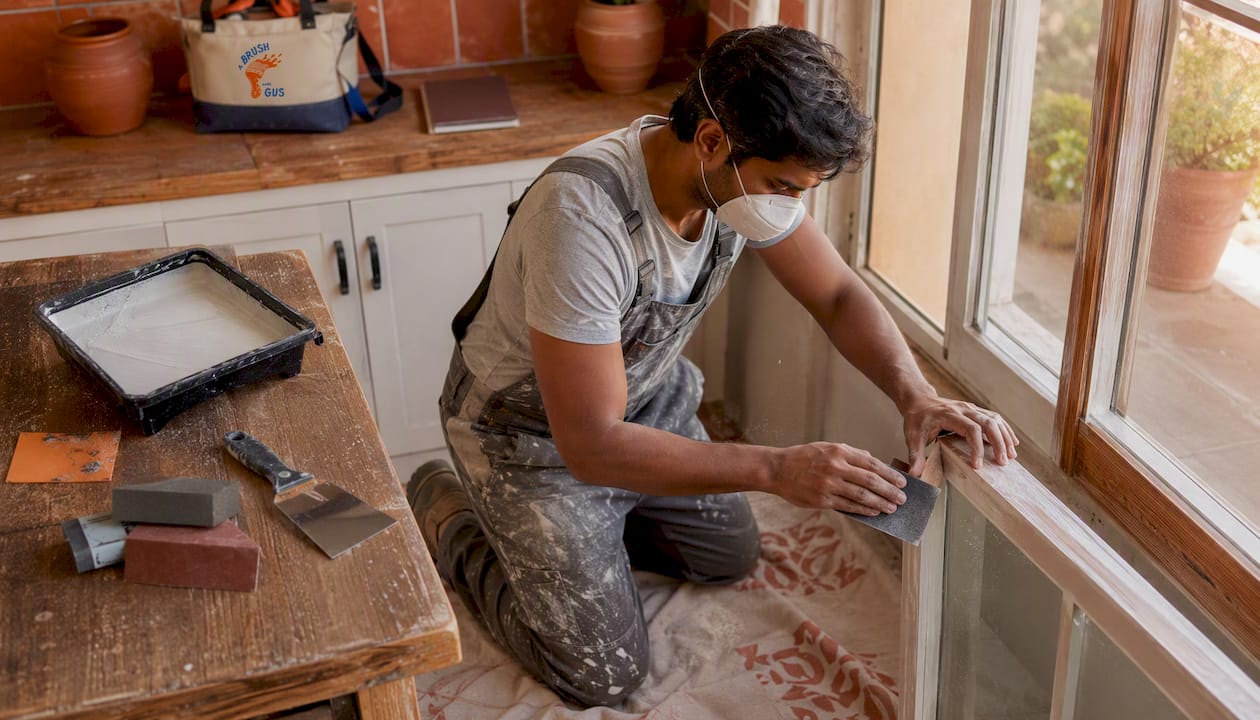
Skipped prep is the main cause of premature failures like peeling, stain bleed-through, and patchy colour. A professional should complete every step below before opening a tin:
Fill and sand all cracks, holes, and imperfections
De-grease kitchen walls, woodwork, and any surface with grease or residue
Treat damp or mould before painting — painting over active moisture guarantees failure; understanding why walls get damp is the first step to fixing it properly
Apply stain-block primer over water stains, nicotine, or tannin bleed
Prime bare surfaces (new plaster, bare wood, repaired areas)
Allow correct drying times between coats — rushing this is one of the most common shortcuts
Trade paint ranges are formulated for higher pigment load and faster curing than retail equivalents. Specifying product codes on a quote (for example, Dulux Trade Diamond Matt) is a practical way to confirm quality and avoid cheap substitutes.
Pro Tip: Ask the decorator to show you the surfaces after filling and sanding, before any primer goes on. If they resist or say it is not necessary, that is a warning sign. A confident professional welcomes the check.
3. How to read a professional quote
A professional quote should be a fixed, itemised document — not a rough estimate scribbled on a business card. Vague descriptions like “paint lounge” tell you nothing about what prep is included, how many coats are planned, or what happens if the finish fails.
Here is what every line item should show:
Line item | What to look for |
Prep work | Filling, sanding, de-greasing, priming — listed separately |
Paint brand and product codes | e.g. Dulux Trade Diamond Matt, Farrow & Ball Estate Emulsion |
Number of coats | Minimum two coats on walls; three on woodwork |
Labour (hours or days) | Broken down by room or area |
Materials | Paint quantities, primer, filler, masking tape |
Protection and clean-up | Dust sheets, floor protection, end-of-job tidy |
Guarantee terms | Duration and what it covers |
Start date and estimated finish | Realistic schedule with drying time built in |
VAT | Stated separately and included in the final total |
Payment terms | Deposit amount, milestone payments, final balance |
Red-flag phrases to watch for: “all-in price”, “as required”, “materials TBC”, and any quote that omits prep entirely. Good quotes separate preparation tasks clearly because these steps account for the majority of durable outcomes.
4. Benchmark costs and realistic timelines
A fully prepped and painted 4m × 4m bedroom commonly costs a few hundred pounds with a professional decorator. DIY materials for the same room cost considerably less — but that gap narrows quickly once you factor in your time, equipment hire, and the cost of fixing mistakes.
Key benchmarks to keep in mind:
A single average bedroom (walls and woodwork) typically takes one decorator one to two days when done properly, allowing for prep, drying, and multiple coats
A decorator who promises to complete walls, ceiling, and woodwork in a single short visit is almost certainly cutting prep
Multi-room jobs usually attract a lower per-room rate — worth asking about when booking two or more rooms together
Exterior work and anything requiring scaffolding or specialist access adds cost due to painting safety regulations and equipment
For South West homeowners, how painting quotes are calculated locally can differ slightly from national averages due to travel time and regional material costs.
5. Which accreditations and trust signals actually matter
Painting is an unregulated trade in the UK. Anyone can call themselves a decorator. That makes voluntary credentials more important, not less.
Membership of trade bodies such as the PDA or a Dulux Select badge is a useful signal of ongoing training and a commitment to industry practice, but homeowners should verify membership claims with references and recent photos of comparable work. NearbyTraders
Meaningful trust signals to check before you book:
PDA membership — indicates adherence to a code of practice and access to ongoing training
Dulux Select decorator status — manufacturer-vetted quality standard, requires demonstrated skill
Public liability insurance — recommended minimum £1 million; ask for the certificate, not just a verbal assurance
Written workmanship guarantee — duration and scope stated clearly
Before/after photos of comparable jobs (similar room type, surface condition)
Local references you can actually contact
Membership alone is not a guarantee of quality. A decorator with a PDA badge and no recent photos of work is less reassuring than one with neither badge but a strong local portfolio and verifiable references.
6. Deposit, payment schedules, and your right to cancel
Safe payment practice for a domestic painting job looks like this:
A small fixed deposit (typically 10–25% of the total) to secure the start date — not a large upfront sum
Staged payments tied to milestones (completion of prep, completion of first room, final sign-off)
Final balance on completion, after you have inspected the work
Written receipts for every payment — refuse any contractor who asks for cash with no paperwork
For contracts agreed at a distance (by phone or online), the Consumer Contracts Regulations 2013 give you a 14-day cooling-off period. If work begins during that window without your express written consent, your cancellation rights are affected. A reputable decorator will explain this before starting. Citizens Advice confirms that the trader must provide written cancellation instructions — if they do not, ask for them before signing anything.
7. Questions to ask at the quote visit and red flags to walk away from
Questions worth asking at every quote visit:
What paint brands and product codes will you use?
How will you prepare this specific surface?
How long will you allow for drying between coats?
What guarantee do you offer, and what does it cover?
Can I see your public liability insurance certificate?
Are you a PDA member or Dulux Select accredited?
Can you provide two or three local references from similar jobs?
What deposit do you require, and what are the payment milestones?
Immediate red flags:
Vague or verbal-only quotes with no written breakdown
No proof of insurance when asked
Retail paint only — no trade product codes offered
Timelines that compress prep and painting into a single rushed day
Refusal to provide references or portfolio photos
Requests for large cash payments upfront
If you spot any of these in the first hour on site, pause the job, document what you have observed, and raise it in writing before work continues.
8. Step-by-step actions if the finish fails
Document everything first. Photograph the defect clearly, note the date, and keep all receipts and written communications.
If they do not respond — , contact Citizens Advice or your local Trading Standards office
A simple first message might read:
Keep the tone factual. Avoid ultimatums in the first message — give the decorator a clear opportunity to put it right before escalating.
Key takeaways
A professional UK painter must supply a written itemised quote, complete proper surface preparation, use trade-quality materials, hold public liability insurance, and offer a written workmanship guarantee.
Point | Details |
Written itemised quote | Demand product codes, prep steps, coat count, timeline, and VAT — all in writing. |
Surface prep is the majority of the job | Professionals spend roughly 60% of project time on prep; rushed quotes skip this. |
Benchmark your costs | A 4m × 4m bedroom costs £300–£500 with a professional decorator; DIY materials run £40–£80. |
Check credentials and insurance | PDA membership, Dulux Select status, and a £1 million public liability certificate all matter. |
Abrushwithgus | A Cornwall and South West decorator delivering itemised quotes, trade paints, and written guarantees as standard. |
The standard most decorators talk about — and what actually separates the good ones
Most articles about painting industry standards focus on what to ask for. Fewer talk about what actually separates a decorator who delivers from one who does not.
The honest answer is preparation discipline. Any decorator can promise two coats of Dulux Trade Diamond Matt. The difference shows up before the tin is opened: whether they fill every crack properly, whether they allow the primer to cure before moving on, whether they treat a water stain with stain-block rather than hoping the topcoat covers it. These are not dramatic decisions. They are small, unglamorous steps that most homeowners never see — which is exactly why some decorators skip them.
The other thing worth saying plainly: accreditations matter less than references. A PDA badge tells you a decorator has engaged with their trade body. A phone call with a previous client in a similar property tells you whether the finish held up six months later. Both are worth having. But if you can only do one, call the reference.
Abrushwithgus operates as a family-run business in Cornwall and the South West, with brothers Gus and Rhys leading every job. Their process runs from an initial survey and itemised written quote through surface-first preparation, trade paint specification, staged payments, and a written guarantee on completion. No shortcuts on prep, no retail paint substituted mid-job, no vague verbal promises.
Get a no-obligation survey from Abrushwithgus
Knowing the standards is one thing. Having a decorator who actually applies them is another.

Abrushwithgus covers Cornwall and the South West with a straightforward survey process: you get an itemised written quote that breaks down prep, materials with product codes, labour, timeline, and guarantee terms before any work begins. No guesswork, no surprises on the final invoice.
Whether you need interior domestic painting, exterior home painting and repair, or UPVC spraying for windows and doors, the survey covers your specific surfaces and conditions. Get in touch to book yours.
Useful sources
Consumer Rights Act 2015 (legislation.gov.uk) — the statutory basis for ‘reasonable care and skill’ in service contracts
Consumer Contracts (Information, Cancellation and Additional Charges) Regulations 2013 — the 14-day cooling-off right for distance contracts
Problem with building work, decorating or home improvements (Citizens Advice) — practical remedies and escalation steps
Cancelling building or decorating work (Citizens Advice) — your cancellation rights and what traders must provide
Painting a bedroom costs (MyJobQuote) — cost benchmarks for domestic painting jobs
Home painting FAQs (Abrushwithgus) — practical answers to common questions from a South West decorator
Surface preparation: the complete guide (Abrushwithgus) — deeper technical guidance on prep steps and products
Recommended
Comments