
0 ppm TDS: When Pure Water Window Cleaning Is Worth It for UK Homes
- WM Creative Designs Limited
- 4 days ago
- 10 min read
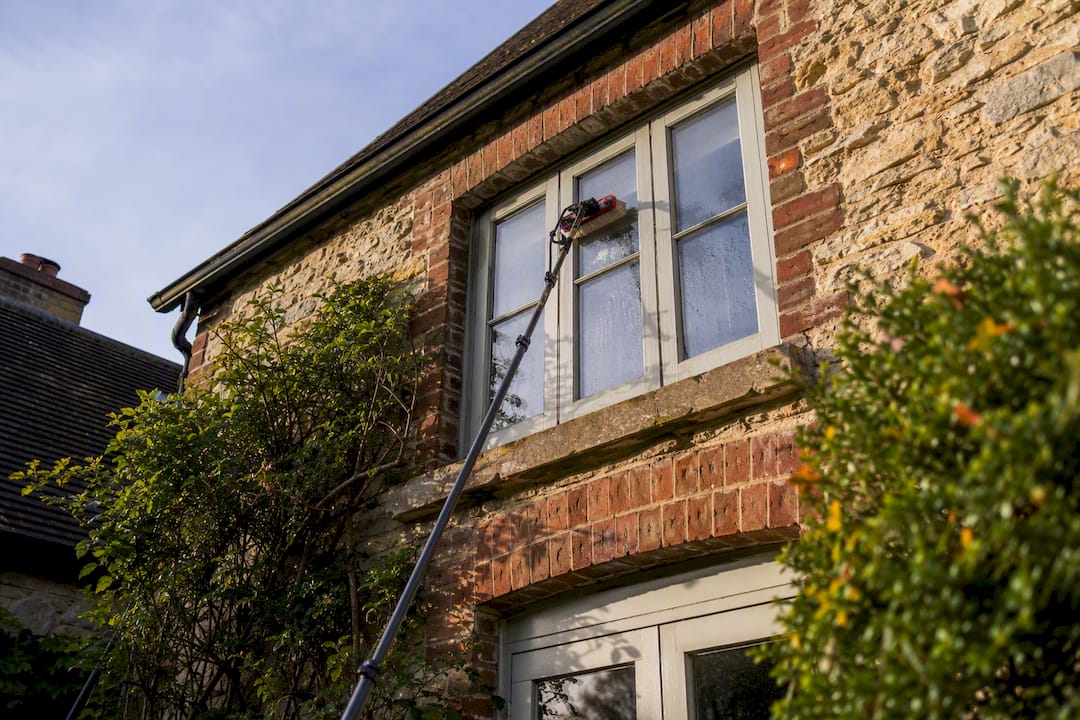
Pure water window cleaning gives the best streak-free finish of any method available and suits most UK properties, especially anything above single-storey. For coastal homes, multi-storey buildings, or a first clean after years of soap residue, hiring a professional is usually the right call. Single-storey properties with soft water and small panes can manage well with a DIY kit. This guide covers the technology, real costs, and how to choose a provider.
TL;DR:
Water hardness varies regionally, with hard water reducing resin lifespan and increasing costs, especially in the South East and East Anglia.
Professional systems use both reverse osmosis and deionisation to achieve 0 ppm TDS, ensuring streak-free finishes in one pass.
Coastal properties benefit most from pure water cleaning to prevent salt film buildup that can etch glass over time.
DIY kits are cost-effective for soft-water, single-storey homes but often require frequent resin replacement in harder regions.
For multi-storey or coastal properties, hiring a professional with calibrated equipment usually proves more economical and safer.
Table of Contents
What is pure water window cleaning?
Pure water window cleaning uses water that has been filtered to remove virtually all total dissolved solids, or TDS. Ordinary tap water is loaded with minerals, chlorine and other dissolved matter that leave the white, cloudy marks you see once water dries on glass. Strip those solids out and you get water that behaves differently on contact with dirt.
That stripped-back water is sometimes called “hungry water” in the trade, because it actively wants to pick up minerals again. Applied to glass with a brush, it dissolves and lifts grime rather than pushing it around, and the purified water leaves glass streak-free as it evaporates with nothing left behind to dry into a mark.
A few things surprise people the first time they see it in action:
The glass can look wet and slightly hazy for a few minutes after cleaning, which is normal.
No squeegee, no cloth, no chamois leather. The water is simply left to air dry.
Rain afterwards doesn’t undo the work. Rainwater is relatively soft, and with no sticky surfactant film left on the glass, dust has nothing to cling to.
How do RO and DI systems actually work?
Two filtration stages do the work. Reverse osmosis (RO) forces mains water through a fine membrane that blocks most dissolved solids, and it typically removes 85 to 95% of TDS on its own. Deionisation (DI) resin then polishes what’s left, pulling out the remaining minerals until the reading hits true zero.
The industry benchmark: 0 ppm on a TDS meter. Readings up to around 7 ppm are often still workable for a decent finish, but professionals aim for zero and record it.
Checking that number isn’t guesswork. A handheld TDS meter dipped in the outflow water gives an instant reading, and it’s the tool every competent operator carries. Recording that figure on a job sheet or quote is one of the simplest ways a customer can tell a serious operator from someone winging it with a hosepipe.
One thing that matters more in the UK than people expect: water hardness varies enormously by region. Areas with hard water, much of the South East and parts of East Anglia, burn through DI resin far faster than soft-water regions like Cornwall or the Scottish Highlands. That regional difference should shape which kit you buy or which system a contractor turns up with.
RO membrane: does the bulk of the heavy lifting, removing most dissolved solids before the water reaches the resin stage.
DI resin: finishes the job, taking the water from “mostly clean” to genuinely 0 ppm.
TDS meter: the only reliable way to confirm the water is actually pure before it touches the glass.
What equipment do UK buyers actually need?
Water-fed poles are the visible signature of this method: long, lightweight poles, usually carbon fibre for the higher reaches, with a brush head and internal hose feeding water straight to the bristles. Professional setups can extend to around 20 metres, covering most three and four-storey buildings from ground level.
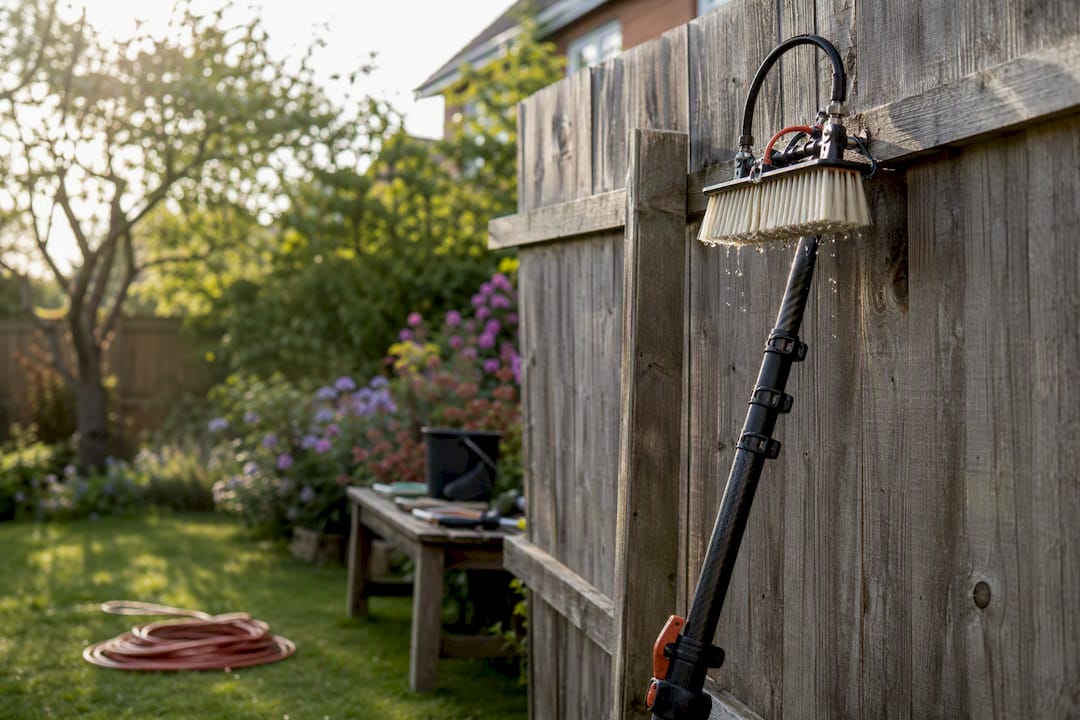
The brush head itself usually combines soft bristles for agitation with pencil jets that flush water out evenly across the glass. Behind that sits either a backpack tank for small jobs, a portable RO/DI unit on a trolley, or for full-time professionals, a van-mounted system with a large storage tank and pump.
For homeowners looking at DIY, the choice generally comes down to:
DI-only portable kits: cheaper to buy, fine for occasional use, but resin depletes quickly in hard-water areas.
Portable RO/DI units: costs more upfront, but resin lasts substantially longer because the RO stage does most of the filtering first.
Van-mounted RO/DI systems: the professional standard, built for daily volume and rarely a sensible purchase for a single household.
When buying in the UK, check warranty length and whether the supplier offers UK-based parts and support. A pole or pump that fails with no local backup is a false economy.
Why pure water beats a bucket and squeegee
The safety case alone is compelling. Water-fed poles mean cleaning upper-storey windows from solid ground, no ladder against a fascia board, no leaning out of an upstairs window. That single change removes most of the risk that traditional window cleaning carries on anything above ground floor.
The finish lasts longer too, because there’s no soap residue for dust to grip onto, and no detergent runoff going straight into flower beds or surface drains. That’s a genuinely different environmental profile compared with soap-and-squeegee methods, something worth weighing alongside broader sustainable exterior cleaning practices if you’re thinking about a property’s overall footprint.
Coastal properties see the biggest benefit. Salt-laden air leaves a film that attracts grime fast and can etch into glass over time if left unaddressed. Pure water lifts that film without leaving anything behind for salt to bond to next time.
Pro Tip: If you live within a mile or two of the sea, ask any contractor how often they’d recommend cleaning your specific property. Coastal homes often need a shorter interval than inland ones to keep salt film from building up between visits.
What does pure water cleaning actually cost?
DIY entry-level DI-only kits typically start in the low hundreds of pounds, covering a basic pole, brush head and a portable resin tank. Step up to a portable RO/DI unit and you’re looking at a bigger outlay, often several hundred pounds more, but resin lasts noticeably longer because RO strips out most of the dissolved solids first.
Combining RO with DI, rather than running DI alone, extends resin life and cuts waste considerably, particularly in hard-water parts of the UK where an RO-free setup can chew through resin within weeks.
Running costs beyond the initial purchase come down to two things: resin cartridges, which need replacing more often in hard-water regions, and water itself, since RO systems reject a portion of the mains supply as waste during filtration. For a homeowner cleaning their own windows once a month, that’s a minor cost. For anyone running a round of properties weekly, refill logistics and resin spend add up fast, which is one reason professional pricing can actually work out more economical than buying and maintaining kit for occasional use.
Entry-level DI kit: lower upfront cost, higher ongoing resin spend in hard-water areas.
Portable RO/DI unit: higher upfront cost, lower ongoing resin spend.
Professional service: no equipment cost at all, and pricing reflects volume the operator already handles efficiently.
DIY or hire a professional?
DIY suits you if: your property is single storey, your local water is naturally soft, and the panes are a manageable size you can reach safely from ground level.
Hire a professional if: you have multiple storeys, a coastal location, glass that’s been cleaned with soap for years, or any access that would need a ladder.
Consider a hybrid: bring in a professional for the first clean, since glass with years of surfactant build-up often needs two or three passes before it comes up properly streak-free, then maintain it yourself between visits.
Red flags to stop a DIY attempt: persistent white haze after drying, a TDS reading that won’t drop below 20 to 30 ppm, or any window higher than you can safely reach without a ladder.
How to choose a pure water provider in the UK
A transparent operator won’t mind being asked hard questions. Public liability insurance is the baseline, not a bonus. Ask how they check purity on site, and a proper answer mentions a TDS meter and a target of 0 ppm, not “we just use tap water with a filter.”
Ask for local references or recent job photos, ideally from properties similar to yours.
Ask how they handle hard-water resin consumption, since a vague answer suggests they haven’t thought about running costs.
Ask what happens if the first clean doesn’t fully remove old soap residue, a competent operator will explain multiple passes rather than promise instant perfection.
Walk away if a quote arrives with no site visit, no TDS figure mentioned, and no recommended cleaning frequency.
Pro Tip: A genuinely transparent quote should always include four things: the site visit, a TDS reading taken on the day, a recommended cleaning interval for your property type, and a clear price. If any of those four is missing, ask why.
Readers considering the commercial side of exterior maintenance can also look at commercial pressure washing and eco-friendly cleaning approaches for a sense of how professional standards apply across different exterior cleaning disciplines.
Why trust Abrushwithgus on this
Abrushwithgus is a family-run painting and decorating business operating across Cornwall and the South West, run by brothers Gus and Rhys. Exterior cleaning sits alongside the firm’s core painting, UPVC spraying, and decorating work, which means the same team assessing your windows also understands how pure water interacts with UPVC frames, render, and painted surfaces nearby.
Working across a region with a long, exposed coastline has shaped how the team approaches frequency and technique for salt-affected properties. That local knowledge, plus a full range of cleaning services, means a visit can address windows and the surrounding exterior in one conversation rather than three separate call-outs.
How long does a typical clean take?
For an average three-bedroom semi-detached house in the UK, budget roughly 45 minutes to an hour for the whole job, including setup. That breaks down into a few distinct stages.
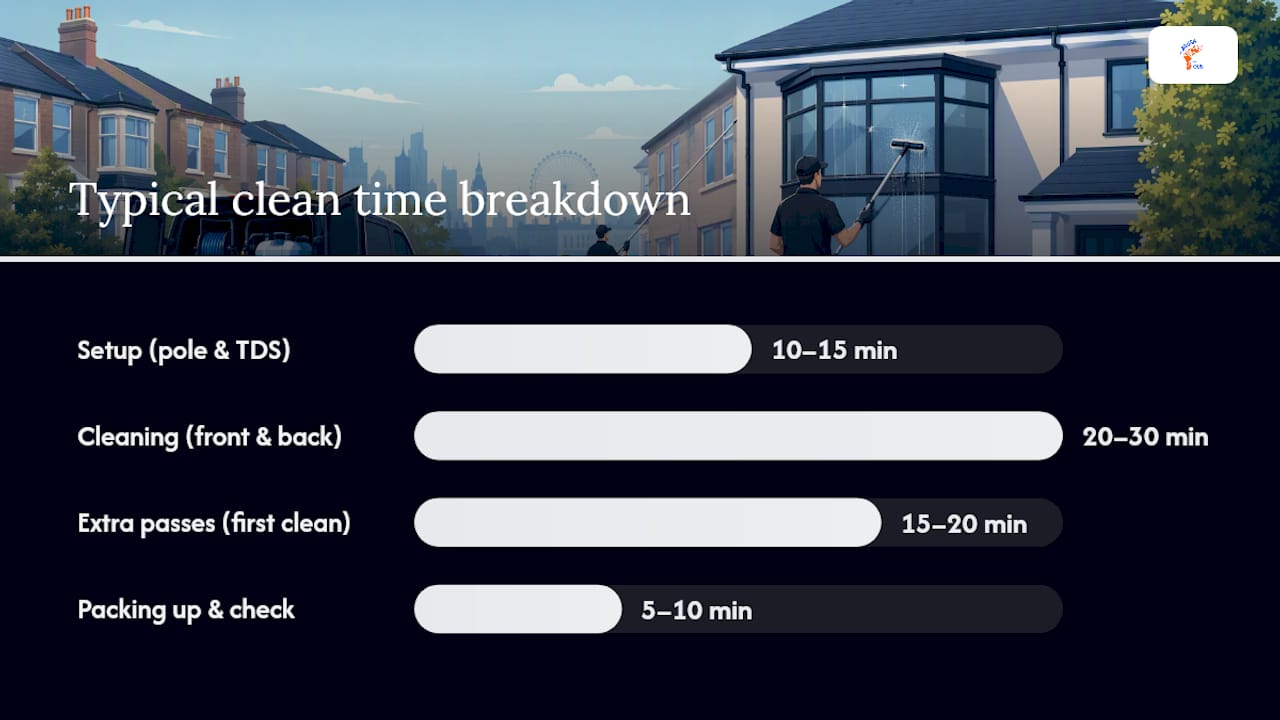
Setting up the pole, connecting the water supply or tank, and taking an initial TDS reading typically takes 10 to 15 minutes. Actual cleaning of a standard semi’s windows, front and back, usually takes 20 to 30 minutes once the operator gets into a rhythm moving pole to pole across each elevation.
Larger detached properties, or homes with conservatories, bay windows, or multiple outbuildings, can push the total time towards 90 minutes. Flats and terraced houses with fewer accessible windows often finish in under half an hour. Multi-storey properties don’t necessarily take longer per window, since the water-fed pole reaches upper floors just as easily as ground level, but more glass overall means more time regardless of height.
First cleans generally run longer than routine maintenance visits. If the glass carries years of soap residue, expect an operator to run two or three passes over particularly stubborn panes, which can add 15 to 20 minutes to that initial visit. Subsequent visits, once that build-up is gone, tend to be noticeably quicker because the glass stays cleaner for longer between rounds. Packing away, checking for missed spots, and a final walk-round typically adds another five to ten minutes at the end.
Keeping your system running properly
DI resin is the part of any pure water system that needs the most attention. As it works, it gradually loses its ability to strip minerals from water, and the tell-tale sign is a rising TDS reading on the meter even though nothing else has changed. Once readings climb above roughly 10 to 15 ppm consistently, it’s time to swap the resin cartridge.
Hard-water areas exhaust resin considerably faster than soft-water regions, sometimes within a few weeks of regular use rather than months. Keeping a spare cartridge on hand avoids a job grinding to a halt halfway through a round.
RO membranes need less frequent attention but shouldn’t be ignored. A gradual drop in output pressure or flow rate usually signals the membrane needs flushing or replacing, and leaving it too long forces the DI stage to work harder, burning through resin even faster than usual.
Common troubleshooting issues are usually simple to diagnose. A sudden jump in TDS readings almost always points to spent resin. Reduced water flow through the pole often means a blocked pencil jet or a kinked hose rather than a system fault. Streaking that reappears after a clean that previously looked fine can indicate the RO membrane has degraded and is letting more dissolved solids through than it should.
A basic maintenance routine, checking TDS before every job, flushing the system after periods of storage, and replacing resin on a schedule rather than waiting for a bad reading, keeps a portable or van-mounted setup reliable through a full working season.
Why the “just buy a kit” advice misses the point
Most online guidance treats pure water systems as a simple product decision: buy the kit, follow the instructions, done. That undersells how much regional water hardness and property type actually change the equation. A DI-only kit that works brilliantly for a friend in Cornwall’s soft-water catchment can leave a homeowner in a hard-water part of the South East replacing resin every fortnight and wondering why the streaks keep coming back.
The bigger gap in most advice is coastal property care. Salt film isn’t just cosmetic. Left unaddressed over years, it can contribute to glass etching that no amount of cleaning reverses. That’s a property-preservation issue, not just an aesthetic one, and it deserves more weight than most guides give it.
My honest read: for anything beyond a single-storey home with easy access and soft water, the maths favours hiring someone who already owns the right RO/DI setup and knows the local water conditions. That’s not a sales pitch, it’s what the running costs and safety numbers actually point to.
— Angus
Book a pure water check for your home
Abrushwithgus offers professional RO/DI pure water window cleaning for homes and small businesses across Cornwall and the South West, the same region-specific water knowledge covered above, put into practice on your own windows. Unlike a DIY kit sitting unused in the shed after the resin runs dry, you get a system that’s already calibrated for local water conditions, with no equipment to store, maintain, or replace.

Every visit starts with an on-site TDS check, so you know exactly what’s coming out of the pole before it touches your glass, followed by a no-obligation written quote covering recommended frequency and price. If you’ve read this far and suspect your property, especially anything coastal or multi-storey, is better suited to a professional visit than a DIY attempt, get in touch through the domestic services page to arrange a visit.
Sources
Recommended
Comments