
Types of kitchen cabinet finishes: your 2026 UK guide
TL;DR:
The finish on kitchen cabinets impacts appearance, durability, and maintenance over time. Light-stained wood and matte finishes are trending in the UK for their natural warmth and practicality. Choosing the right finish depends on household use, environmental factors, and proper application for lasting quality.
The finish on your kitchen cabinets does more work than most homeowners realise. It determines how your kitchen looks on day one, how it holds up after five years of daily cooking, and how much effort you spend keeping it clean. The principal types of kitchen cabinet finishes available in the UK are:
Lacquer (high gloss and matt): a hard, sprayed film finish offering a sleek, contemporary look with strong durability
Painted finishes: solid colour applied over MDF or wood, available in virtually any shade and multiple sheen levels
Wood veneers: a thin layer of real timber bonded to a substrate, giving the warmth of solid wood at a lower cost
Laminates and thermofoil: synthetic sheet or heat-bonded vinyl finishes prized for easy cleaning and resilience
Natural finishes (stains, oils, waxes): treatments that soak into or coat real wood to enhance grain without hiding it
Each category sits at a different point on the trade-off between aesthetics, durability, and maintenance. The sections below break down every option in detail, including what goes wrong, what it costs, and what the latest UK trends are doing to shift demand.
1. Lacquer finishes
Lacquer is a sprayed, solvent-based or water-based coating that dries to a hard, smooth film. It comes in two main expressions: high gloss and matt, and the difference between them is more than cosmetic.
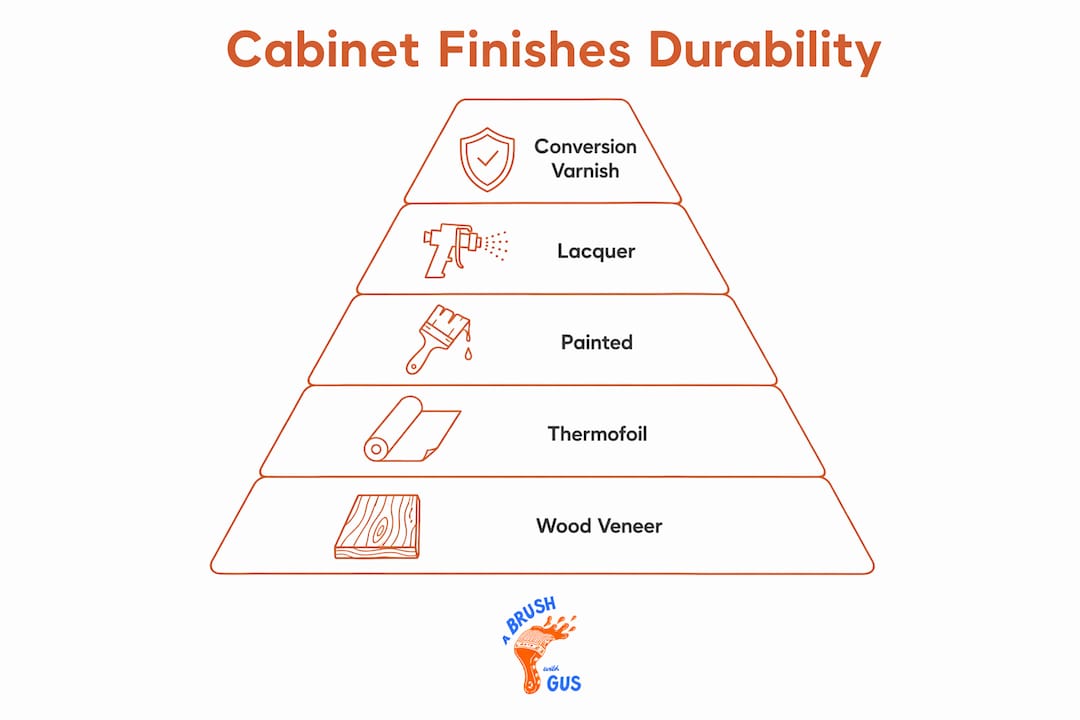
High-gloss lacquer reflects light intensely, making a kitchen feel larger and brighter. The trade-off is that every fingerprint, water splash, and minor scratch shows up clearly. Factory-applied conversion lacquer is the hardest variant on the market, mixed with a chemical hardener immediately before spraying to produce a coating that resists moisture, grease, and most household chemicals far better than site-painted alternatives.
Matt lacquer has surged in popularity across UK kitchens in 2026 for its velvety, understated appearance. It hides surface imperfections better than gloss, but fingerprints can still be visible, and it requires a gentler cleaning approach to avoid burnishing the surface.
Pros:
Extremely durable when factory-applied
Wide range of colours and sheen levels
Wipes clean easily on gloss variants
Cons:
High gloss shows fingerprints and scratches readily
Matt variants need careful, non-abrasive cleaning
Site-applied lacquer rarely matches factory quality
2. Painted finishes
Paint is the most versatile cabinet finish option, covering virtually any colour from crisp white to deep navy. MDF cabinets suit painted finishes particularly well because the material is dimensionally stable, meaning it does not expand and contract with humidity the way solid timber does, so the paint film is less likely to crack over time.
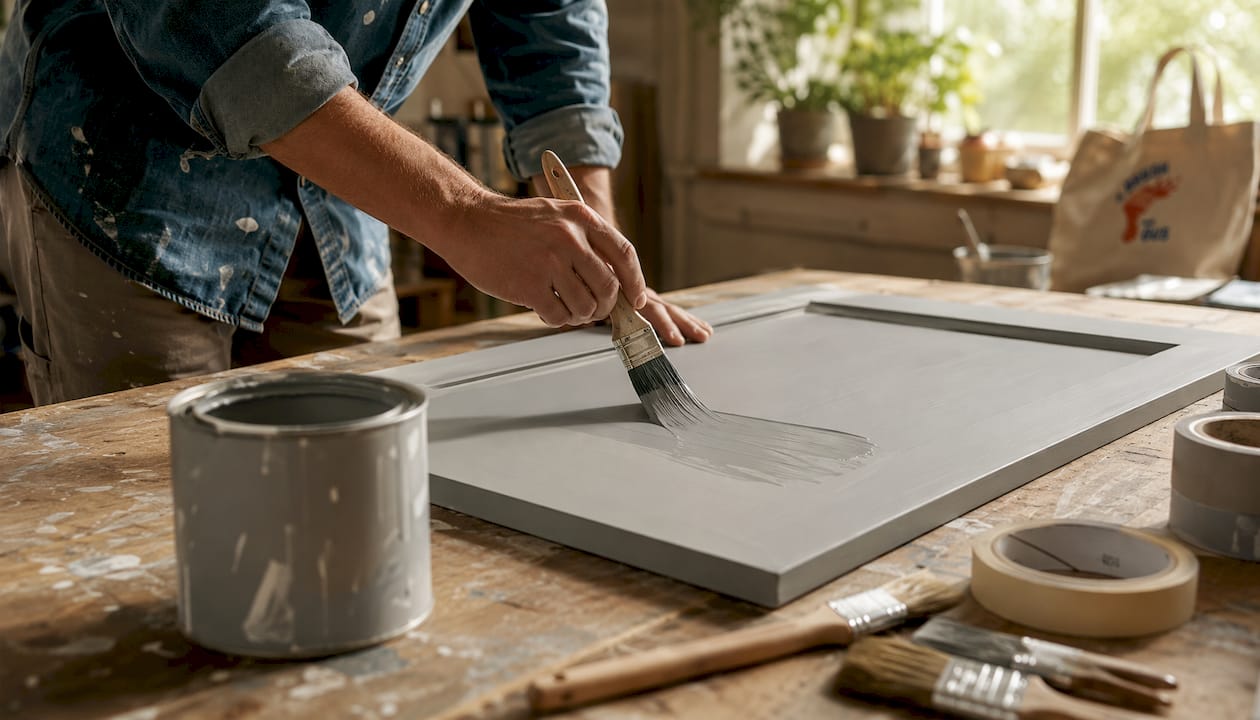
Sheen level matters as much as colour. Satin and eggshell sheens offer a practical middle ground: they reflect enough light to feel fresh without showing every mark the way high gloss does. Matte paint looks sophisticated but can be harder to wipe down without leaving dull patches.
Pros:
Limitless colour choice
Suits most kitchen styles from traditional to contemporary
Relatively straightforward to touch up or repaint
Cons:
Factory-painted finishes outperform site-painted ones in durability
Chipping can occur at door edges with heavy use
Matte sheens require gentle cleaning products
Pro Tip: If you are considering repainting existing cabinets rather than replacing them, read Abrushwithgus’s guide on repainting kitchen cabinets before committing to a colour or sheen.
3. Wood veneer finishes
A wood veneer is a thin slice of real timber, typically 0.5–2mm thick, bonded to an MDF or plywood substrate. You get the genuine grain, warmth, and character of natural wood without the cost or weight of solid timber throughout.
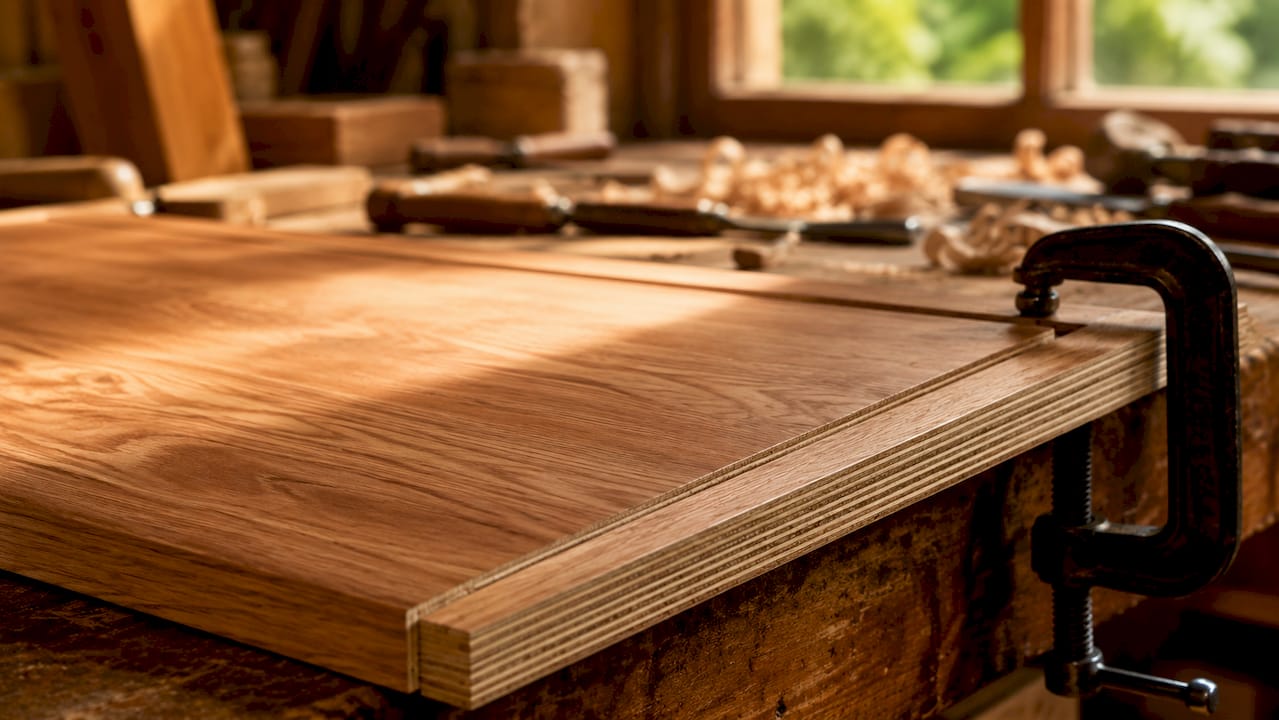
Veneer works particularly well on flat-panel, slab-style doors where the grain can be displayed without interruption. The substrate beneath keeps the panel stable, reducing the warping risk that affects solid wood in humid kitchens. Maintenance is similar to solid wood: avoid prolonged moisture contact and use a mild, damp cloth rather than abrasive cleaners.
Pros:
Authentic wood appearance at lower cost than solid timber
Good dimensional stability due to engineered substrate
Suits modern and Scandi-style kitchens well
Cons:
Cannot be sanded back as many times as solid wood
Delamination can occur if moisture penetrates edges
Repair is harder than with painted surfaces
4. Laminates (HPL)
High-pressure laminate, known as HPL, is made by bonding layers of resin-impregnated paper under intense heat and pressure. The result is a surface that withstands high-traffic impact and frequent cleaning with very high durability, making it one of the most practical choices for busy UK kitchens.
HPL is available in a wide range of colours, textures, and wood-effect prints. It does not require sealing or periodic oiling, and most marks wipe off with a damp cloth. The surface is resistant to scratches, heat, and most household chemicals, which is why it appears frequently in rental properties and family homes.
Pros:
Extremely durable and scratch-resistant
Very easy to clean
Wide range of finishes including realistic wood effects
Cons:
Edges can chip if struck hard
Repairs are difficult; damaged panels usually need replacing
Can look less premium than real veneer or lacquer
5. Thermofoil finishes
Thermofoil is heat-bonded vinyl applied over an MDF substrate. The vinyl wraps around the door profile under heat and pressure, creating a seamless surface with no visible joints. It offers medium durability and very easy maintenance, which makes it popular in family homes and rental properties.
The main vulnerability of thermofoil is heat. Placing it near a hob or a heat-generating appliance can cause the vinyl to peel away from the substrate over time. Once peeling starts, it is difficult to reverse without replacing the door entirely.
Pros:
Seamless, easy-to-clean surface
Budget-friendly
Good colour consistency
Cons:
Susceptible to heat damage and peeling near hobs
Limited repairability once delamination begins
Fewer design options than HPL or lacquer
6. Stained finishes
Stain is a semi-transparent coating that soaks into the wood fibres rather than sitting on top of them. The grain, knots, and natural character of the timber remain fully visible, which is the whole point. Stains range from light naturals like honey and wheat through to deep espresso and near-black tones.
Solid wood is the correct substrate for stained finishes. MDF does not absorb stain in the same way and produces a blotchy, uneven result. Once stained, cabinets are typically sealed with a clear topcoat such as varnish or polyurethane, which protects the wood with high durability while preserving the natural appearance.
Pros:
Showcases natural wood character
Forgiving of minor wear and scratches
Can be refreshed by re-staining and resealing
Cons:
Requires solid wood substrate
More maintenance than synthetic finishes
Colour options are limited compared to paint
7. Natural finishes: oils and waxes
Oils and waxes penetrate the wood surface rather than forming a film on top of it. Hardwax oils, in particular, have become a popular choice for UK kitchen cabinetry because they feed the wood fibres and leave a natural, tactile surface that does not look plastic or artificial.
The trade-off is maintenance. Oiled and waxed surfaces need periodic reapplication, typically once or twice a year depending on use, to keep the wood protected against moisture and staining. They are not well suited to households where the kitchen takes heavy daily punishment.
Pros:
Beautiful, natural appearance
Easy to spot-repair without refinishing the whole surface
Breathable finish that suits solid timber well
Cons:
Requires regular reapplication
Less resistant to water and grease than lacquer or HPL
Not suitable for MDF substrates
8. Glaze finishes
Glaze is not a standalone finish but an accent technique applied over a base coat of paint or stain. It sits within the profiles, grooves, and corners of a door, adding depth and highlighting architectural details in a way that a flat base coat cannot achieve on its own. The result reads as layered and considered rather than flat.
Glaze suits traditional and transitional kitchen styles particularly well. It is typically sealed with a clear topcoat after application, which gives it good durability and makes it easy to wipe clean.
9. Conversion varnish
Conversion varnish is a two-part catalysed coating that provides the hardest, most chemically resistant finish used in premium factory cabinet production. It is mixed with a hardener before spraying and cures to a surface that outperforms standard paints, lacquers, and single-part varnishes in resistance to moisture, grease, and abrasion.
Factory-finished cabinets using conversion varnish offer superior durability and moisture resistance compared to hand-painted finishes applied on site. For homeowners investing in a kitchen that needs to last a decade or more without significant refinishing, conversion varnish is the benchmark to look for.
How does your lifestyle affect which finish you should choose?
The most durable finish in the world is wasted if it does not suit how your household actually uses the kitchen. Busy families with children or pets need surfaces that can take daily knocks, frequent wiping, and the occasional splash without showing the damage.
Key lifestyle factors to consider:
High-traffic households: HPL laminate and factory-cured lacquers handle heavy use without chipping or peeling under normal conditions
Families with young children or pets: synthetic finishes resist staining and clean up quickly; pet-safe finish options are worth reviewing before you commit
Low-traffic or occasional-use kitchens: natural oils, waxes, and wood veneers are perfectly practical when the kitchen is not under constant pressure
Fingerprint concerns: satin and eggshell sheens hide marks far better than high gloss or very flat matt finishes
Cleaning habits: if you prefer a quick wipe rather than careful maintenance, thermofoil, HPL, and gloss lacquer are the most forgiving
Pro Tip: Matt finishes look stunning but require fingerprint-resistant formulations to stay practical. Ask your supplier specifically whether a matt finish has been treated for this before ordering.
What are the biggest kitchen cabinet finish trends in the UK for 2026?
Light-stained wood has become the most preferred cabinet finish in the UK, overtaking white as the dominant choice and reflecting a broader shift toward natural warmth in kitchen design. Woodgrain textures, warm neutrals, and tactile surfaces are shaping new kitchen installations across the country.
Matt finishes in deep, earthy tones are also prominent in 2026, valued for their sophisticated appearance. The practical caveat, noted by kitchen designers, is that matt surfaces need more careful cleaning than satin or semi-gloss equivalents.
White cabinetry remains timeless with strong mass appeal, but design expert Kylie Mawdsley advises letting the kitchen’s existing architecture dictate the finish colour rather than chasing trends. Choosing a trending colour without considering fixed elements like flooring, worktops, and wall tiles can result in a mismatched aesthetic that dates quickly.
Layering colours and mixing materials is another direction gaining traction: island units in a contrasting tone to wall cabinets, or a combination of painted uppers and wood-veneer lowers. This approach requires careful coordination but produces a kitchen that feels considered rather than catalogue-standard.
Expert advice from Abrushwithgus on getting your finish right
Choosing a finish is one decision; having it applied well is another. At Abrushwithgus, the team works with homeowners across the South West on cabinet respraying, painted finishes, and surface preparation, and the same practical points come up repeatedly.
The single biggest mistake homeowners make is choosing a finish based on how it looks in a showroom rather than how it will perform in their specific kitchen. A high-gloss white might look immaculate under showroom lighting, but in a north-facing kitchen with a busy family, it will show every mark within a week.
Pro Tip: Match your finish to the existing fixed elements first: flooring, worktops, and wall tiles. Once those are locked in, the cabinet finish should complement rather than compete. Abrushwithgus offers expert kitchen painting advice for homeowners planning a refresh.
Factory-applied finishes consistently outperform site-painted ones in longevity, but that does not mean a professionally resprayed cabinet cannot achieve excellent results. The key is proper surface preparation, the right primer for the substrate, and a finish coat suited to kitchen conditions. Abrushwithgus uses airless spraying techniques that produce a far smoother result than brush or roller application, reducing the risk of brush marks and uneven coverage.
How much do different cabinet finishes cost?
Cost varies considerably depending on whether you are buying new cabinets with a factory finish or refinishing existing ones. As a general guide for the UK market:
Finish type | Relative cost | Notes |
Thermofoil | Low | Budget-friendly; replacement cost rises if doors peel |
Melamine / laminate | Low to medium | Durable value option; wide availability |
Painted (site-applied) | Medium | Cost depends heavily on preparation quality |
HPL laminate | Medium | Higher upfront cost offset by low maintenance |
Wood veneer | Medium to high | Real wood character without solid timber pricing |
Lacquer (factory) | High | Conversion lacquer commands a premium |
Solid wood with stain | High | Timber cost plus finishing labour |
Natural oil or wax | Medium (ongoing) | Lower initial cost but recurring maintenance spend |
Respraying existing cabinets with Abrushwithgus’s kitchen spraying service is often the most cost-effective route to a fresh finish without the expense of full replacement.
What goes wrong with each finish, and can it be repaired?
Every finish has a characteristic failure mode. Knowing what to expect helps you plan maintenance and avoid costly surprises.
Painted finishes chip at door edges and corners with repeated impact. Touch-up paint can address small chips, but colour-matching an aged finish is difficult. A full respray is the cleanest solution when chipping becomes widespread.
Lacquer can yellow slightly over time, particularly solvent-based formulations in kitchens with poor ventilation. Scratches on gloss lacquer are visible and hard to spot-repair without leaving a patch. Factory conversion lacquer is the most resistant to both issues.
Wood veneer is vulnerable to moisture at the edges. Once the veneer lifts or bubbles, re-bonding is possible if caught early, but widespread delamination usually means door replacement.
Thermofoil peels near heat sources. There is no practical repair once peeling begins; the door needs replacing. Keeping thermofoil doors away from hobs and ovens extends their lifespan considerably.
HPL laminate chips at edges if struck hard. Individual panels can be replaced, but matching an existing colour after years of fading can be tricky.
Oiled and waxed finishes show water rings and staining if neglected. The good news is that spot-repair is straightforward: sand lightly and reapply oil or wax to the affected area.
Are some cabinet finishes better for the environment?
VOC (volatile organic compound) emissions are the primary environmental concern with cabinet finishes. Solvent-based lacquers and conventional paints release VOCs during application and curing, which affect indoor air quality and contribute to atmospheric pollution. Water-based lacquers and paints have significantly lower VOC content and are now the standard choice for environmentally conscious projects.
Hardwax oils derived from plant-based sources, such as linseed or sunflower oil, carry a lower environmental burden than synthetic coatings. They are biodegradable and free from the heavy solvents found in traditional varnishes.
When sourcing new cabinets, look for products certified to CARB Phase 2 (California Air Resources Board) or the European E1 standard for formaldehyde emissions from the substrate. MDF and plywood substrates vary in their formaldehyde content, and lower-emission boards make a meaningful difference to indoor air quality over the lifetime of the kitchen. Asking your supplier for certification documentation is a straightforward step that many homeowners overlook.
Key takeaways
The right kitchen cabinet finish balances aesthetics, durability, and the reality of how your household uses the space every day.
Point | Details |
Match finish to substrate | MDF suits painted finishes; solid wood is needed for stains and natural oils to show grain properly. |
Factory beats site for durability | Conversion varnish and factory-cured lacquers outperform hand-painted or site-applied finishes in longevity. |
Sheen level affects maintenance | Satin and eggshell sheens hide daily wear better than high gloss or very flat matt finishes. |
Lifestyle drives the decision | Busy households with children or pets should prioritise HPL laminate or factory-cured lacquers over delicate natural finishes. |
UK trends favour natural warmth | Light-stained wood has become the most preferred cabinet finish in the UK, overtaking white and reflecting a shift to natural warmth in kitchen design; matt tones and mixed materials are also prominent in 2026. |
Why the “best finish” question is the wrong starting point
Most homeowners approach a kitchen renovation by asking which finish looks best. The more useful question is which finish will still look good in seven years given how this particular household actually lives.
A high-gloss lacquer in a showroom is genuinely beautiful. In a kitchen used by two adults who cook twice a week and wipe surfaces immediately, it stays beautiful. In a kitchen with three children, a dog, and a hob that gets used twice a day, it becomes a daily source of frustration within months. The finish has not failed; the selection process has.
The trend toward light-stained wood and matt finishes in 2026 reflects something real: homeowners have grown tired of high-maintenance surfaces that demand constant attention. Natural textures and lower-sheen finishes are more forgiving of the imperfect conditions of real domestic life. That said, following a trend without checking whether it suits your kitchen’s fixed elements, flooring, worktops, and lighting, is how you end up with a kitchen that looks dated before the renovation is even finished.
The other point worth making is about factory versus site finishing. The gap in quality between a factory-applied conversion varnish and a brush-painted site finish is substantial. If you are investing in new cabinetry, the factory finish is worth the premium. If you are refreshing existing cabinets, a professionally applied respray using airless equipment and the right primer gets you far closer to factory quality than a DIY brush job ever will.
Spend time on the kitchen painting techniques before you pick up a brush, or better still, get a professional opinion on what your specific cabinets and kitchen conditions actually need.
Recommended
Comments