
Commercial property decorating guide: 2026 edition
- WM Creative Designs Limited
- Jun 27
- 9 min read

TL;DR:
Commercial property decorating involves designing interior enhancements that improve space appeal and function. Proper planning, including assessing space, selecting durable materials, and following design principles, is crucial for successful results. Staging spaces effectively can accelerate leasing and sales by showcasing their potential to prospects.
Commercial property decorating is the process of intentionally designing and executing interior enhancements that improve the look, feel, and utility of business spaces. Done well, it does far more than make a room look attractive. A well-executed commercial interior design guide approach can increase productivity by 20% and reduce physical discomfort by 85% when ergonomics, lighting, and acoustics are addressed together. This commercial property decorating guide covers every stage, from initial assessment through to finishing touches, so property owners and managers can make confident, cost-effective decisions.
What does a commercial property decorating guide actually cover?
Commercial interior design, the recognised industry term for this discipline, encompasses far more than paint colours and furniture choices. It includes spatial planning, compliance with building regulations, acoustic management, lighting hierarchy, and brand expression. The distinction matters because property owners who treat decorating as purely cosmetic consistently underinvest in the elements that drive real business outcomes. A CAT B fit-out, for example, transforms an empty shell into a fully branded, functional workspace by integrating FF&E (furniture, fixtures, and equipment), specialist IT and AV infrastructure, and final finishes such as paint and lighting. Understanding that scope from the outset prevents costly rework later.
What preparation do you need before decorating a commercial space?
Preparation is the stage most property owners rush, and it is where most budgets unravel. A structured assessment of the space, its function, and its occupants sets every subsequent decision on firm ground.
Assess the space and its function
Start by mapping the space against its intended use. A retail floor has different requirements from a law firm’s reception or a co-working hub. Identify traffic flow, natural light sources, acoustic challenges, and any compliance obligations under the Workplace (Health, Safety and Welfare) Regulations 1992. These regulations set minimum standards for lighting, temperature, and space per person, and they are non-negotiable.
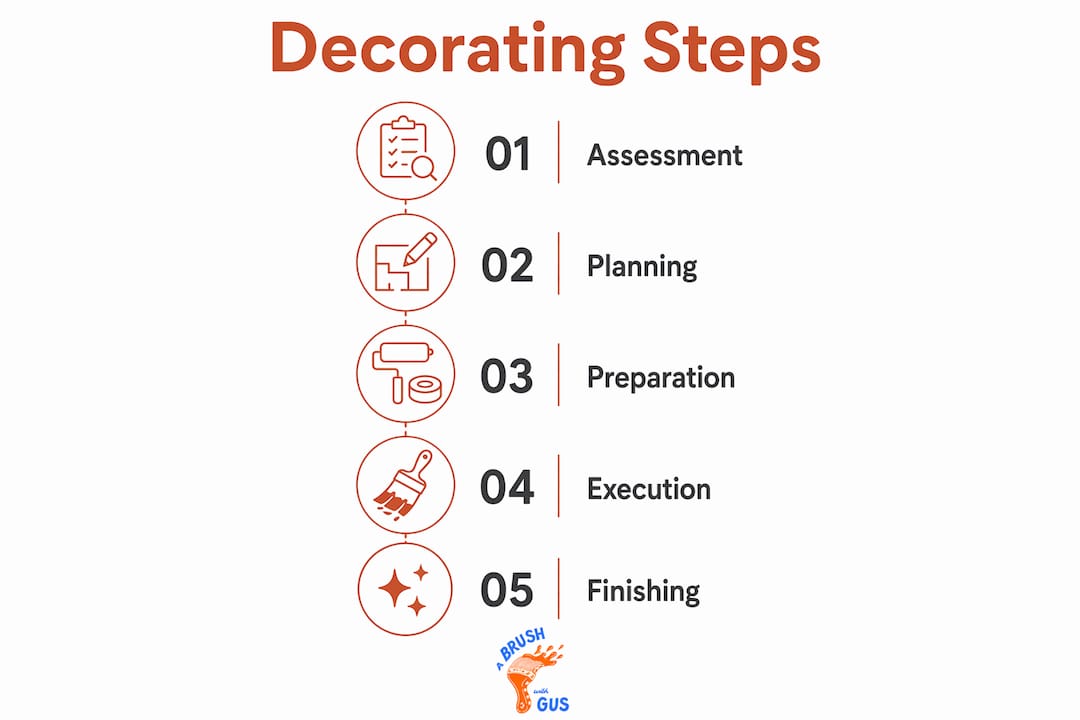
Build your checklist of tools and materials
A professional commercial decorating project requires the following before work begins:
Surface preparation materials: filler, sanding equipment, and appropriate primers for the substrate
Commercial-grade paints: scrubbable, low-VOC formulations rated for high-traffic use
Lighting fixtures: LED panels, task lamps, and accent fittings specified to workspace function
Ergonomic furniture: commercial-grade chairs with 8–12 year warranties, rated for 8+ hours of daily use, unlike residential alternatives
Acoustic panels: Class A absorbers for open-plan areas
Measurement and planning tools: floor plan software or scaled drawings
Budget and timeline planning
Project phase | Typical duration | Key cost drivers |
Assessment and planning | 1–2 weeks | Surveyor fees, floor plan drawings |
Surface preparation | 2–5 days | Extent of repairs, substrate condition |
Painting and finishes | 3–10 days | Square metreage, number of coats |
Furniture and lighting | 1–3 weeks | Lead times, installation complexity |
Snagging and sign-off | 2–3 days | Contractor availability |
Set a contingency of at least 15% above your quoted budget. Commercial projects regularly encounter hidden defects once surfaces are stripped back.
Which design principles should guide commercial property decorating?
The strongest commercial space styling ideas share a common foundation: they balance brand identity with occupant wellbeing, and aesthetics with durability.
Embed brand identity through colour and finish
Colour is the fastest way to communicate brand values without a single word. A financial services firm benefits from deep navy or slate tones that signal stability. A creative agency might use warm terracotta or bold accent walls to project energy. Choosing paint for businesses requires matching the psychological effect of a colour to the function of the room, not just the logo palette.

Apply lighting hierarchy across every zone
Workspace lighting standards recommend 300–500 lux for general lighting and 500–800 lux for focused task areas. Desk lamps work best positioned 16–24 inches above the surface at a 30–45 degree angle to eliminate glare. Cooler colour temperatures suit focused workstations; warmer tones foster comfort in lounges and breakout areas. Workstations placed within 15–20 feet of windows also help regulate occupants’ circadian rhythms, reducing afternoon fatigue.
Layer textures for visual depth
Flat, uniform surfaces reduce visual interest and make commercial spaces feel institutional rather than inviting. Intentional layering of upholstery fabrics, varied wall finishes, timber accents, and soft furnishings creates depth without visual noise. The goal is a curated feel, not a showroom.
Design for flexibility from day one
Adaptable interiors that cater to fluctuating workforce numbers are no longer optional. Hybrid working has made fixed, rigid layouts a liability. Modular furniture, moveable partitions, and multi-purpose zones allow a space to serve 20 people on a Monday and 60 on a Thursday without feeling either cramped or empty.
Pro Tip: Specify furniture on castors for breakout and meeting areas. It costs little extra at the point of purchase and gives you years of layout flexibility without additional spend.
How to decorate a commercial property: step-by-step
Step 1: Prepare all surfaces thoroughly
Surface preparation determines the quality of every finish that follows. Fill cracks, sand back flaking areas, and apply the correct primer for the substrate. Skipping this step is the single most common cause of premature paint failure in commercial environments. Detailed guidance on preparing commercial walls covers the specific techniques needed for different wall types.
Step 2: Apply commercial-grade paint and finishes
Residential paints are not built for commercial use. Specify scrubbable, low-VOC formulations that meet commercial durability standards. Sustainable, low-VOC materials improve indoor air quality and can boost employee productivity by 8–11%. That is a measurable return on a relatively modest upgrade in specification.
Step 3: Select furniture at the correct scale
Furniture scale is the detail most property owners get wrong. Oversized desks in a compact office make the room feel oppressive. Undersized seating in a large reception looks sparse and unwelcoming. Measure every zone and specify furniture to the floor plan, not to a catalogue photograph.
Step 4: Install lighting in sequence
Fit ambient lighting first, then task lighting, then accent. This sequence prevents over-specification of ambient fixtures, which is a common and expensive error. Use dimmer controls wherever possible to give occupants control over their immediate environment.
Step 5: Add biophilic elements and art
Plants, natural materials, and artwork are not decorative afterthoughts. Biophilic design, the practice of connecting interior spaces to natural elements, measurably reduces stress and improves concentration. Even a single living wall or a curated selection of framed prints shifts the atmosphere of a commercial space from functional to memorable.
Step 6: Consider architectural wrapping as an alternative
Architectural wrapping with high-quality vinyl films offers a cost-effective alternative to full renovation for doors, walls, and furniture. It produces minimal noise and dust, which matters enormously in occupied commercial buildings. For a reception desk refresh or a feature wall update, wrapping can deliver a high-end result at a fraction of the cost of replacement.
Pro Tip: When specifying paint for high-traffic corridors and stairwells, choose a sheen level of eggshell or satin rather than matt. These finishes withstand cleaning and scuffing far better, and they do not sacrifice the professional appearance you need.
What are the most common mistakes in commercial property decorating?
Avoiding these errors saves time, money, and the cost of remedial work.
Ignoring acoustics: Covering 50–60% of ceiling surfaces with Class A absorbers is the minimum requirement in open-plan spaces without suspended ceilings. Untreated echo destroys concentration and raises stress levels.
Mismatched furniture scale: Incorrectly scaled furniture degrades the perceived value of a space faster than almost any other single error.
Neglecting maintenance requirements: Specify materials you can actually maintain. A polished concrete floor looks excellent on day one and becomes a liability if the cleaning regime is not in place.
Skipping a detailed budget: Vague budgets produce vague results. Line-item every cost, including labour, materials, furniture, lighting, and contingency.
Choosing paint by aesthetics alone: Paint type must match the surface, the traffic level, and the cleaning frequency. Aesthetics come last in that hierarchy.
“The spaces that fail are almost always the ones where someone made a decision based on how something looked in a showroom rather than how it would perform in a busy commercial environment.”
How does commercial staging speed up leasing and sales?
Commercial staging is distinct from decorating. Decorating serves the occupant; staging serves the prospective tenant or buyer. The goal of staging is to present a space so clearly and attractively that viewers can immediately picture their business operating within it.
Professionally staged commercial spaces can lease or sell up to 73% faster than empty units. That figure reflects the power of helping viewers see potential rather than vacancy.
The five staging priorities for commercial properties are:
Reception: sets the first impression and signals the quality of the entire space
Lounge and breakout: demonstrates culture and comfort, which matters to talent-conscious tenants
Workstations: must show clear function and adequate scale for realistic team sizes
Meeting rooms: need a table, chairs, and a screen or whiteboard at minimum
Circulation routes: clear, uncluttered paths make a space feel larger and more professional
The best decorations for businesses in a staging context are neutral, durable, and scaled correctly. Avoid personal or highly branded items that make it harder for viewers to project their own identity onto the space.
Key takeaways
Effective commercial property decorating combines brand-aligned design, ergonomic planning, and durable materials to produce spaces that perform as well as they look.
Point | Details |
Prepare before you decorate | Assess function, compliance requirements, and surface condition before specifying any materials. |
Lighting hierarchy matters | Use 300–500 lux for general areas and 500–800 lux for task zones to meet workspace standards. |
Scale furniture to the floor plan | Incorrectly scaled furniture degrades perceived value faster than almost any other single error. |
Low-VOC paints deliver ROI | Sustainable, low-VOC finishes can improve productivity by 8–11% through better indoor air quality. |
Staging accelerates leasing | Professionally staged commercial spaces lease or sell up to 73% faster than empty units. |
What I have learned from commercial decorating projects in 2026
The biggest shift I have noticed is that property owners are finally treating decorating as a business decision rather than a cosmetic one. That is long overdue. When you frame a repaint or a furniture refresh in terms of lease-up speed or employee retention, the budget conversation changes entirely.
The projects that go wrong are almost always the ones where flexibility was not built in from the start. A client fits out a beautiful open-plan office with fixed desks and a rigid layout, and six months later their headcount changes. The space no longer works, and the cost of adapting it is significant. Modular thinking at the design stage costs almost nothing extra and saves a great deal later.
I am also seeing architectural wrapping used far more intelligently than before. It is not a cheap shortcut. In the right application, on a reception desk or a feature wall in an occupied building, it is genuinely the most sensible choice. Minimal disruption, fast turnaround, and a finish that looks deliberate rather than provisional.
The one thing I would push back on is the idea that biophilic design is a trend. Plants and natural materials in commercial spaces are not fashionable. They produce measurable results in wellbeing and concentration. Treat them as infrastructure, not decoration.
— Angus
How Abrushwithgus can support your commercial decorating project
Abrushwithgus provides professional painting and decorating services for commercial properties across the South West, with a track record of high-standard finishes delivered on time and with minimal disruption to your business.
Whether you need a full interior repaint, specialist surface preparation, or commercial spraying services for a durable, even finish across large areas, Abrushwithgus brings the expertise and commercial-grade materials your project requires. The team works around your schedule to keep downtime to a minimum. For sustainable finishes that meet low-VOC standards, the eco-friendly painting approach Abrushwithgus follows delivers both quality and compliance. Get in touch for a no-obligation quote.
FAQ
What is commercial property decorating?
Commercial property decorating is the planned process of improving the interior appearance and functionality of business spaces through paint, finishes, furniture, and lighting. It differs from residential decorating in its focus on durability, compliance, and brand expression.
How much does commercial interior decorating cost?
Costs vary significantly based on square metreage, surface condition, and specification level. A contingency of at least 15% above the quoted figure is advisable for any commercial project.
Does lighting really affect productivity in commercial spaces?
Workspace lighting standards recommend 300–500 lux for general areas and 500–800 lux for focused task zones. Correct lighting specification measurably reduces fatigue and supports concentration throughout the working day.
What paint finish is best for commercial walls?
Eggshell or satin finishes outperform matt in commercial environments because they withstand cleaning and everyday scuffing without losing their professional appearance. Low-VOC formulations are the preferred specification for occupied spaces.
How does commercial staging differ from decorating?
Decorating serves the current or future occupant; staging serves the prospective tenant or buyer by presenting the space as functional and attractive. Staged commercial properties lease or sell up to 73% faster than empty units.
Recommended
Comments