
How to paint skirting boards: a step-by-step guide
TL;DR:
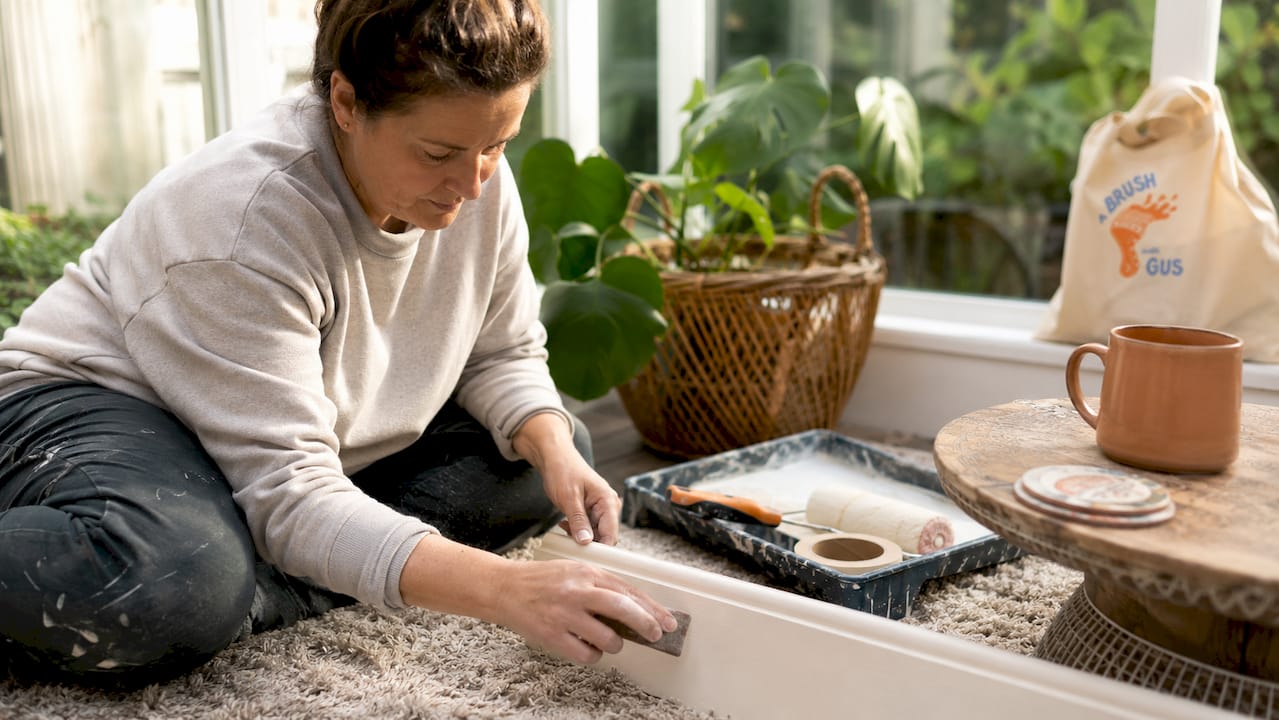
Proper preparation is essential for achieving a professional finish when painting skirting boards, including thorough cleaning, sanding, filling, and caulking. Using semi-gloss or water-based alkyd hybrid paints with thin, multiple coats and high-quality brushes ensures durability and a smooth appearance. Protecting carpets with plastic barriers and masking tape prevents stains, while maintenance involves gentle cleaning and timely touch-ups; for a hassle-free result, hiring professional painters like Abrushwithgus is a practical option.
Painting skirting boards to a professional standard is achievable for any DIY homeowner when you follow the right preparation, use quality tools, and apply paint in thin, controlled coats. The difference between a patchy, peeling result and a crisp, lasting finish almost always comes down to what happens before the brush touches the wood. This guide covers every stage of the process, from choosing the best paint for skirting boards to protecting your carpet and keeping the finish looking sharp for years. Whether you are renting or renovating, these skirting board painting tips will save you time and frustration.
What tools and materials do you need to paint skirting boards?
The right materials make the difference between a finish that lasts two years and one that lasts ten. Before you start any painting skirting boards tutorial, gather everything listed below so you are not stopping mid-job.
Paint type and finish
Semi-gloss paint is the top choice for skirting boards. It balances durability, cleanability, and a subtle sheen that suits most interiors. Full gloss is only worth using on perfectly smooth boards because it highlights every imperfection. Satin works in low-traffic areas but scuffs more easily than semi-gloss.
For paint brand, a water-based alkyd hybrid gives you the best of both worlds: the easy clean-up of a water-based product with the hardness of an oil-based finish. Sherwin-Williams Emerald Urethane is a strong choice, and recoat time drops to 4 hours compared to 16 hours for traditional alkyds like Benjamin Moore Advance. That speed matters when you are painting a whole room in a day.
Tools checklist
Angled sash brush: A 2-inch or 2.5-inch angled brush such as a Purdy Nylox or Wooster Shortcut gives you control along edges and tight corners.
Paint pail: Decant paint into a small pail rather than working from the tin. It is lighter and easier to handle.
Sandpaper: 120-grit for initial sanding, 220-grit for between coats.
Sugar soap or mild detergent: For cleaning the surface before you start.
Wood filler: For nail holes, dents, and cracks.
Decorator’s caulk: To seal the gap between skirting board and floor or wall.
Low-tack masking tape: For protecting wall edges and carpet.
Dust sheets and carpet protectors: To cover flooring during the job.
Paint shield: A thin metal or plastic blade, roughly 25 centimetres long, slid along the floor as you paint.
Shellac-based primer: For boards with tannin or resin staining.
Material | Purpose |
Semi-gloss or alkyd hybrid paint | Durable, cleanable finish suited to skirting boards |
Purdy Nylox or Wooster Shortcut brush | Precise cutting in along edges and corners |
Decorator’s caulk | Seals gaps, prevents moisture and draught penetration |
Shellac-based primer | Blocks tannin and resin bleed before topcoat |
120 and 220-grit sandpaper | Surface preparation and inter-coat smoothing |
Pro Tip: Buy a small foam roller alongside your brush. Rolling the flat face of wide skirting boards first, then tipping off with the brush, produces a noticeably smoother finish than brushing alone.
How to prep skirting boards before painting
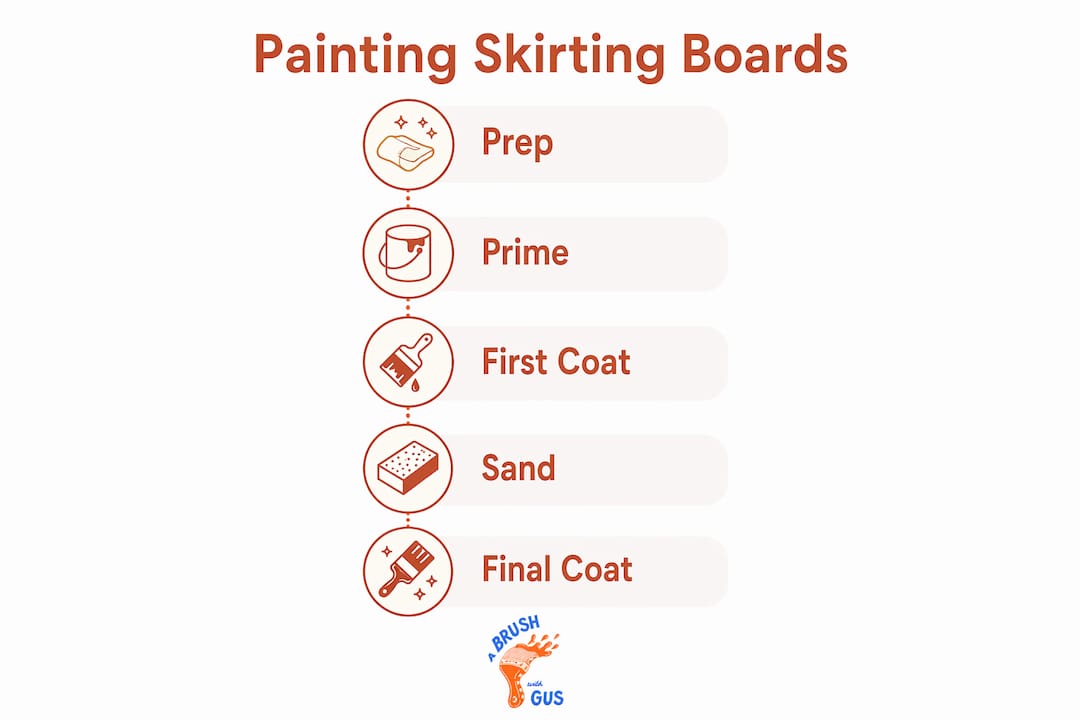
Preparation is where most DIY paint jobs either succeed or fail. Skipping even one step here leads to peeling, yellowing, or poor adhesion within months.
Clean the surface. Wipe down the skirting board with sugar soap diluted in warm water. This removes grease, dust, and any wax residue left from previous cleaning products. Rinse with clean water and allow to dry fully before moving on.
Sand lightly. Use 120-grit sandpaper to scuff the existing paint surface. You are not stripping the paint. You are creating a key for the new coat to grip. Sand with the grain, wipe away dust with a damp cloth, and allow to dry.
Fill holes and dents. Press wood filler into any nail holes, dents, or cracks with a flexible filling knife. Overfill slightly, allow to dry fully, then sand flush with 120-grit paper. Run your hand along the board to check for any remaining unevenness.
Treat tannin and resin stains. If your skirting boards show yellow or brown patches beneath the existing paint, this is tannin or resin bleed, not paint failure. Applying a standard primer over these patches will not stop them returning. Use a shellac-based stain-blocking primer such as Zinsser BIN, which creates a chemical barrier against the migration. Allow to cure fully before topcoating.
Apply decorator’s caulk. Run a thin bead of decorator’s caulk along the joint between the skirting board and the wall, and along the bottom edge where the board meets the floor. Moisture-wicked paint fails within 18 months if this gap is left open. Caulk cures in roughly 24 hours, so apply it the day before you paint.
Assess for moisture. Press your hand against the skirting board near external walls or below windows. Any cold or damp feeling suggests moisture in the wall. Painting over a damp surface guarantees early failure. Address the source of moisture before proceeding.
Pro Tip: After caulking, smooth the bead with a wet finger in one continuous stroke. This gives a neat, professional joint that takes paint cleanly without ridges or gaps.
How to paint skirting boards step by step
With prep complete, the painting process itself is straightforward. Professionals paint trim last, after ceilings and walls, so you can cut in cleanly against a set wall surface without worrying about damaging fresh skirting paint. Follow this sequence for the best result.
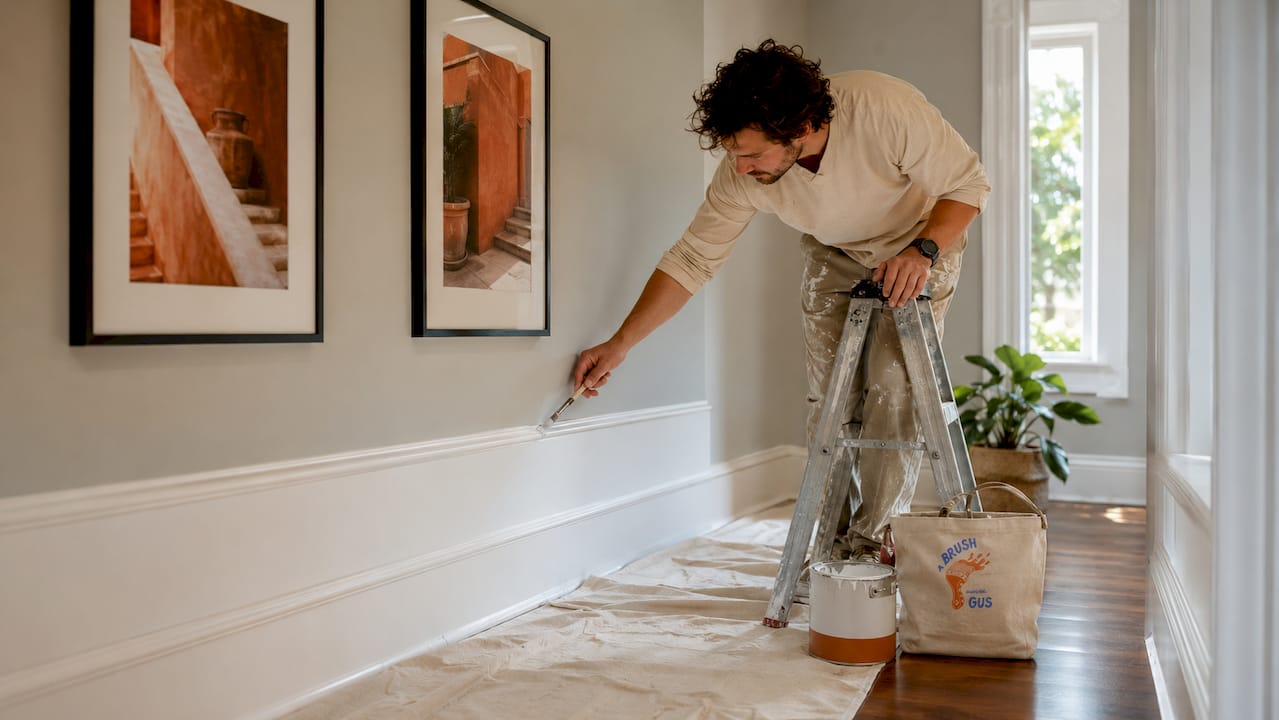
Protect the floor. Lay dust sheets across the floor and tuck carpet protectors or thin plastic sheeting into the gap beneath the skirting board edge. More on this in the next section.
Apply masking tape. Run low-tack tape along the wall edge above the skirting board. Press the tape edge firmly with your fingernail or a credit card to seal it completely. Any gap between tape and wall allows paint to bleed through, leaving a ragged line.
Load your brush correctly. Dip the bristles roughly one-third of the way into the paint. Tap the brush gently against the inside of the pail rather than wiping it on the rim. Wiping on the rim strips paint from the bristles and leads to choppy, uneven strokes.
Cut in the top edge first. Use the tip of your angled brush to paint a clean line along the top edge of the skirting board where it meets the wall. Work in sections of roughly 60 centimetres at a time to maintain a wet edge.
Paint the face of the board. Once the top edge is cut in, brush the main face of the board using long, smooth strokes in the direction of the wood grain. Keep the wet edge moving and avoid going back over sections that have started to dry.
Use a paint shield along the floor. Slide a paint shield along the floor as you paint the bottom edge. This catches any drips and keeps paint off hard floors or carpet. Wipe the shield clean every few passes.
Apply two to three thin coats. One thick coat looks uneven and takes far longer to dry. Two or three thin coats build a harder, more durable finish. With a fast-drying hybrid paint, you can apply the second coat the same day.
Sand lightly between coats. Once the first coat is fully dry, run 220-grit sandpaper lightly over the surface. This knocks back any dust nibs or brush marks and gives the next coat a better key. Wipe away dust before recoating.
Fix minor drips immediately by brushing them out while wet.
If a drip dries, sand it flat with 220-grit paper before applying the next coat.
Remove masking tape at a 45-degree angle while the final coat is still slightly tacky to avoid pulling dried paint with it.
Pro Tip: Experienced decorators often skip masking tape entirely. Using cutting in and back-cutting techniques with a steady hand and a quality angled brush produces sharper lines and saves significant prep time once you have practised the method.
How do you protect carpets when painting skirting boards?
Carpet protection is the part of skirting boards DIY painting that most guides underestimate. A single careless brushstroke can leave a permanent stain on carpet fibres.
Loosen the carpet edge. Use a filling knife or flat-bladed tool to gently press the carpet edge down and away from the skirting board. This creates a small gap you can work into.
Insert a physical barrier. Push carpet fibres down and slide a strip of thin plastic or a purpose-made carpet protector into the gap beneath the skirting board edge. This creates a physical shield that paint cannot soak through.
Apply low-tack tape. Once the barrier is in place, run a strip of low-tack masking tape along the top of the carpet edge for added protection.
Use a paint shield. Slide a paint shield along the floor as you paint the lower section of the board. The shield intercepts any drips or stray bristle marks before they reach the carpet.
Lay dust sheets. Cover the remaining floor area with dust sheets. Even with a shield in place, accidental spills happen.
Pro Tip: Work with a nearly dry brush along the very bottom edge of the skirting board. Load less paint than you think you need for this section. A dry-brush technique here gives you control without the risk of a loaded brush flicking paint onto carpet fibres.
How do you maintain painted skirting boards long term?
A well-painted skirting board in semi-gloss finish is easy to maintain. The goal is to keep it clean without abrading the surface.
Clean gently. Wipe down skirting boards with a damp cloth and a small amount of mild washing-up liquid. Avoid abrasive sponges or harsh chemical cleaners, which dull the finish over time.
Store leftover paint. Decant a small amount of your topcoat into a labelled, airtight jar. This is your touch-up supply. Stored correctly in a cool, dry place, water-based paints remain usable for two to three years.
Feather touch-ups. For small chips, apply a tiny amount of paint with a fine artist’s brush. Blend the edges outward with a light, feathering stroke so the repair does not leave a visible patch.
Know when to repaint. Widespread scuffing, yellowing, or chipping across multiple boards means a full repaint is more efficient than repeated touch-ups. A full repaint every five to seven years is typical for high-traffic areas.
Choose the right finish for the room. Semi-gloss holds up well in hallways and living rooms. For bathrooms or kitchens, consider a full gloss or specialist moisture-resistant trim paint to handle humidity without peeling.
Key takeaways
Painting skirting boards to a professional standard requires thorough preparation, the right semi-gloss or alkyd hybrid paint, and multiple thin coats applied with a quality angled brush.
Point | Details |
Prep determines the outcome | Clean, sand, fill, and caulk before any paint touches the board. |
Semi-gloss is the correct finish | It resists scuffs, cleans easily, and suits most rooms without highlighting imperfections. |
Treat stains before priming | Shellac-based primer blocks tannin and resin bleed that standard primers cannot stop. |
Thin coats outperform thick ones | Two to three thin coats produce a harder, smoother finish than one heavy application. |
Protect carpet with a physical barrier | Insert plastic sheeting beneath the skirting board edge before you start painting. |
What I have learned from years of painting skirting boards
Most DIY guides tell you to use masking tape and leave it at that. In my experience, tape is a crutch that creates as many problems as it solves. If the edge is not pressed down perfectly, paint bleeds under it. If you pull it off too late, it lifts the new paint with it. The real skill in painting skirting boards is brush control. A Purdy Nylox or Wooster Shortcut brush, loaded correctly and held at the right angle, will give you a cleaner line than tape every time once you have put in a bit of practice.
The other thing I see go wrong repeatedly is moisture. Homeowners paint over damp skirting boards near external walls or under windows, and within a year the paint is yellowing and peeling. The paint is not the problem. The moisture is. Caulk that gap at the bottom, check for cold spots on the wall, and deal with any dampness before you open a tin.
My honest recommendation for finish is semi-gloss in a water-based alkyd hybrid. It dries quickly, cleans up with water, and hardens to a finish that takes real punishment in hallways and living rooms. For painting techniques that go beyond skirting boards, the same principles of thin coats, proper prep, and quality brushes apply throughout the home.
— Angus
Want a professional finish without the effort?
If you have read this far and decided you would rather hand the job to someone who does this every day, Abrushwithgus is here to help. Based in the South West, Gus and Rhys offer a full range of domestic painting services covering skirting boards, interior trim, walls, and ceilings. Every job is approached with the same prep-first mindset described in this guide, which is why their finishes last.

Whether you are refreshing a single room or redecorating an entire property, the team at Abrushwithgus delivers clean, durable results without the mess or guesswork. Get in touch for a no-obligation quote and see what a professional finish actually looks like.
FAQ
What is the best paint for skirting boards?
Semi-gloss or a water-based alkyd hybrid is the best choice for skirting boards. These finishes resist scuffs, clean easily, and dry harder than standard emulsion or satin paints.
How many coats of paint do skirting boards need?
Two to three thin coats produce the most durable finish. Sand lightly with 220-grit paper between coats to remove dust nibs and improve adhesion.
Why do white skirting boards turn yellow?
Yellowing is caused by tannin or resin migrating through the paint, not by the paint wearing out. Apply a shellac-based stain-blocking primer such as Zinsser BIN before repainting to stop the bleed permanently.
Do I need to sand skirting boards before painting?
Yes. A light sand with 120-grit paper creates a key for the new paint to grip. Without it, the topcoat is far more likely to peel or chip within the first year.
How do I stop paint getting on my carpet?
Insert a strip of thin plastic or a carpet protector beneath the skirting board edge before painting, then use a paint shield slid along the floor as you work. Low-tack masking tape along the carpet edge adds a further layer of protection.
Recommended
Comments