
What is trade certified painting? A homeowner's guide

TL;DR:
Trade certified painting is a voluntary industry credential that verifies a painter’s technical skills and adherence to quality standards beyond legal licensing. It serves as a reliable indicator of professionalism and reduces project risks, especially in commercial or lead-safe work, by confirming ongoing competence. Verifying credentials through official registers and requesting original documents ensures homeowners and property managers choose qualified, accountable contractors.
Trade certified painting is a voluntary professional credential that proves a painter’s technical competence and commitment to recognised industry standards, going well beyond the legal minimum of holding a contractor’s licence. For homeowners and property managers in the UK and beyond, understanding this distinction is the single most useful filter when choosing who to trust with your property. Bodies such as the Painting and Decorating Association (PDA) in the UK and the Painting and Decorating Contractors of America (PDCA) in the US award these credentials to painters who meet documented skill thresholds. Hiring a trade certified painter means you are not simply relying on someone’s word. You are relying on verified evidence.
What is trade certified painting and how does it work?
Trade certified painting refers to a formal recognition awarded by an industry body to painters who demonstrate technical proficiency, safety awareness, and adherence to published quality standards. The term is descriptive rather than a single regulated title. In practice, it covers credentials such as the PDCA’s Certified Painting Contractor (CPC) designation, the UK’s NVQ Level 2 in Painting and Decorating, and membership categories within the PDA that require proof of competence.

Certification verifies skills and adherence to quality standards such as the PDCA P-Series, while a licence is simply a legal permission to trade. This matters because a painter can hold a valid licence without ever having passed a skills assessment. Conversely, a certified painter has had their workmanship, knowledge, and processes independently evaluated.
The trade certification painting process typically involves submitting documented work experience, passing a written or practical examination, and agreeing to abide by a professional code of conduct. Ongoing renewal requirements mean certified painters must keep their knowledge current, which is why technical mastery through certification is driving the painting trade towards lifelong learning rather than treating the craft as purely manual labour.
How does trade certification differ from a painting licence?
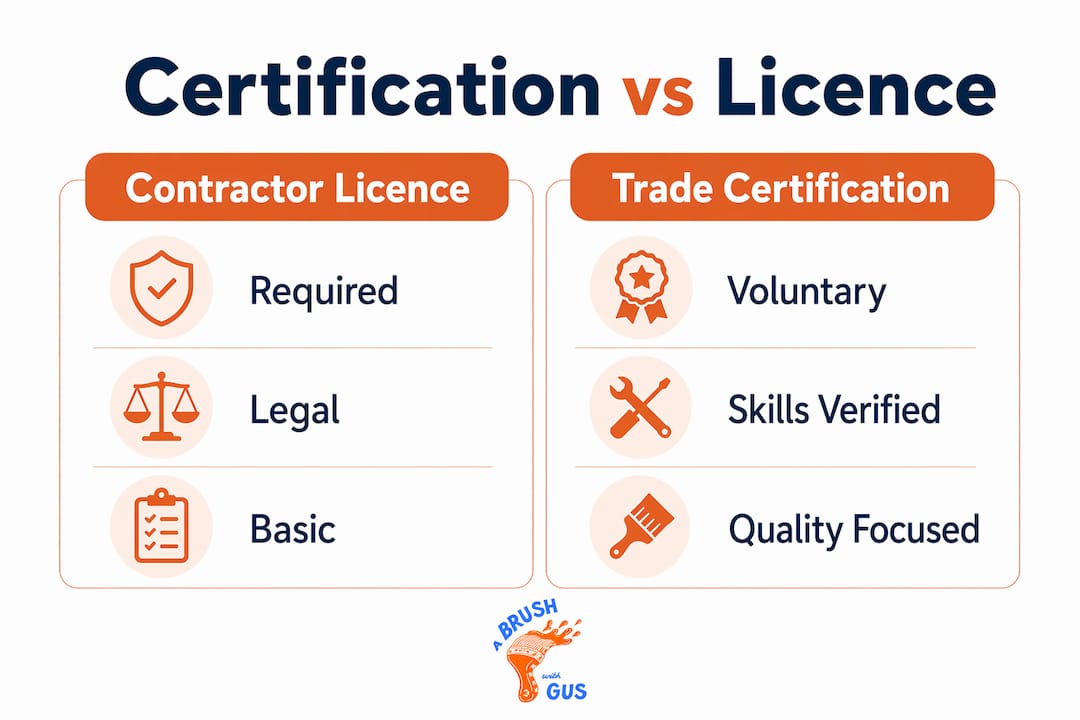
The confusion between certification and licensing is the most common misunderstanding homeowners bring to this topic. A contractor’s licence is a legal requirement issued by a local authority or government body. Without it, a painter cannot legally operate. Certification is entirely separate. It is a voluntary credential that signals professional excellence rather than basic legal compliance.
Feature | Contractor licence | Trade certification |
Required by law | Yes, in most jurisdictions | No, voluntary |
Issued by | Government or local authority | Industry body (e.g. PDCA, PDA) |
Proves | Legal right to trade | Technical skill and quality standards |
Renewal | Varies by jurisdiction | Typically every 1 to 5 years |
Can appear in contracts | Rarely specified | Frequently written into commercial bids |
Certifications are often written into bids and contracts, giving them contractual force that a licence alone does not carry. This is particularly relevant for property managers overseeing commercial refurbishments, where procurement teams routinely specify certification as a condition of tender.
Pro Tip: Ask any painter you are considering to show you both their licence and their certification separately. If they present only one document and claim it covers both, that is a red flag worth investigating before you sign anything.
In the UK, the NVQ Level 2 in Painting and Decorating combined with a CSCS Blue Skilled Worker card represents the industry benchmark for commercial sites. The CSCS card costs approximately £36 and is valid for five years, requiring a health and safety test. Neither is legally mandatory for domestic work, but both are frequently required on managed commercial sites and housing association contracts.
What are the benefits of hiring trade certified painters?
The benefits of trade certified painting extend well beyond a framed certificate on a van door. Certified painters follow workmanship standards that exceed typical expectations, reducing the likelihood of peeling, poor adhesion, and premature colour fade. For a homeowner investing in an exterior repaint or a property manager maintaining a portfolio of rental properties, that reliability has direct financial value.
The core advantages break down as follows:
Quality assurance. Certified painters work to published standards such as the PDCA P-Series, which specify surface preparation, coating thickness, and finish criteria. Cutting corners on surface preparation is the leading cause of paint failure, and certified painters are assessed on exactly this.
Risk reduction. Professional painters maintain liability insurance and follow safety protocols. Insurance and OSHA compliance are standard for certified contractors, protecting you from costs if something goes wrong on site.
Lead-safe compliance. On properties built before 1978, disturbing painted surfaces carries a legal obligation in many jurisdictions. Certified painters understand these requirements and can demonstrate compliance.
Warranty and accountability. Many certified contractors offer written workmanship warranties, which uncertified painters rarely provide.
Professionalism. Certified painters are more likely to provide detailed written quotes, stick to agreed timelines, and communicate clearly throughout a project.
“Certified painters act as quality trust signals for property owners, distinguishing competent contractors from unlicensed or uncertified ones and improving project outcomes and satisfaction.” — National Painting Authority
The importance of certified painters becomes clearest when something goes wrong. An uncertified painter who causes damage to a listed building or fails to follow lead-safe procedures leaves the property owner exposed. A certified painter carries the accountability that comes with a professional body looking over their shoulder.
How to get trade certification in painting
The pathway to trade certification varies by country and credential, but the underlying structure is consistent. Here is how the process typically works for painters seeking recognised status:
Accumulate documented experience. Most certifying bodies require a minimum number of years working in the trade, backed by references or employment records. The PDCA CPC credential, for example, requires experience and a proficiency exam before any application is considered.
Complete formal training or an NVQ. In the UK, the NVQ Level 2 in Painting and Decorating involves workplace assessments and written tests covering colour theory, surface preparation, and application techniques. City and Guilds qualifications follow a similar structure.
Pass a health and safety assessment. For the CSCS Blue card in the UK, painters must pass the CITB Health, Safety and Environment test. This is non-negotiable for working on managed commercial sites.
Apply to the relevant certifying body. Submit documentation, pay the application fee, and in some cases attend an interview or practical assessment. The PDA in the UK and the PDCA in the US both maintain public registers of certified members.
Meet lead-safe requirements where applicable. In the US, the EPA’s Renovation, Repair and Painting Rule requires firm certification for lead-safe work on pre-1978 homes where work disturbs more than six square feet of interior surface or twenty square feet of exterior surface.
Renew credentials on schedule. Certification is not a one-time achievement. Renewal typically requires evidence of continuing professional development and, in some cases, re-examination.
Pro Tip: If you are a homeowner rather than a painter, this list gives you a precise checklist to use when interviewing contractors. Ask which of these steps they have completed and request documentation for each one.
Common misconceptions about certification and legal requirements
The most damaging misconception is that certification replaces legal licensing. It does not. A painter can be certified without a licence and vice versa. The two credentials serve entirely different purposes and neither substitutes for the other in legal terms.
Several other misunderstandings regularly catch homeowners out:
“Any qualified painter can work on my older property.” Not necessarily. In the US, the EPA RRP Rule makes firm certification a legal requirement for work on pre-1978 homes above set surface thresholds. Ignoring this exposes both the contractor and the property owner to significant penalties.
“Certification is only relevant for large commercial projects.” Certification matters on domestic projects too, particularly for exterior work, lead paint remediation, and specialist finishes such as UPVC spraying.
“A long trading history equals certification.” Years of experience do not confer certification. A painter who has been trading for twenty years without formal assessment has not been certified.
“Certification is just a marketing tool.” In commercial contracts, certification is frequently a contractual obligation. Failing to meet it can void a contract or trigger penalty clauses.
Understanding these distinctions protects you legally and financially. The importance of certified painters is not abstract. It is the difference between a project that meets compliance requirements and one that creates liability.
How to verify a painter’s credentials before hiring
Verification is straightforward if you know where to look. Do not rely solely on what a painter tells you during a sales conversation.
Check the PDA’s online member directory for UK painters, or the PDCA’s member search for US contractors. Both registries are publicly accessible and confirm active membership status.
Ask to see the original certification document, not a photocopy. Check the issuing body, the date of issue, and the renewal date.
Request proof of public liability insurance and, where relevant, employer’s liability insurance. A reputable painter will provide these without hesitation.
Ask for references from projects of a similar type and scale to yours. A painter with strong professional painting techniques will have a portfolio of comparable work.
Review the contract carefully. Certification and licence numbers should appear in writing, along with the scope of work, materials specified, and warranty terms.
Verifying credentials through official registries mitigates risk and confirms compliance with both quality and legal requirements. Property managers overseeing multiple sites should build this verification into their standard procurement process rather than treating it as optional.
Pro Tip: Search the certifying body’s website directly rather than clicking links provided by the painter. This removes any possibility of being shown a forged or outdated document.
Key takeaways
Trade certified painting is the most reliable way to confirm a painter’s technical competence, safety compliance, and commitment to quality standards before a single brush touches your property.
Point | Details |
Certification is voluntary, not legal | Trade certification proves skill; a contractor’s licence proves legal permission to trade. Both are needed. |
UK benchmark credentials | NVQ Level 2 plus a CSCS Blue card are the standard for commercial painting work in the UK. |
Lead-safe rules carry legal weight | Work on pre-1978 properties above set surface areas requires EPA firm certification in the US. |
Verification is your responsibility | Check certifying body registries directly and request original documents before hiring. |
Certification appears in contracts | On commercial projects, certification is frequently a contractual condition, not just a quality preference. |
Why I think certification is the most underused filter in the South West
From years of working on residential and commercial properties across the South West, I have seen the same pattern repeat itself. A homeowner chooses a painter based on a competitive quote and a friendly manner, skips the credential check, and ends up with a finish that fails within eighteen months. The repainting cost always exceeds what they would have paid for a certified contractor in the first place.
What surprises me is how rarely homeowners ask about certification unprompted. Most people ask about price, availability, and whether the painter can match a colour. Almost nobody asks to see a CSCS card or asks which professional body the painter belongs to. That gap is closing, and I think it is because more property managers are bringing commercial procurement habits into domestic projects, which is genuinely good for the industry.
The trend I find most interesting is the move towards lifelong credentialing. Certification is no longer a box you tick once. The best painters I know treat it as an ongoing commitment to their craft, taking refresher courses and staying current with new materials and application methods. That attitude shows in the quality of their finished work in ways that are visible to any informed eye.
My advice is simple. Before you hire anyone for a significant painting project, ask three questions: Are you certified, by whom, and can I verify it today? The answer tells you everything you need to know.
— Angus
Certified painting services from Abrushwithgus

Abrushwithgus is a family-run painting and decorating business serving homeowners and property managers across the South West of the UK. Brothers Gus and Rhys bring professional standards to every project, from full exterior home painting to specialist airless spraying services for complex surfaces. Every job is approached with the same commitment to preparation, quality materials, and a finish that lasts. If you are looking for a reliable, professional team that takes certification and compliance seriously, get in touch with Abrushwithgus for a no-obligation quote. The portfolio of client reviews on the website reflects the standard you can expect on your own property.
FAQ
What does trade certified painting mean?
Trade certified painting refers to a voluntary professional credential awarded by an industry body such as the PDCA or PDA, confirming that a painter meets documented standards of technical skill, safety awareness, and workmanship quality. It is separate from and additional to any legal contractor’s licence.
Is trade certification a legal requirement for painters in the UK?
In the UK, trade certification such as the NVQ Level 2 or CSCS Blue card is not legally mandatory for domestic painting work, but it is frequently required on commercial sites and housing association contracts. It is a strong indicator of professional competence regardless of legal obligation.
How can I check if a painter is trade certified?
Check the relevant certifying body’s online member directory directly. In the UK, the PDA maintains a public register. Ask the painter for their original certification document and confirm the issuing body and renewal date before agreeing to any contract.
Does certification cover lead-safe painting work?
In the US, the EPA RRP Rule requires specific firm certification for work on pre-1978 homes where painted surfaces above set thresholds are disturbed. Standard trade certification does not automatically cover this. Always ask specifically about lead-safe credentials for older properties.
Can a painter be certified but not licensed?
Yes. Certification and licensing are entirely separate credentials. A painter can hold one without the other. For legal compliance and quality assurance, you should confirm that your contractor holds both the appropriate licence for your jurisdiction and a recognised trade certification.
Recommended
Comments