
Essential painting safety tips for businesses in 2026
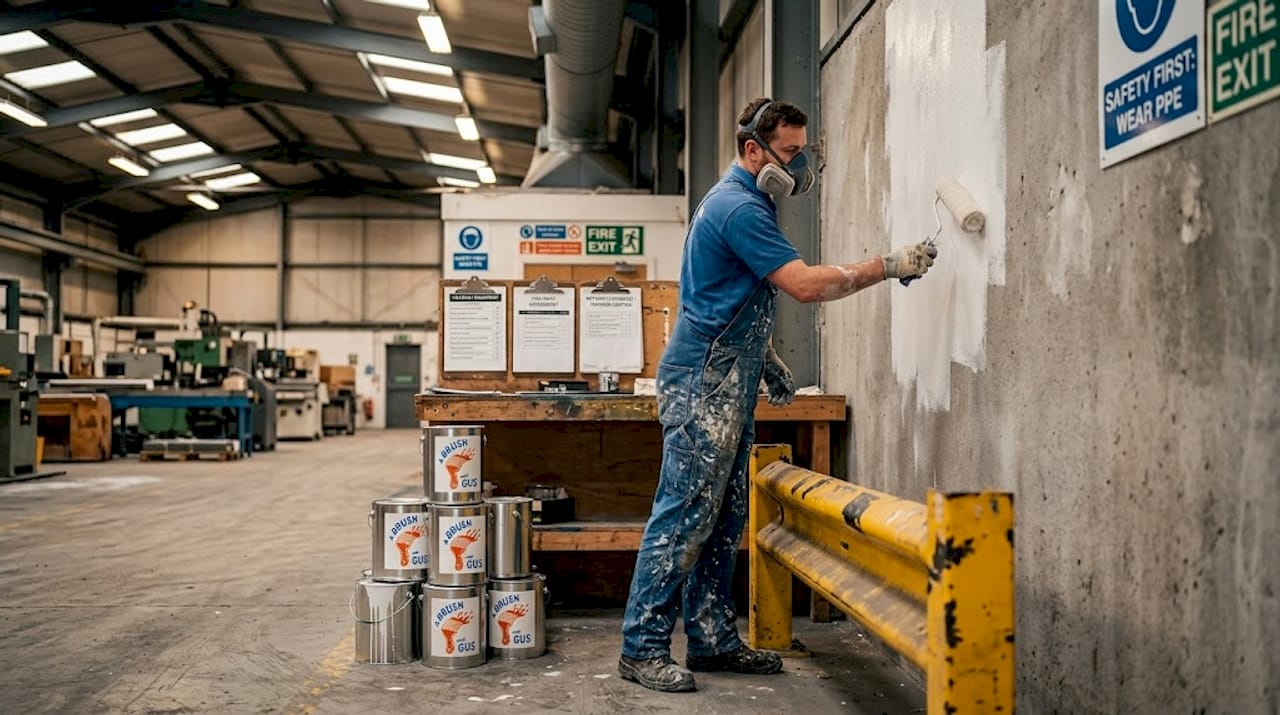
TL;DR:
Proper risk controls and ventilation are essential to prevent health and legal risks in commercial painting.
Spray painting, especially with high-risk paints like isocyanates, requires strict safety measures and training.
Relying solely on PPE is insufficient; elimination, substitution, and engineering controls provide more effective safety.
Balancing a quality paint finish with legal safety obligations is harder than most business owners in the South West expect. The moment spraying equipment enters the picture, or a worker climbs a ladder to reach a high wall, the complexity multiplies fast. Get the controls wrong and you are not just risking fines from the Health and Safety Executive (HSE); you are putting real people at genuine risk of lasting respiratory damage or serious injury. This guide cuts through the confusion, drawing on HSE guidance and practical field experience to give you a clear, workable framework for safe, compliant painting in a business environment.
Table of Contents
Key Takeaways
Point | Details |
Do not rely on PPE alone | Use engineering controls and safer methods before turning to personal protective equipment. |
Know the paint risks | Isocyanates and solvents often require stricter controls, air-fed respirators, and exclusion procedures. |
Ventilation is vital | Always assess and optimise ventilation to avoid high airborne paint exposure. |
Ladder safety myths | Ladders can be used but only for suitable tasks—avoid using them for extended high-risk painting. |
What makes painting risky for businesses?
Most business owners picture painting as a low-risk trade task. Grab a roller, open a tin, and crack on. The reality for commercial environments is very different, and underestimating the hazards is where most compliance failures begin.
Chemical exposure is the first serious concern. Solvent-based coatings, primers, and specialist finishes all release volatile organic compounds (VOCs) into the air as they are applied and as they cure. Painters breathing these fumes repeatedly over time can develop occupational asthma, serious lung conditions, and skin sensitisation. These are not hypothetical risks; they are well-documented in HSE incident records from construction and maintenance settings across the UK.
Ventilation makes a dramatic difference to the level of risk. A large, draughty warehouse is a fundamentally different environment to a small storeroom with one window. Poor air flow allows solvent vapours to accumulate to dangerous concentrations, and in enclosed spaces this can become a fire risk as well as a health one. Checking ventilation before any painting begins is not optional; it is a legal duty under the Control of Substances Hazardous to Health (COSHH) Regulations 2002.
Application method changes everything. Rolling or brushing paint onto a surface produces relatively limited airborne contamination. Spraying is an entirely different matter. As the HSE makes clear, spraying solvent products can create very high airborne exposure, especially in enclosed spaces. The tiny paint particles produced by airless or conventional spray equipment remain suspended in the air for far longer than most people realise, and they travel further than you would expect.
Understanding professional painting techniques helps business owners have more informed conversations with contractors about which methods are appropriate for their site. Equally, choosing the right commercial paint can itself reduce risk before a brush or spray gun is even picked up.
Key risk factors in business painting include:
Solvents and chemical-based coatings causing respiratory illness with repeated exposure
Inadequate ventilation allowing vapour concentrations to reach dangerous levels
Spray application dramatically increasing airborne particle exposure
Skin contact with sensitising agents leading to dermatitis or allergic reactions
Ignition risks from flammable solvent vapours in poorly ventilated rooms
“PPE is only ever the last line of defence. Businesses that plan their painting projects around PPE rather than around eliminating and controlling risks at source are already in a vulnerable legal position.”
Key safety strategies: From safer methods to proper controls
Once you understand where the risks originate, you can build a control strategy that actually holds up. HSE uses a framework called the hierarchy of controls, and it is the right starting point for any business painting project.
The hierarchy works from most effective to least effective:
Eliminate the hazard entirely. Can the task be done without painting at all, or can you choose a pre-finished product?
Substitute with a lower-risk product. Water-based coatings instead of solvent-based ones, for example.
Engineer controls into the process. Local exhaust ventilation (LEV) systems that capture fumes at the source are far more effective than relying on open windows.
Administer safer working procedures. Restrict access during spraying, rotate workers to limit exposure time, schedule work during unoccupied hours.
PPE as the final layer. Masks, gloves, and eye protection are important but should never be the primary strategy.
As the HSE emphasises, choosing safer methods and controls based on actual risk assessment is central to compliance, particularly when spraying solvents.
The reason engineered controls like LEV so often outperform respiratory protective equipment (RPE) is consistency. An LEV system removes contaminated air continuously, regardless of whether a worker’s mask fits perfectly that day. RPE depends on correct fitting, correct maintenance, and correct use every single time. That is a lot of human variables in a busy commercial environment.
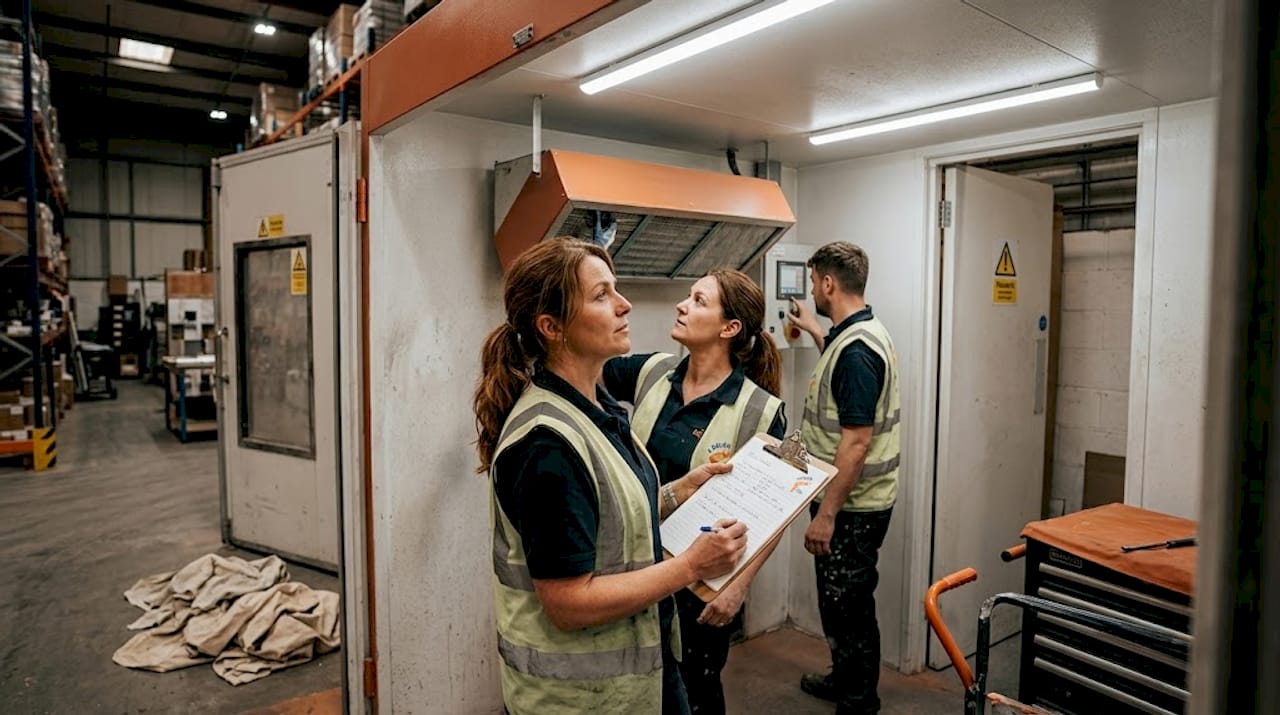
Understanding the full range of spraying methods and their implications helps you and your contractors choose application approaches that match your site’s ventilation capacity and your team’s capabilities.
Control type | Effectiveness | Depends on human behaviour? | Example |
Elimination | Highest | No | Remove the need for painting |
Substitution | High | Minimal | Water-based instead of solvent-based |
Engineering (LEV) | High | Minimal | Extraction fan at the spray area |
Administrative | Moderate | Yes | Limiting hours of exposure |
PPE | Lowest | Fully | Respirator mask |
Pro Tip: Never design your safety plan around PPE first. If your COSHH risk assessment does not show why elimination, substitution, and engineering controls were considered and either implemented or ruled out with good reason, you may be non-compliant even if every worker is wearing a mask.
Special focus: Isocyanate and high-risk paint spraying
Not all paints carry the same level of risk. At the serious end of the spectrum sit isocyanate-containing coatings, which are used in certain industrial and protective paint systems. If your business commissions this type of work, the legal requirements go well beyond what applies to standard decorating.
Isocyanates are one of the leading causes of occupational asthma in the UK. Once a person becomes sensitised to isocyanates, even tiny concentrations can trigger a severe asthmatic response. There is no reversing sensitisation. This is why HSE’s requirements for working with these materials are so strict and so non-negotiable.
When spraying isocyanates, HSE guidance is explicit: air-fed breathing apparatus is required, all non-essential people must be kept away from the area, and the very high drift risk must be actively managed. A standard dust or paint mask is not sufficient. Filtering respirators alone are simply not suitable for isocyanate paints, meaning that businesses using contractors who arrive with filtering masks for this type of work should stop them immediately and question their competence.
Practical requirements when isocyanate spraying is involved:
Air-fed RPE (respiratory protective equipment) for all operatives in the area
Enclosure of the spray zone to prevent drift
Exclusion of all non-essential personnel from the immediate and adjacent areas
Regular air quality checks before re-entry is permitted
Operatives trained specifically in isocyanate hazards and RPE use
Written COSHH assessment that specifically names the isocyanate product
For business owners, the practical implication is straightforward. Before engaging any contractor for specialist coatings work, ask to see their COSHH assessment, their RPE maintenance records, and evidence of relevant training. A reputable contractor should have this documentation ready without hesitation. Following the step-by-step painting process expected of a professional helps ensure nothing is overlooked.
Risk level | Paint type | Minimum RPE required | Exclusion zone needed? |
Low | Water-based emulsion | None in ventilated space | No |
Medium | Solvent-based gloss | Half-face filtering mask (P3) | Restrict access |
High | Isocyanate-containing | Air-fed breathing apparatus | Yes, strictly enforced |
Non-compliance with isocyanate regulations is not treated lightly by HSE. Improvement notices, prohibition notices, and prosecution are all real outcomes. The human cost is worse: a worker sensitised to isocyanates may never be able to work in a painting environment again.
Common myths and overlooked hazards in business painting
Misinformation around painting safety is surprisingly common, even among experienced property managers. Two myths in particular cause real problems when they inform a business’s approach to a painting project.
Myth one: ladders are banned on commercial sites. This is flatly wrong, and acting on this belief leads businesses to either over-engineer simple tasks or avoid them altogether. HSE’s own guidance on work at height myths confirms that ladders and stepladders are not banned. They remain appropriate for low-risk, short-duration work where the risk assessment supports their use. The key phrase here is “short duration,” which HSE guidance typically frames as around 30 minutes or less for a given task without the need for an alternative working platform.
Myth two: PPE covers everything. We have covered this in the hierarchy of controls, but it bears repeating in the context of real-world incidents. The majority of occupational asthma cases linked to painting arise not from workplaces that had no PPE at all, but from workplaces that had PPE but nothing else. Workers wear masks inconsistently, masks fit badly, masks are not the right type for the specific substance. PPE cannot compensate for inadequate ventilation or the wrong application method.
Spray drift is an overlooked hazard that deserves specific attention outdoors and in large spaces. Even a light breeze carries spray particles far outside the intended work area, contaminating surfaces, neighbouring areas, and the lungs of bystanders who may not even be aware that spraying is taking place nearby. Wind speed and direction must be assessed before any outdoor spraying begins, and the site must be cordoned accordingly.
Additional overlooked hazards include:
Skin sensitisation from repeated glove-free handling of primers
Eye contamination from splash during mixing or decanting
Ignition from static during solvent spraying in poorly earthed environments
Fatigue-related incidents during long spraying sessions without breaks
Understanding business painting best practices and being familiar with commercial painting safety terminology equips managers to spot gaps in a contractor’s safety plan before work begins rather than after an incident occurs.
“The biggest safety failures we see in business painting are not dramatic. They are incremental: small shortcuts, missed checks, assumptions that last time was fine so this time will be too. That kind of drift is what leads to real harm.”
A veteran’s take: What most business owners get wrong about painting safety
Here is the honest truth that years of painting jobs across the South West have taught us. Most business owners approach painting safety as a one-time documentation exercise. They approve a COSHH assessment, sign off a method statement, and consider the job safe. That mindset is where things go wrong.
Safety on a real painting site is not static. Weather changes, ventilation gets blocked by stored goods, a substitute product is unavailable and a more hazardous one is used without updating the risk assessment. A checklist cannot respond to these shifts. Only a competent, engaged person on site can. That means either employing someone with genuine safety knowledge, or working with contractors who have it built into how they operate day-to-day.
Cost-cutting on controls is the other common error. Businesses sometimes compare quotes and choose the cheapest contractor without asking how safety is managed. Cheaper quotes can reflect fewer controls. When an incident happens and HSE investigates, the business owner can be held responsible even when the operative was a subcontractor, if it can be shown that they failed to verify competence or enforce safe working.
Overreliance on PPE is not just a safety failure; it is a legal one. If HSE inspects and finds that the entire safety strategy rests on masks and gloves with no engineered controls, no substitution consideration, and no administrative restrictions, the business is exposed regardless of how compliant the workforce appears.
The professional painting insights we draw on come from working through these exact challenges on real sites. Safety becomes reliable when it is embedded in how the work is done, not bolted on as an afterthought.
Stay safe and compliant with expert help
Navigating HSE requirements, choosing the right controls, and managing contractors with specialist coatings experience is a significant responsibility for any business or property manager. Getting it right from the start saves time, money, and very real human cost.

At A Brush With Gus, we approach every commercial project with proper risk assessment, compliant working methods, and the kind of transparency that gives property managers genuine confidence. From our professional spraying services to specialist UPVC spraying work, every job we take on in the South West follows HSE guidance as standard, not as an optional extra. If you want a painting contractor who brings the systems, training, and documentation your site needs, get in touch with Gus and Rhys today for a no-obligation quote and a conversation about your project requirements.
Frequently asked questions
Are there legal requirements for respiratory protection when spraying paint in my business?
Yes. For high-risk coatings such as isocyanate-containing paints, air-fed breathing apparatus is legally required, and filtering masks are not adequate. Legal standards also require regular checks on the quality of breathing air supplied to operatives.
Can my workers use ladders for painting high walls?
Ladders are not banned and HSE permits their use for low-risk, short-duration tasks, typically no more than 30 minutes at a time, provided a risk assessment supports it.
Do I need to keep people out of the building during spraying?
During spraying of high-risk paints such as isocyanates, excluding all non-essential personnel is mandatory, and wind and drift risk must also be actively managed to protect people in adjacent areas.
Is personal protective equipment alone enough for paint safety?
No. HSE is clear that PPE is the last resort in the hierarchy of controls, and relying solely on PPE for spray painting hazards falls short of legal requirements. Safer methods, ventilation, and administrative controls must come first.
Recommended
Comments