
£100 Typical Cost: 5 Questions to Check a UK Gutter Cleaning Quote
- WM Creative Designs Limited
- 1 day ago
- 10 min read
Most UK homeowners pay between £60 and £200 for a standard professional gutter clean in 2026, with the figure driven mainly by property size, access difficulty and how many downpipes need clearing. A three-storey house or one needing scaffolding can push that well past £300. Before you accept any quote, check whether it’s a fixed fee or based on per-metre or hourly rates, since that single detail explains most of the price variation you’ll see between tradespeople.
TL;DR:
Most UK gutter cleaning jobs cost between £60 and £200, with larger or scaffold-requiring jobs exceeding £300, depending on property size and access difficulty.
Fixed-price quotes generally outperform hourly or per-metre rates, especially if unexpected blockages or moss removal prolong the job.
Extra charges for downpipe unblocking, moss removal, debris disposal, or access equipment can significantly increase the final bill.
Regional differences mean London prices are around 30% higher than the national average, influenced by labour and access costs.
DIY gutter cleaning is suitable only for single-storey homes with easy access, whereas professional cleaning offers safety benefits and better detection of hidden blockages.
Table of Contents
Gutter cleaning cost UK: fast facts and typical price ranges
If you want a number to hold a quote against, here it is: £100 is roughly the typical job figure across the UK, with most homes falling either side of that depending on size and access. Gutter cleaning prices UK-wide sit within a fairly predictable band once you strip out the outliers caused by scaffolding or unusually long runs of guttering.
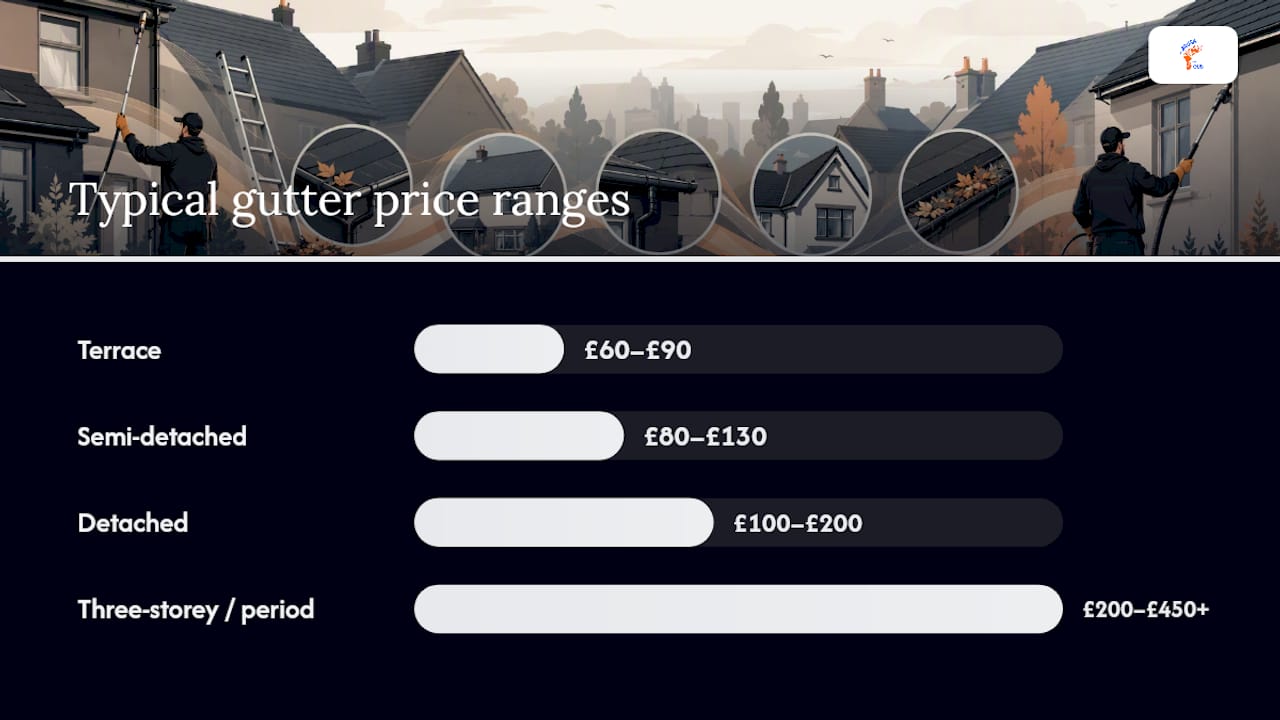
The typical cost for professional gutter cleaning ranges from £60 to £200 per job, covering the vast majority of standard semis, terraces and modest detached homes. Larger or more complex jobs, including anything needing scaffold access, can run to £300–£450 or more, according to a wider market synthesis of UK pricing.
Here’s how that breaks down by property type:
Property type | Typical price range | Notes |
Small terrace | £60–£90 | Shortest gutter run, usually easy ladder access |
Standard semi | £80–£130 | Most common job, single ladder setup |
Detached house | £100–£200 | Longer perimeter, sometimes two access points |
Three-storey / scaffold job | £200–£450+ | Access equipment adds £100–£300+ |
A few numbers worth keeping in your back pocket when you’re comparing quotes:
Typical median job cost: around £100
Per-metre rate for cross-checking a fixed quote: £4–£12
Standard job duration: 2–5 hours
Extra for scaffolding or a cherry picker: £100–£300+
That per-metre figure matters more than most homeowners realise. If a company quotes you a flat £70 for a detached house with 25 metres of guttering, multiply it out. At even £5 per metre, that’s £125 in materials of labour time alone, which tells you the flat fee is either a loss-leading introductory offer or someone’s cutting corners on the clean itself.
How gutter cleaning prices are calculated
Three pricing models dominate the trade, and knowing which one you’re being quoted changes how you should read the number.
Fixed-job pricing. The tradesperson assesses your property (ideally in person or via photos) and gives you one number for the whole job. This is the model Abrushwithgus and most reputable exterior cleaning firms prefer, because it removes the risk of the job “running long” and costing you more than expected.
Per-metre pricing. Rates typically run £4 to £12 per linear metre of guttering. This suits larger or irregular properties where a flat fee is hard to estimate fairly, but it means your final bill depends on an accurate measurement, not always something you can verify yourself.
Hourly or day rates. Expect £20–£30 per hour or £150–£300 for a full day. This model shifts risk onto you as the customer. If the crew hits a blocked downpipe or years of compacted moss, the meter keeps running.
Statistic to remember: a standard residential clean takes 2 to 5 hours on average, which is exactly why fixed pricing tends to work in the homeowner’s favour. If a job that should take three hours stretches to five because of unexpected blockages, an hourly rate quietly doubles your cost while a fixed quote doesn’t move.
Here’s a worked example. Say a company quotes you £90 flat for a semi-detached house. Cross-check it: if your guttering runs to roughly 15 metres, that’s £6 per metre, sitting comfortably mid-range. If the same company instead quoted £25/hour and the job took four hours, you’d pay £100, plus whatever they charge for downpipe clearance. The fixed price wins on predictability almost every time for a standard residential job.
What does access and property type do to the price?
Property type sets your starting point, but access is what actually swings a quote up or down. Two identical detached houses can carry very different price tags depending on whether the gutters sit above a flat, ground-level lawn or over a Victorian bay window three storeys up.
Typical ranges by property, using average gutter lengths as a rough guide:
Terrace (roughly 8–12 metres of guttering): £60–£90, straightforward ladder access from the pavement or a small front garden.
Semi-detached (roughly 15–20 metres): £80–£130, usually two accessible elevations.
Detached (roughly 20–30 metres): £100–£200, often includes a garage roof or extension guttering too.
Bungalow: often at the lower end of the semi/detached range, since single-storey access is quick even where the gutter run is long.
Three-storey or period property: £200–£450+, frequently requiring scaffolding, a cherry picker, or a specialist ladder rig.
Access complications push prices up regardless of property type. Valley gutters (the internal channels where two roof pitches meet) trap far more debris than a standard eaves gutter and take longer to clear properly. Steeply pitched roofs limit where a ladder can safely stand, and awkward eaves above conservatories, bay windows or extensions often need a second access point altogether.
The scaffolding factor: expect £100 to £300 or more added to a job that needs scaffold towers or a cherry picker rather than extendable ladders. This isn’t padding on the invoice. Scaffold hire, erection time and the additional labour of working at height all carry real cost, and any tradesperson quoting a suspiciously low price for a three-storey property is either skipping proper access equipment or hasn’t seen your property at all.
If your home has a mix of easy and awkward elevations, ask for the quote to reflect that rather than a blanket “detached house” rate. A bungalow with a single tricky dormer section shouldn’t cost the same as a full scaffold job, and a good tradesperson will price the two very differently.
Common add-ons and extra costs to budget for
The headline gutter cleaning price rarely covers everything you actually need done. Extras are where quotes creep, and they’re the single biggest source of “why is this more than I expected” phone calls in the trade.
The most common additions, based on typical UK trade pricing:
Downpipe unblocking: £10–£30 per downpipe, and most houses have between two and four.
Moss or algae intensive removal: £50–£100, common on north-facing roofs or properties near overhanging trees.
Debris disposal: £10–£30, covers taking the muck away rather than leaving it bagged on your drive.
Travel surcharges: £25–£50, more likely if you’re outside a company’s usual patch.
Minor repairs: loose clips or resealing a joint typically add a modest amount per fix, though a gutter needing structural repair is a separate job entirely.
Specialist tasks like downpipe unblocking and moss removal are the two extras that catch people out most often, largely because they’re easy for a tradesperson to spot on the day but easy to leave out of an initial phone quote.
Pro Tip: *Ask for downpipe unblocking and moss removal to be priced as separate line items before the job starts, not bundled into a vague “plus extras” clause.
Regional variation: how to read a local quote
Where you live shifts the price more than most homeowners expect. London carries a clear premium over the rest of the country, driven by higher labour costs, congestion charging and tighter parking for vans and ladders.
Regional data shows London running around 30% above the UK typical, with the North, Scotland and Wales generally sitting lower.
Region | Typical job cost |
London | ~£130 |
South East / South West | ~£100–£110 |
North England | ~£90 |
Scotland / Wales | ~£90 |
If you’re in Cornwall or elsewhere in the South West, expect quotes closer to the national typical than the London premium, though rural or hard-to-reach properties can still attract a travel surcharge. When comparing two quotes from different areas, or a national company versus a local one, factor in that surcharge separately rather than assuming the base price should match. A quote £20 higher because the tradesperson is travelling 40 minutes each way isn’t necessarily poor value. It’s simply reflecting real cost.
How to get an accurate quote and spot red flags
A good quote answers your questions before you’ve had to ask them. A poor one raises more questions than it settles.
Ask if the price is fixed or variable. Get clarity on whether you’re paying a flat fee or an hourly/per-metre rate that could move.
Ask exactly what’s included. Does the quote cover downpipe unblocking, moss removal and debris disposal, or are those extras?
Ask how many downpipes and elevations they’ve counted. A quote based on the wrong number of downpipes is a quote that’s about to change.
Ask about waste removal. Some firms leave bagged debris for you to dispose of; others take it away as standard.
Ask for proof of insurance. Public liability cover matters when someone’s working at height on your property.
Insist on a written breakdown before work starts. A proper quote states the number of downpipes to be cleared, whether moss removal is included, and whether scaffolding or a cherry picker is likely, so nothing gets added as a surprise on the day.
Red flags worth walking away from: no site visit and no questions about your property before a number is given; no proof of insurance when asked directly; pressure to pay in cash on the day; and a price sitting well below every other quote you’ve had, with no explanation for the gap.
If a quote seems unusually cheap, ask how they plan to access the gutters and what equipment they’ll bring. A low price built on unsafe ladder work isn’t a bargain. It’s a safety risk to the person doing the job and often a sign the clean itself will be rushed.
How often should you clean your gutters, and is DIY worth it?
Once a year is the minimum for most UK homes, and twice yearly is worth the extra cost if you’re surrounded by trees. Late autumn, after leaf fall but before winter rain, is the best single-clean timing if you’re only doing it once.
DIY is reasonable if you’re dealing with a single-storey property, easy ladder access, and you’re comfortable working at height. Beyond that, the maths and the risk tip firmly towards hiring a professional:
Single-storey, easy access: DIY is fine with a stable ladder and basic tools.
Two-storey or steeper roofs: hire a professional; the fall risk isn’t worth the saving.
Properties with valley gutters or awkward eaves: professional cleaning almost always finds blockages a DIY clean misses.
Cost comparison: a DIY clean costs you an afternoon and the price of a ladder hire; a professional clean at £80–£130 buys you insured, trained access and a proper check of joints and brackets while they’re up there.
Falls from ladders remain one of the most common causes of serious injury around the home, which is reason enough on its own to think twice before tackling a two-storey clean solo.
Practical tips from A Brush With Gus on keeping costs down
A fixed-price quote, agreed after a proper look at your property, is the single best way to avoid a bill that grows once the job’s underway. Ask what happens if extra downpipe blockages or heavier moss than expected are found, and get that answer before the ladders come out.
Between professional cleans, a few low-cost habits keep the bigger bill down. Gutter guards reduce how much debris builds up in the first place, particularly under overhanging trees. A quick visual check from the ground every few months, spotting sagging sections or visible plant growth, gives you early warning before a small problem becomes a full repair job.
A Brush With Gus approaches exterior cleaning as part of a wider property maintenance conversation, not an isolated job. When we quote for guttering, we look at the whole exterior, including fascias, soffits and render, because problems in one area often show up in another. That’s covered in more depth on our exterior cleaning services guide.
Pro Tip: Get your gutters checked at the same time as any exterior render or UPVC clean. Booking both together often means one site visit and one access setup, rather than paying for scaffolding or ladder access twice in the same year.
Why most gutter cleaning quotes are harder to compare than they should be
The frustrating truth about gutter cleaning prices UK-wide is that two quotes for the same house can look wildly different and both be fair. One tradesperson prices for exactly what you asked; another prices for what they expect to find once they’re up the ladder. Neither is dishonest. They’re just answering different questions.
Where conventional advice falls short is in treating “get three quotes” as sufficient. Three quotes only help if they’re pricing the same job. Without a written breakdown, you’re often comparing a bare-bones clean against a full service that includes downpipes and moss removal, and the cheaper number wins for the wrong reason.
My advice: prioritise the breakdown over the headline figure. A £110 quote that lists downpipe unblocking and debris disposal beats a £90 quote that’s silent on both, because you’ll likely pay more than £20 extra once those gaps surface anyway. Ask the awkward questions early. It’s the only real defence against a bill that grows after the ladders are already up.
— Angus
Book a fixed-price gutter clean with A Brush With Gus
Abrushwithgus prices gutter cleaning the way this guide recommends you check for: a fixed fee agreed after we’ve actually looked at your property, not a number plucked from a phone call. That means no hourly clock running while we clear a blocked downpipe, and no surprise scaffolding charge sprung on you after the van’s already outside.

As a family-run team covering Cornwall and the wider South West, we handle gutter clearing, downpipe unblocking and moss removal alongside the rest of our exterior cleaning work, so you’re not juggling separate trades for guttering, render and UPVC. Our client reviews consistently mention clear communication and tidy work, the same standard we bring to every quote we write. If you’d like a fixed price for your property, get in touch through our domestic services page and we’ll arrange a site visit before we put a number on paper.
Sources
Recommended
Comments