
How to choose paint for businesses: a practical guide
Choosing the wrong paint for your business premises can cost thousands in premature repaints, regulatory fines, and lost productivity. Many property managers discover too late that standard household paints fail under commercial demands, leading to peeling surfaces, compliance issues, and unhappy tenants. This guide walks you through selecting paints that meet durability standards, comply with UK environmental regulations, and deliver long-term value for your commercial property investment.
Table of Contents
Key Takeaways
Point | Details |
Paint types by environment | Choose coatings based on durability and environment, such as epoxy for floors, polyurethane for walls and metal, water based acrylics for interiors and mineral paints for masonry. |
Low VOC compliance | Low VOC paints help meet UK regulations and improve indoor air quality. |
Colour affects perception | Colour choices influence customer behaviour and perceived value, shaping brand impact in commercial spaces. |
Finish for traffic | Finish should match traffic and moisture exposure levels to prevent premature wear. |
Premium paints extend repaint intervals | Premium coatings can extend repaint intervals from three to five years to seven to ten years. |
Understanding paint types and their applications
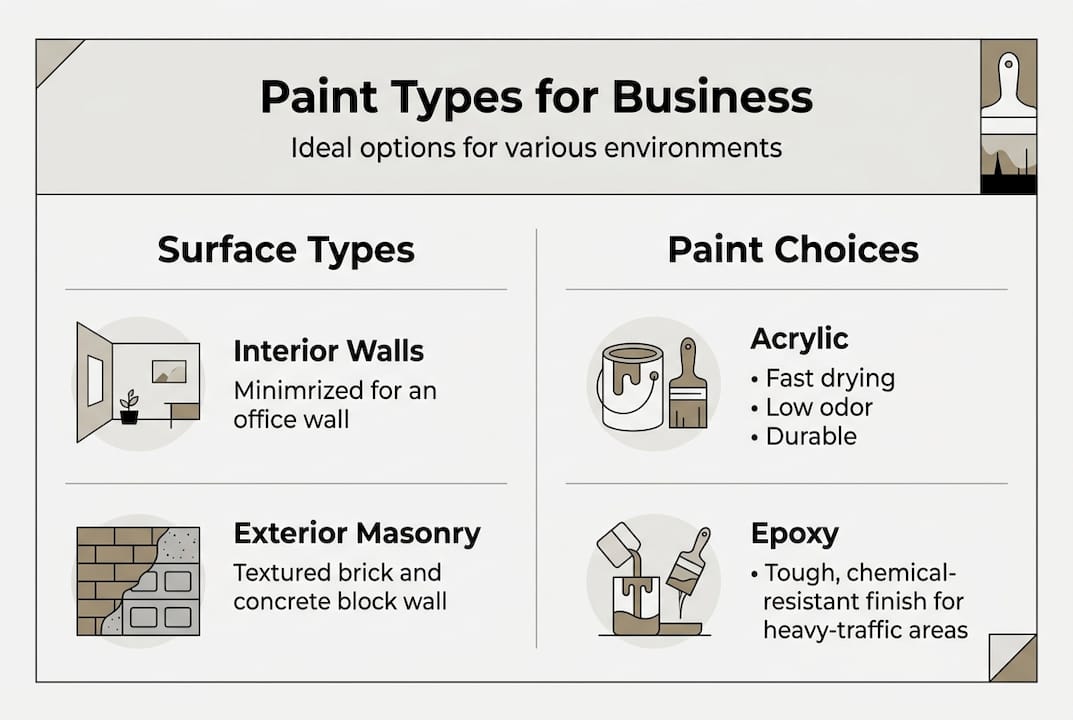
Commercial environments demand far more from paint than residential spaces. You need coatings that withstand heavy foot traffic, resist chemical exposure, and maintain appearance under constant use. Select paint types based on durability, application, and environment: epoxy for floors, polyurethane for walls and metal, water-based acrylics for interiors, mineral paints for masonry. Each formulation offers distinct advantages for specific commercial applications.
Epoxy paints excel in demanding floor applications where chemical resistance matters. Warehouses, commercial kitchens, and manufacturing facilities benefit from epoxy’s exceptional durability and resistance to oils, solvents, and cleaning agents. The coating forms a hard, impermeable surface that protects concrete substrates whilst providing slip resistance when textured additives are incorporated. Epoxy typically requires professional application due to strict mixing ratios and surface preparation requirements, but the investment pays dividends in reduced maintenance cycles.
Polyurethane coatings deliver outstanding impact resistance for walls, metal surfaces, and high-traffic corridors. These paints maintain gloss retention far longer than standard acrylics, making them ideal for retail environments and office reception areas where appearance matters. Polyurethane’s flexibility allows it to expand and contract with temperature changes without cracking, particularly valuable in South West UK coastal properties exposed to salt air and humidity fluctuations. The coating resists abrasion from trolleys, equipment, and constant contact better than any alternative.
Water-based acrylic paints suit interior walls in offices, meeting rooms, and low-traffic commercial spaces. Modern acrylic formulations offer excellent coverage, quick drying times, and minimal odour during application, allowing businesses to continue operations with minimal disruption. These paints clean up with water, reducing hazardous waste disposal costs. Whilst less durable than epoxy or polyurethane, acrylics provide sufficient performance for protected indoor environments at a lower material cost.
Mineral paints work exceptionally well on masonry, brick, and lime-based substrates common in historic commercial buildings throughout the South West. These breathable coatings allow moisture vapour to escape, preventing the trapped dampness that causes paint failure and structural damage. Mineral paints bond chemically with substrates rather than forming a surface film, creating exceptionally long-lasting finishes that can outlast conventional paints by decades. Heritage properties and conservation areas often require mineral paint specifications to maintain authentic appearances.
Pro tip: Investing in premium paint types appropriate to each surface reduces long-term costs by extending repaint intervals from 3-5 years to 7-10 years, cutting labour disruption and material expenses substantially over the property lifecycle.
When specifying paints for your commercial property, consider consulting professional painting services to match coating systems to your specific environmental conditions and performance requirements. Proper paint selection prevents costly failures and ensures your investment delivers maximum value.
Choosing colours and finishes for commercial properties
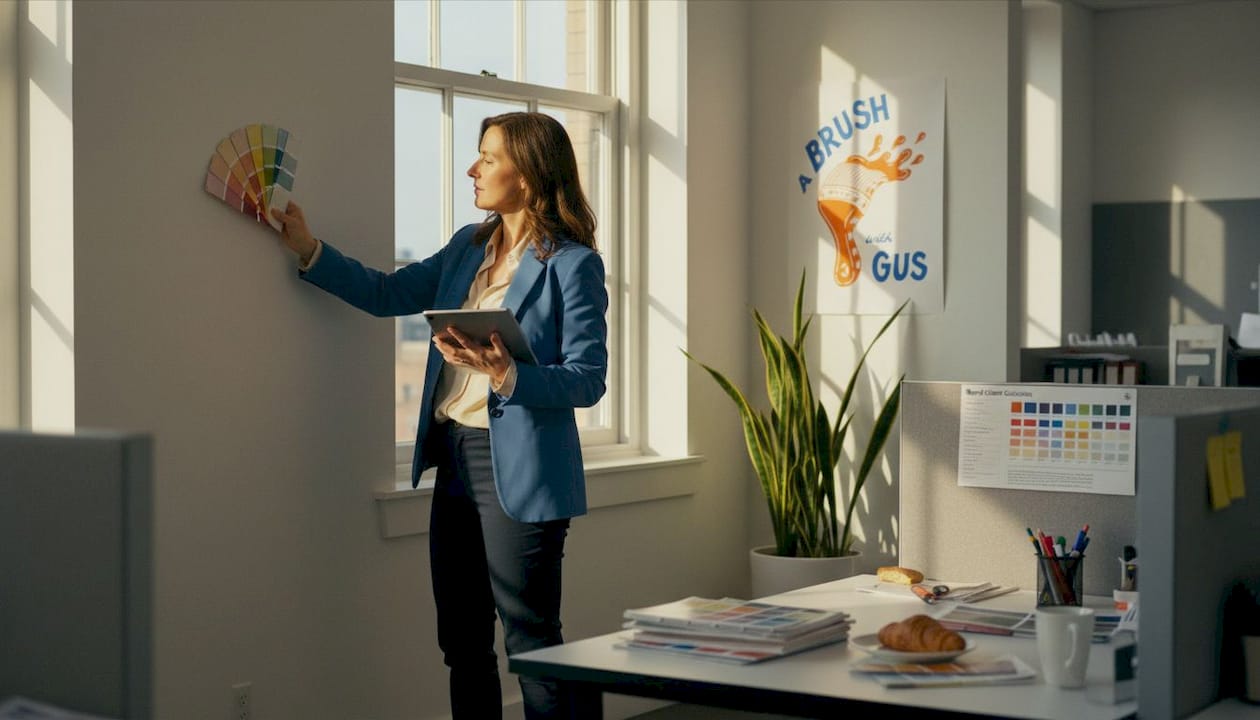
Colour selection influences customer behaviour, employee productivity, and brand perception more than most business owners realise. Strategic colour choices create specific psychological responses that either support or undermine your business objectives. Choose colours based on psychology and industry with professional neutrals for offices and bold for retail; test colours under site lighting. Getting this decision right requires understanding both colour theory and practical testing methods.
Neutral tones like grey, beige, and soft white create professional atmospheres in office environments, promoting concentration without distraction. Financial services, legal firms, and consulting businesses typically favour these palettes to project stability and trustworthiness. Conversely, retail environments benefit from bolder accent colours that draw attention to product displays and create emotional engagement. Restaurants use warm reds and oranges to stimulate appetite, whilst wellness centres employ calming blues and greens to reduce stress and promote relaxation.
Safety colour coding forms a critical compliance requirement in industrial and warehouse settings. Yellow marks physical hazards, red indicates fire equipment and emergency stops, green shows first aid stations and emergency exits, and blue designates mandatory actions. Following British Standards for safety colours ensures your facility meets Health and Safety Executive expectations whilst protecting workers from preventable accidents. These colours must maintain visibility and contrast even under artificial lighting or in dusty conditions.
Finish selection directly impacts durability, maintenance requirements, and light reflection characteristics. Match finishes to traffic level: satin/eggshell for offices, semi-gloss for high-traffic, flat for ceilings. Each finish type serves specific functional purposes beyond aesthetics:
Flat finishes hide surface imperfections and reduce glare, ideal for ceilings and low-traffic walls
Eggshell provides subtle sheen with moderate washability for general office spaces
Satin offers enhanced durability and easier cleaning for corridors and communal areas
Semi-gloss delivers maximum washability and moisture resistance for kitchens, toilets, and high-traffic zones
Gloss finishes suit trim, doors, and metal surfaces requiring frequent cleaning
Testing paint colours before full application prevents expensive mistakes. Follow this systematic approach:
Obtain large sample pots of your shortlisted colours
Paint 60cm x 60cm test patches on actual walls in the target space
Observe colours under morning, afternoon, and artificial lighting conditions
Evaluate how colours interact with existing furnishings, flooring, and fixtures
Allow 48 hours for paint to cure fully before making final decisions
Photograph samples to compare options objectively
Lighting dramatically alters colour perception. Fluorescent tubes cast cool blue tones that make warm colours appear dull, whilst LED lighting renders colours more accurately but varies by colour temperature rating. South West UK properties with large windows experience intense natural light that can bleach pale colours or intensify bold hues. Coastal locations face additional UV exposure that accelerates fading, requiring more durable pigment formulations.
Pro tip: Specify semi-gloss finishes in high-traffic corridors, stairwells, and moisture-prone areas to extend paint life by 40-60% compared to flat finishes, reducing maintenance cycles and associated business disruption.
Explore commercial painting options to access professional colour consultation services that factor in your brand guidelines, lighting conditions, and functional requirements for optimal results.
Application methods and compliance requirements
Application technique affects paint performance as much as product selection. Professional contractors choose methods based on surface type, project scale, and operational constraints. Application methods include spray for efficiency and rollers/brushes for precision; South West UK contractors offer out-of-hours service. Understanding these approaches helps you specify the right solution for your commercial project.
Spray application delivers unmatched efficiency for large commercial spaces, applying uniform coatings three to five times faster than roller methods. Airless sprayers atomise paint at high pressure, creating fine mist that penetrates surface textures and produces exceptionally smooth finishes. This method suits warehouses, retail units, and office refurbishments where speed minimises business disruption. However, spray requires extensive masking to protect fixtures, floors, and adjacent areas from overspray. Professional operators control application thickness precisely, preventing runs whilst ensuring adequate coverage.
Roller application provides excellent control for walls and ceilings in occupied spaces where overspray poses unacceptable risks. Rollers work paint into surface textures more effectively than spraying, improving adhesion on slightly imperfect substrates. This method generates minimal airborne particles, allowing businesses to maintain partial operations during painting. Microfibre rollers produce smoother finishes than traditional wool, whilst foam rollers suit gloss applications on doors and trim.
Brush application remains essential for cutting in edges, painting trim, and coating complex architectural details. Quality synthetic brushes maintain sharp lines and prevent bristle loss in water-based paints. Angled sash brushes excel at window frames and detailed work, whilst broad wall brushes cover flat surfaces efficiently. Brush application takes longer but delivers superior results on intricate surfaces where precision matters more than speed.
Environmental compliance forms a non-negotiable requirement for commercial painting projects. Prioritise low-VOC paints to meet UK regulations and reduce harmful emissions indoors and outdoors. Volatile organic compounds contribute to air pollution and create health risks for building occupants. UK VOC Regulations 2012 set strict limits on paint formulations, with penalties for non-compliance.
“Selecting compliant low-VOC paints protects your business from regulatory fines whilst creating healthier indoor environments that reduce sick leave and improve productivity. This isn’t optional; it’s a legal and ethical responsibility.”
Specialist paint applications address specific commercial requirements:
Intumescent coatings expand when exposed to heat, providing critical fire protection for structural steel
Anti-slip additives create textured surfaces that prevent accidents on ramps and wet areas
Anti-graffiti coatings allow easy removal of vandalism without damaging underlying paint
Antimicrobial paints inhibit bacterial growth in healthcare and food preparation environments
Chemical-resistant formulations protect surfaces in laboratories and manufacturing facilities
Scheduling painting around business operations requires careful planning. Many South West contractors offer evening and weekend services to avoid disrupting trading hours. Phased approaches allow you to repaint sections sequentially, maintaining partial operations throughout the project. Communicate timelines clearly to staff and customers, providing adequate ventilation during and after application even with low-VOC products.
Specialist paint spraying services deliver professional results with minimal disruption, using advanced equipment and techniques that standard decorators cannot match for commercial-scale projects.
Maintaining and planning repaints to maximise value
Proactive maintenance extends paint life significantly, reducing total ownership costs and business disruption. Understanding typical repaint cycles helps you budget accurately and schedule work strategically. Repaint interiors every 5-10 years, exteriors 5-8 years; premium paints can extend life by 20-50%. These benchmarks vary based on traffic levels, exposure conditions, and initial paint quality.
High-traffic areas like reception lobbies, corridors, and stairwells require repainting every 3-5 years due to constant contact, scuff marks, and wear. Private offices and meeting rooms typically last 7-10 years before showing significant deterioration. Exterior facades face weathering from rain, UV exposure, and coastal salt, necessitating repainting every 5-8 years to maintain protection and appearance. South West coastal properties often require more frequent exterior maintenance due to harsh marine environments.
Paint quality | Interior lifespan | Exterior lifespan | Cost per litre | Life-cycle cost |
Standard | 5 years | 5 years | £15 | £3.00/year |
Premium | 8 years | 7 years | £28 | £3.50/year |
Professional | 10 years | 8 years | £40 | £4.00/year |
Whilst premium paints cost more initially, extended durability often delivers better value over time. Calculate life-cycle costs by dividing total project cost by expected lifespan rather than focusing solely on material prices. Factor in labour costs, business disruption, and productivity losses during repainting when comparing options. Premium products that extend repaint intervals by even two years can save thousands in avoided labour and downtime.
Implement these maintenance practices to maximise paint longevity:
Clean painted surfaces quarterly with mild detergent solution to remove accumulated grime
Address scuffs and marks promptly before they become permanent stains
Repair minor chips and scratches immediately to prevent moisture penetration
Maintain adequate ventilation to prevent condensation damage
Inspect exterior paintwork annually for early signs of failure
Touch up high-wear areas like door frames and light switches between full repaints
Scheduling repaints strategically reduces costs and disruption. Coordinate painting with other planned maintenance like carpet replacement or HVAC servicing to consolidate downtime. Many businesses repaint during traditional slow periods, annual shutdowns, or between tenant occupancies. Retail premises often schedule work after Christmas sales or before autumn trading peaks.
Pro tip: Bundling exterior repainting with facade cleaning and minor repairs reduces mobilisation costs by 15-25% compared to separate projects, whilst ensuring all exterior maintenance happens simultaneously with minimal scaffolding time.
High-quality paint selection supports compliance by maintaining appearance longer, reducing the frequency of disruptive repainting projects. Well-maintained commercial properties command higher rents, attract better tenants, and preserve asset values more effectively than neglected buildings. Professional exterior home painting and professional cleaning services help maintain your property investment between major refurbishment cycles.
Document paint specifications, application dates, and maintenance schedules in your property management system. This record helps you plan future work accurately and ensures consistency when touching up or repainting individual areas. Retain leftover paint for repairs, storing it properly to prevent deterioration.
Professional painting and spraying services in the South West UK
Implementing the strategies outlined in this guide requires experienced contractors who understand commercial painting demands. Local South West specialists deliver the expertise, equipment, and flexibility that business projects require.

Professional commercial painting services in Cornwall and Devon combine industrial-grade materials with proven application techniques. Family-operated teams bring decades of experience to projects ranging from small retail units to large industrial facilities. Expert spraying services utilise airless technology that delivers flawless finishes whilst minimising project timelines.
Flexible scheduling accommodates your operational requirements, with evening and weekend options that protect revenue during critical trading periods. Contractors work efficiently to complete projects on time and within budget, understanding that every day of disruption affects your bottom line. Comprehensive insurance and health and safety compliance protect your business from liability whilst ensuring worker safety.
Quality workmanship ensures your paint investment delivers expected performance and longevity. Proper surface preparation, premium materials, and skilled application techniques prevent premature failure and costly remedial work. Contact professional painting in Cornwall for tailored quotes that address your specific property requirements and operational constraints.
Frequently asked questions
What types of commercial paint are best for high-traffic areas?
Epoxy paints are chemically resistant and ideal for high-traffic floors; polyurethane provides impact resistance for walls and metal. These industrial-grade coatings withstand constant use far better than standard acrylics. Semi-gloss finishes enhance durability by allowing easy cleaning without surface damage, extending repaint intervals significantly.
How can I ensure paint complies with UK environmental regulations?
Low-VOC paints with VOC levels under 30g/L for interior matt and 40g/L for exterior mineral surfaces comply with UK VOC Regulations 2012. Check product data sheets for VOC content declarations and certification marks. Reputable suppliers clearly label compliant products, whilst professional contractors specify appropriate formulations automatically.
What is the best way to test paint colours before committing?
Test paint samples in situ to see colour shifts under fluorescents, LED or natural light, especially important for South West UK coastal locations with UV exposure. Apply large patches directly on target walls rather than relying on small colour cards. Observe samples throughout the day and under artificial lighting to identify any unexpected colour shifts before purchasing full quantities.
Recommended
Comments