
Homeowners: Make Laminate Kitchen Spraying Last with a Bonding Primer
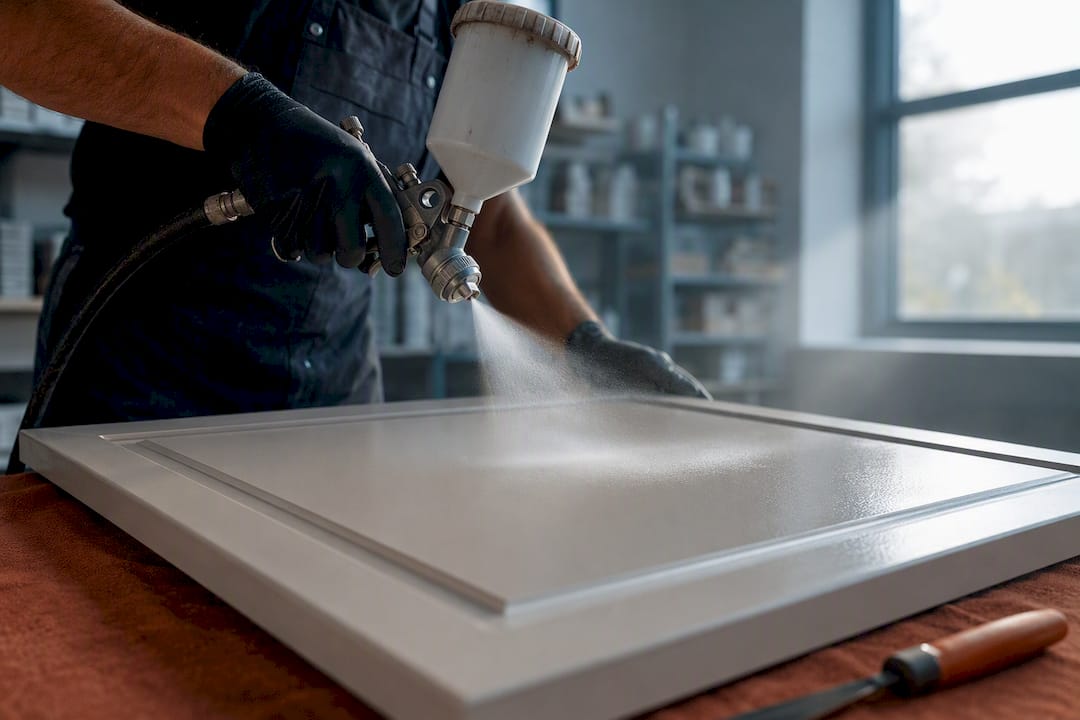
Yes, most laminate kitchen cabinets can be given a durable, factory-like finish through professional spraying, provided the doors are structurally sound. Success depends almost entirely on preparation and using a specialist bonding primer designed for non-porous surfaces. Skip either step and the paint fails within months. For a lasting result with minimal disruption, hiring a professional sprayer is the sensible route for most kitchens.
TL;DR:
The success of laminate kitchen spraying relies heavily on proper surface preparation and the use of a specialist bonding primer for non-porous surfaces.
Laminate doors must be structurally sound, with intact edges and corners, and free from water damage or delamination to be suitable candidates for spraying.
Repainting with professional spraying costs significantly less than replacing cabinets, especially when repairs are minimal, but complex or heavily damaged kitchens may not justify the expense.
A proper process includes careful removal, labeling, degreasing, light abrasion, high-adhesion primer, multiple thin topcoats, and thorough curing, preferably in a controlled environment.
Choosing the right primer and spray equipment, such as a bonding primer and HVLP system, is critical to durability, with proper preparation and expert application key to long-lasting results.
Table of Contents
What is laminate kitchen spraying and is your kitchen suitable?
Laminate kitchen spraying means applying a professional-grade primer and topcoat system directly onto existing laminate cabinet doors and carcasses, transforming the colour and finish without ripping anything out. It is not the same job as refinishing solid wood. Wood refinishing typically involves sanding back to bare timber and staining or oiling; laminate is a factory-sealed, non-porous surface, so it needs a purpose-built painting system rather than traditional wood products. The distinction between refinishing and painting laminate matters because the correct approach treats it as a high-performance coating job, not a wood-restoration one.
Not every kitchen is a good candidate. Before booking a survey, check for these conditions:
The door substrate (usually MDF or chipboard under the laminate skin) feels solid, with no soft or crumbling patches.
Laminate edges and corners are intact, without significant peeling or lifting.
There’s no swelling around sinks, dishwashers, or under-worktop areas.
Handles, hinges, and cabinet frames are structurally sound, even if cosmetically tired.
Kitchens that fail these checks are usually poor candidates. Severe water damage around sinks, swollen chipboard cores, or doors that have delaminated at the edges won’t hold a new finish reliably, whatever primer you use. In those cases, replacing the affected doors, or the whole kitchen, tends to be the more sensible long-term move.
What does laminate kitchen spraying cost compared with replacement?
Spraying existing cabinets instead of ripping out and replacing them is the single biggest reason homeowners choose this route. You keep your existing carcasses, worktops, and layout, and simply transform the doors, drawer fronts, and any exposed end panels. That means far less mess, no new plumbing or electrical disconnection, and a fraction of the waste going to landfill.
Cost saving: Respraying a kitchen typically costs a fraction of a full replacement, since you’re paying for labour, primer, and topcoat rather than new carcasses, worktops, and fitting.
Price depends on several factors:
Door count and size, since more doors and drawer fronts mean more spraying time and material.
Repair work needed, such as filling dents, reveneering damaged edges, or replacing a swollen panel.
Colour complexity, where two-tone kitchens or bold, dark colours often need extra coats for even coverage.
Bespoke elements, including cornices, pelmets, glazed doors, or handle changes that add fitting time.
The savings from repainting rather than replacing come largely from avoiding the cost of new units, new worktops if you keep the existing ones, and the disruption of a full refit. A straightforward respray of a mid-sized kitchen, with doors and drawers in reasonable condition, will usually land well below the cost of a comparable new fitted kitchen. Where the numbers get less favourable is when a lot of repair work is needed first, or when a kitchen has an unusual number of bespoke or oversized doors.
How does the professional spraying process actually work?
A proper respray follows a set sequence, and skipping any of these steps is where most poor results come from.
Removal and labelling. Every door, drawer front, and hinge plate gets carefully labelled before removal, since cabinet dimensions can vary slightly even within the same kitchen, and mixing them up creates fitting problems at refit stage.
Inspection. Each piece gets checked for delamination, swelling, or damage that needs repair before any coating goes on.
Degreasing. Kitchen laminate accumulates a film of cooking grease that ordinary cleaning never fully removes, and any residue left behind will stop primer bonding properly.
Light abrasion and dust removal. A careful key to the surface, followed by thorough dust extraction, gives the primer something to grip. Careful cleaning and light abrasion are the steps that determine whether paint sticks to laminate at all.
Bonding primer application. A high-adhesion primer formulated specifically for melamine and laminate goes on next, since this is the layer doing the real work of making everything else stick.
Spraying the topcoat. Using HVLP equipment or a controlled spray environment, the sprayer builds up several thin coats rather than one thick one, which avoids drips, orange peel, and uneven sheen.
Curing and drying between coats. Each coat needs time to flash off before the next goes on, and the final coat needs proper cure time before handling.
Refit and final inspection. Doors and drawers go back exactly where they were labelled from, hinges are adjusted, and any final touch-ups get addressed on-site.
Preparation and labelling aren’t a minor footnote here. Preparation accounts for the large majority of the quality of the finished job, and careful labelling avoids the frustrating scenario of a door that no longer quite fits its original position.
Many professional services remove doors and drawers entirely for off-site spraying, giving a dust-free, controlled environment that’s difficult to replicate spraying in situ in an occupied kitchen.
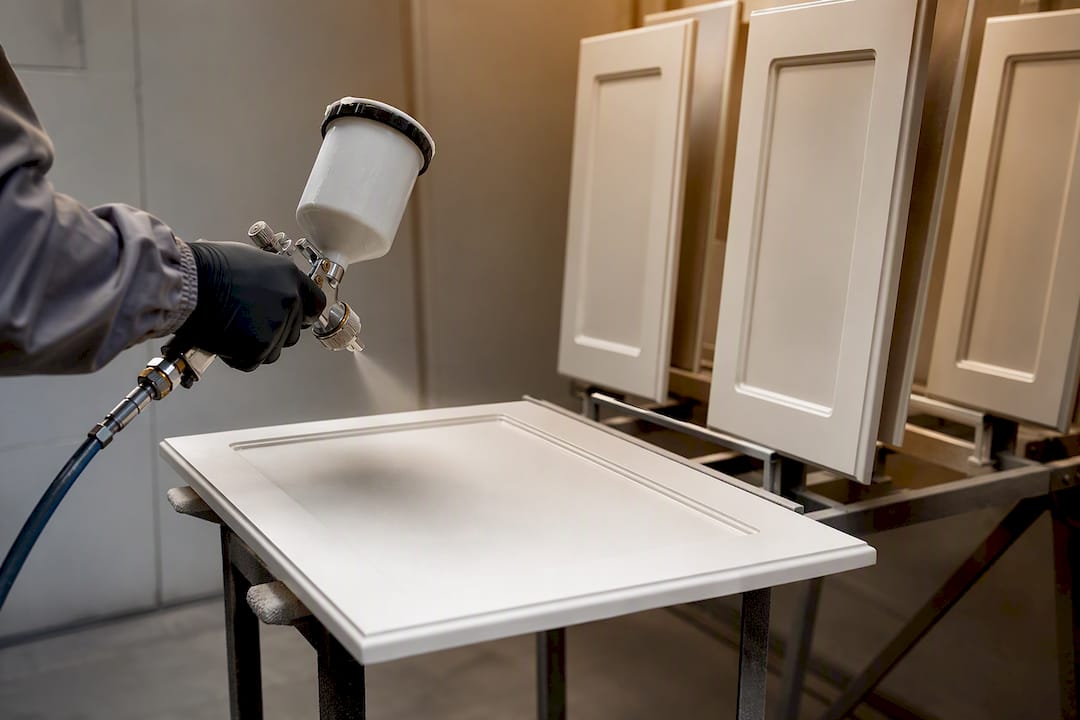
Pro Tip: Ask your sprayer whether doors are sprayed on-site or removed to a dedicated booth. Off-site spraying in a controlled environment almost always produces a cleaner, more even finish, particularly on flat door fronts where dust nibs show up badly.
Which primers and spray equipment actually make a difference?
The primer is where laminate jobs succeed or fail, full stop. Standard wall emulsion or ordinary wood primer is formulated to bond to porous surfaces. Laminate is the opposite: a hard, sealed, factory-finished skin that most conventional primers simply sit on top of rather than grip. Bonding primers engineered specifically for difficult, non-porous substrates are essential, and using anything less specialist is the single most common reason DIY laminate paint jobs peel and chip within weeks.
On top of the primer, the topcoat matters:
Urethane or enamel-based topcoats give the hardness and scrub resistance a kitchen needs, standing up to daily wiping, splashes, and knocks far better than standard craft paints.
Waterborne alkyd systems offer a similar durability profile with lower odour and faster recoat times, which suits occupied homes.
HVLP spray equipment atomises paint into a fine, even mist, which is what gives a brush-stroke-free, factory-like finish rather than the visible texture you get from a roller or brush.
Contractor-grade enamel systems are generally recommended over standard wall or furniture paint for cabinet durability, given how much handling a kitchen door takes.
A domestic HVLP unit can be hired, but professional results usually come down to control over atomisation pressure and flash-off timing between coats, skills a first-time user rarely gets right on the first attempt. Use standard primer on laminate and you’ll likely be repainting within a year.
How long does a respray take and how durable is the finish?
A typical kitchen respray runs through several stages, each with its own time demand. A site survey and quote usually happens first, followed by door removal, which for an average kitchen takes half a day. Preparation, including degreasing, abrasion, and repairs, often takes longer than the spraying itself. Primer and topcoat application, allowing for drying between coats, tends to spread over several days, and full cure before heavy use needs longer still.
Temperature and humidity affect every stage. Cold or damp conditions slow drying dramatically, which is why many professional sprayers work off-site in controlled, heated spaces rather than relying on a chilly garage or an occupied kitchen in midwinter.
Recoat and cure guidance from paint manufacturers stresses multiple thin coats and sufficient drying time between each one to avoid tackiness later.
A properly sprayed and cured laminate finish typically lasts many years under normal kitchen use.
The most common causes of early failure are inadequate degreasing, the wrong primer, or moisture getting behind the coating around sinks and dishwashers.
Day-to-day care matters too. Gentle cleaning, avoiding abrasive scourers, and wiping up splashes promptly all help the finish last. Simple maintenance habits go a long way towards keeping a sprayed kitchen looking new.
Should you spray it yourself or bring in a professional?
DIY laminate spraying can work for small, low-risk jobs, a single cupboard, a utility room door, or a project where you’re comfortable accepting an imperfect finish. It becomes a harder sell for a full kitchen, where colour consistency across dozens of doors, correct primer selection, and spray control all compound any small mistake into a very visible one.
Assess the scope honestly. A handful of doors with basic prep is manageable at home; a full kitchen with repairs, bespoke trims, or a dark, unforgiving colour is not.
Check what equipment you actually have. Renting an HVLP sprayer is possible, but without practice, achieving even atomisation across a whole kitchen’s worth of doors is genuinely difficult.
Vet any contractor before booking. Ask specifically which bonding primer they use on laminate, not just “a primer”. Ask to see photos of similar laminate kitchens they’ve sprayed, not just wood ones. Ask whether they carry insurance and what warranty covers the finish.
Watch for red flags. A quote with no mention of primer type, a contractor unwilling to show past laminate work, or a price that seems too low for the door count, should all make you pause.
Pro Tip: If a quote doesn’t specify the primer brand or system by name, ask directly. A sprayer who genuinely understands laminate will answer without hesitation, because primer selection is exactly where cheap jobs cut corners.
What does A Brush With Gus bring to a laminate respray?
A Brush With Gus is a family-run painting and decorating business operating across Cornwall and the South West, run by brothers Gus and Rhys. The company’s core services span interior and exterior painting, UPVC spraying and restoration, airless spraying, and exterior home cleaning, alongside kitchen spraying for domestic clients.
Handling UPVC spraying and restoration day to day gives direct experience of coating non-porous, factory-finished surfaces, the same underlying challenge that laminate kitchen cabinets present. That crossover matters: UPVC spraying demands the same bonding and adhesion discipline as laminate, just on a different substrate.
A few things worth knowing about how the business proves its work:
A portfolio of before-and-after project photos sits on the website, showing finished kitchens and exterior transformations.
Client reviews on the site speak to efficiency, professionalism, and finish quality across completed jobs.
Practical guidance on preparing kitchen surfaces before spraying sits alongside the service pages, reflecting the same preparation-first approach covered throughout this guide.
What should a fair quote for kitchen spraying include?
A proper written quote should break down labour, materials, and any repair work separately, rather than bundling everything into one vague figure. That transparency is what lets you compare quotes on genuinely equal terms.
Common add-ons that push a price up include reveneering damaged edges, replacing a swollen door outright rather than repairing it, adding new handles or hinges, and spraying end panels or cornices that weren’t part of the original scope. None of these are unreasonable charges, but they should be itemised, not folded silently into a headline number.
What a proper quote should include | Why it matters |
Door and drawer count | Confirms the scope matches what you’re expecting to pay for |
Primer and topcoat system named | Shows a bonding primer suited to laminate is actually being used |
Repair work itemised separately | Prevents surprise costs for damage discovered mid-job |
Labour and drying/cure time stated | Sets realistic expectations for how long your kitchen is out of action |
Warranty or guarantee terms | Clarifies what happens if the finish fails early |
Understanding the specific cost drivers before you request quotes makes it much easier to spot a quote that’s missing something important.
When does laminate spraying actually pay off?
The kitchens that get the best value from spraying are the ones with good bones and tired cosmetics: solid doors, functioning cabinets, just an outdated colour or a worn finish. I’ve seen the same layout go from dated 1990s oak-effect laminate to a flat, contemporary sage green with nothing structural touched at all, just degreasing, a bonding primer, and several thin sprayed coats.
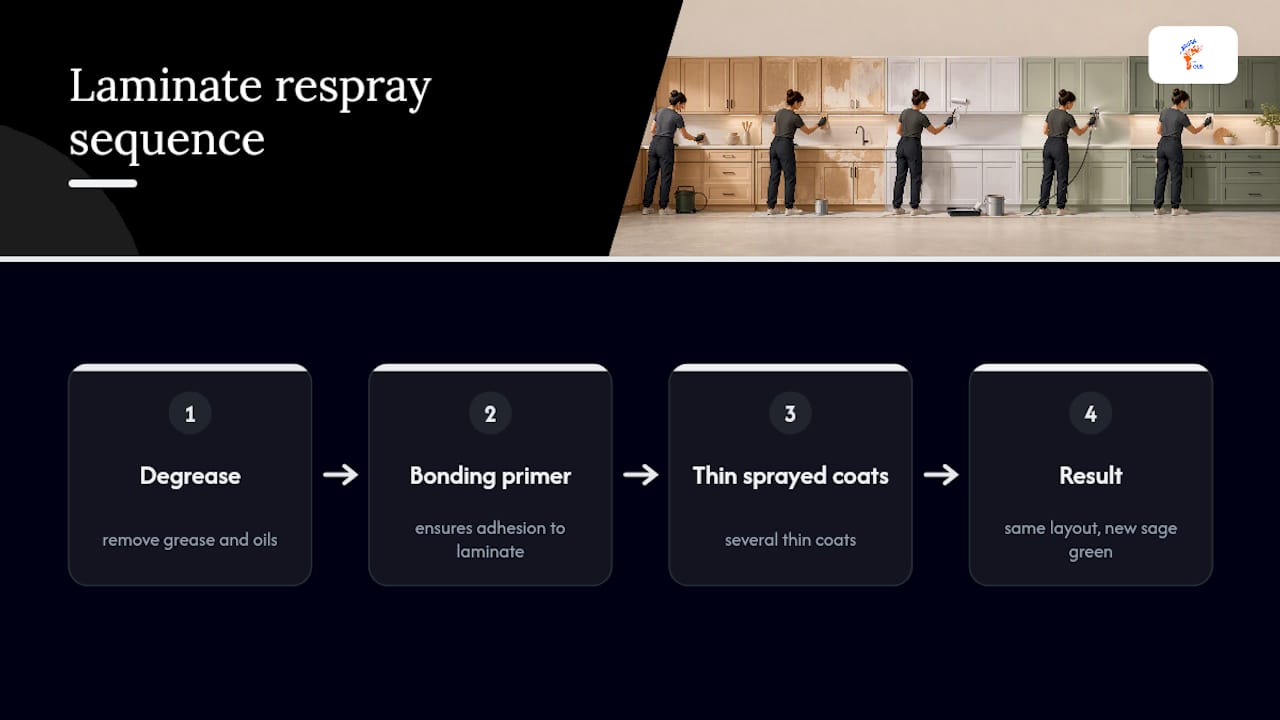
Where it doesn’t pay off is when the underlying carcass is failing. No primer fixes swollen chipboard.
If you take one thing from vetting a contractor, make it this: ask what primer they’re using and how they’re spraying it. Everything else follows from those two answers.
— Angus
Ready to get your kitchen sprayed? Here’s how it works with us
An alternative to a full kitchen refit is to keep existing units and worktops and transform the doors, drawers, and exposed panels with a professional bonding primer and sprayed topcoat system, reducing disruption and cost compared to completely removing the kitchen.

Every job starts with a site visit, where we assess door condition, check for any repair work needed, and talk through colour options before anything is quoted. From there, you get a written breakdown covering labour, primer and topcoat system, any repairs, and expected timescale, so there are no surprises once work starts. We carry insurance and cover jobs across Cornwall and the South West, whether it’s a full kitchen respray or spraying alongside other work like exterior home cleaning or UPVC windows and doors.
If your kitchen doors are sound but the finish has had its day, get in touch through our spraying services page for a quote, and we’ll tell you honestly whether spraying is the right call for your kitchen.
Sources
Recommended
Comments