
Stop Peeling: Trade Tested Render Paint Compatibility for 4 UK Renders
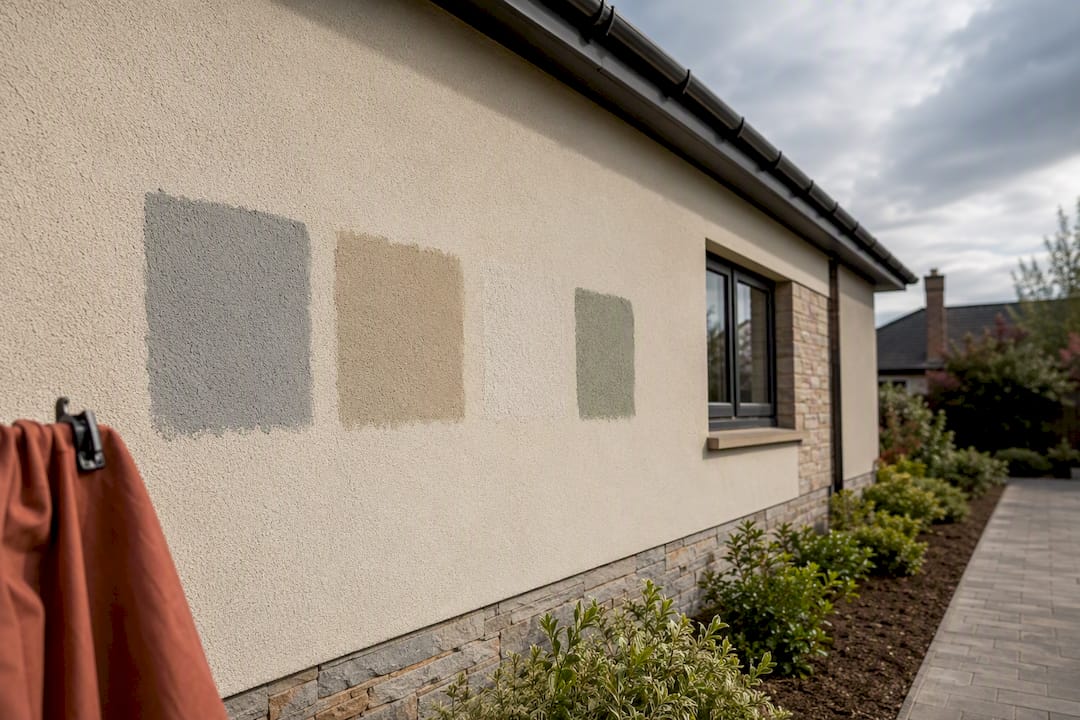
Yes, you can paint most rendered exteriors, but only if the paint matches the render underneath. Silicone render needs a silicone-based masonry paint, lime render needs a mineral or silicate finish, and cement render is more forgiving as long as the surface is sound. The rule that overrides everything else: breathability and adhesion come from matching paint family to render family, not from picking whatever’s on offer at the builders’ merchant. If you’re seeing active damp, hollow patches, or algae growth, address those issues first — paint won’t hide a problem, it’ll trap it.
TL;DR:
Silicone render requires a silicone-based masonry paint to maintain water repellency and breathability, preventing peeling and trapping moisture.
Lime render must be painted with mineral, silicate, or limewash finishes to allow vapor passage and avoid structural damp issues.
Proper surface preparation, including cleaning, repairs, and adhesion testing, is essential to ensure paint longevity and avoid failures.
Application timing matters: avoid painting below 5°C or in direct sunlight to prevent weak adhesion and surface drying issues.
Choosing a longer-lasting product, like silicone paint, can significantly reduce repaint frequency and overall maintenance costs over time.
Table of Contents
Render paint compatibility checklist: what to check before you buy
Before you open a tin, work out what render you’re dealing with. Most UK homes fall into one of four camps, and each needs a different answer.
K-Rend and other branded silicone renders usually carry a texture that’s slightly rubbery to the touch and a manufacturer sticker or invoice from the original installer if the render’s recent. Lime render tends to sit on older stone or cob properties, feels chalkier, and often shows fine hairline cracking that’s normal rather than dangerous. Cement render (including monocouche) is harder, flatter, and usually pre-coloured through the mix rather than painted on top. If the wall’s already painted, scrape a small area to see what’s underneath before assuming anything.
Once you know the render, the paint choice follows a fairly simple logic:
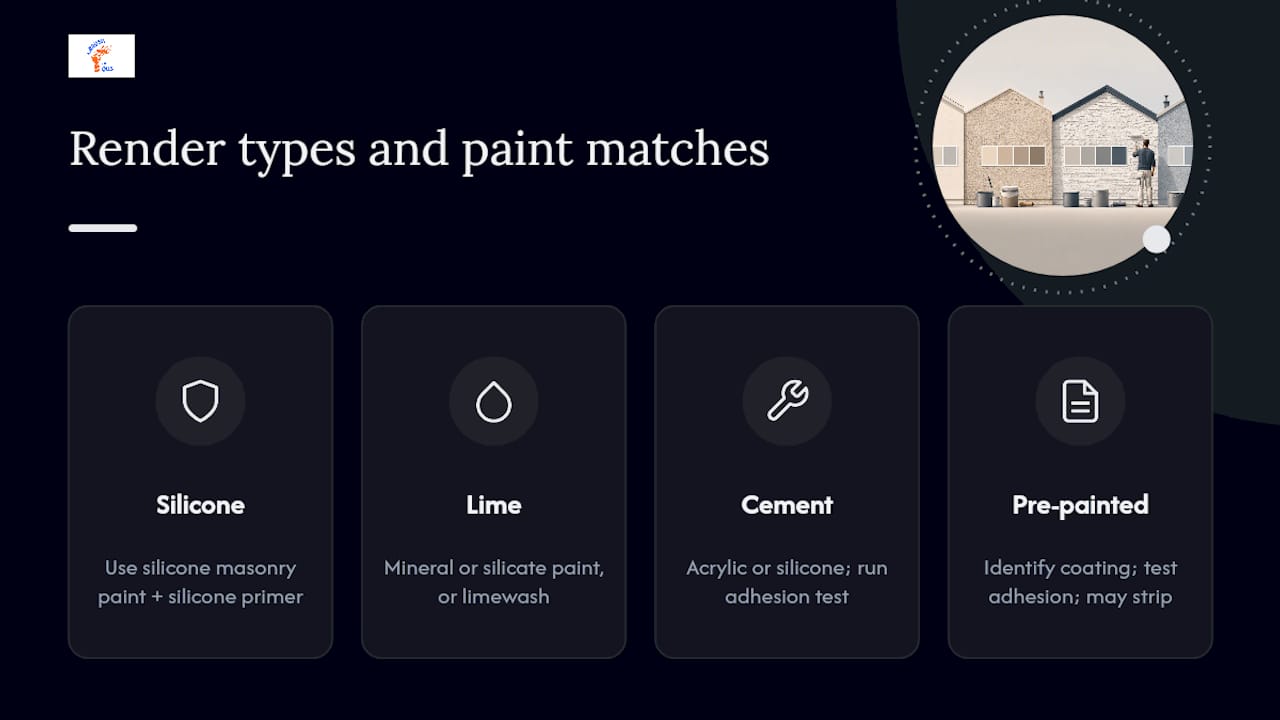
Silicone render → silicone-based masonry paint only; acrylics tend to peel within months.
Lime render → mineral, silicate, or traditional limewash, never a sealed acrylic system.
Cement or monocouche render → acrylic or silicone masonry paint, once the surface is properly prepared.
Pre-coloured render (through-colour monocouche) → often best left unpainted, or repainted only after confirming what future maintenance will involve.
Previously painted render → identify the existing coating before adding another layer on top.
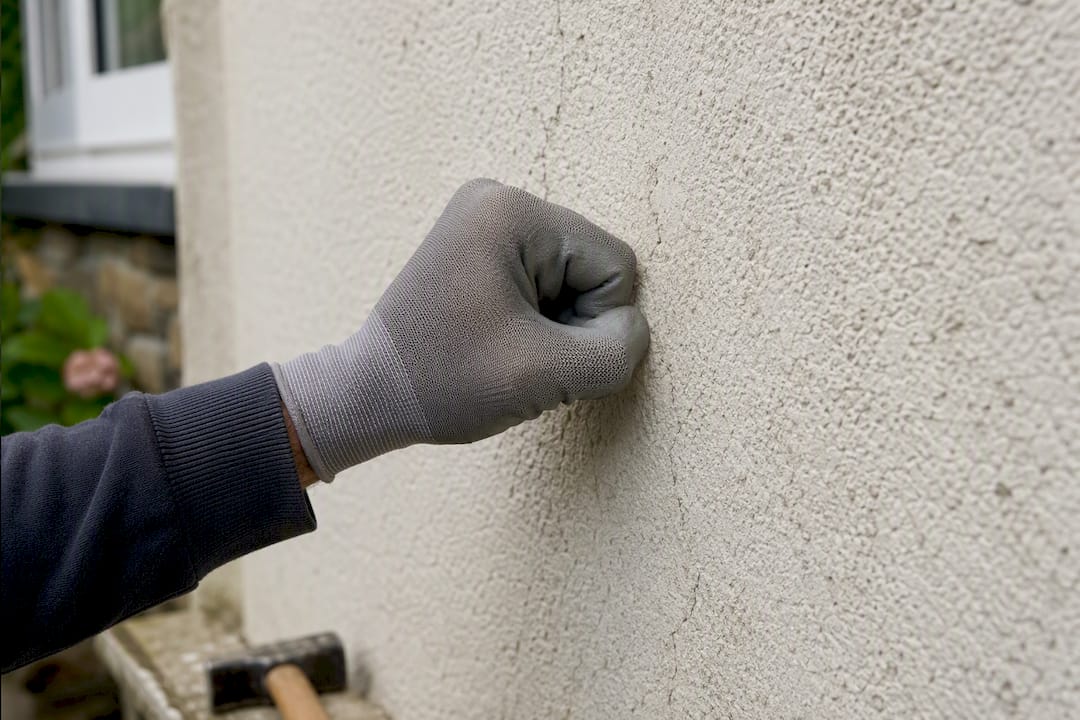
Some signs mean you should call a plasterer before you touch a paintbrush: damp patches that don’t dry out, render that sounds hollow when you tap it, cracks wider than a couple of millimetres, or white, chalky salt deposits (efflorescence) bleeding through the surface.
Pro Tip: Tap the render gently with a knuckle across a few square metres. A dull, hollow sound means it’s detached from the substrate underneath — paint over that and you’re just delaying a much bigger repair bill.
What “compatible” paint actually means on a render wall
Compatibility comes down to two properties working together: how well the paint sticks to that specific render, and how much moisture vapour it lets pass through. That second property is called breathability, and it’s measured using an SD value, which tells you how many metres of still air the coating is equivalent to in terms of vapour resistance. Lower SD numbers mean higher breathability. UK trade guidance generally treats an SD value under roughly 0.5 as breathable enough for most render systems, and that figure is worth checking on the technical data sheet before you commit to a product.
The main paint families behave quite differently once they’re on the wall:
Acrylic masonry paint is the most common and cheapest option, with a typical lifespan of around 5 to 10 years, but breathability varies widely between products and cheaper ranges can seal the surface more than you’d want.
Silicone masonry paint repels rain while staying breathable, and manufacturer claims put lifespans at 10 to 25 years or more when applied correctly, though that’s a supplier figure worth weighing against independent verification.
Mineral and silicate paints bond chemically into the substrate rather than sitting as a film on top, which suits older or heritage buildings where vapour movement matters more than a glossy finish.
Limewash is the most vapour-open finish of the lot but needs reapplying every few years, which some owners see as a maintenance chore and others see as a feature of a traditional look.
Acrylic paint’s main failure mode isn’t usually the paint itself. It’s applying it to a render that was never designed to be sealed, which pushes trapped moisture out somewhere else, often as blistering or flaking a season or two later.
Matching paint to render type, one by one
1. Silicone render (including K-Rend)
Silicone renders like K-Rend are already water-repellent and breathable straight out of the tin, so the paint you choose has to match that chemistry. Standard acrylic paints often fail to bond properly to silicone render, and even where they stick initially, they can reduce the render’s own water-repellent performance underneath. Manufacturers such as Tikkurila recommend running a sample patch first and pairing a silicone-based masonry paint with a matching silicone primer where the product range calls for one. Mismatched chemistries, acrylic over silicone in particular, regularly cause peeling within months rather than years.
2. Lime render
Lime render needs to breathe more than almost any other type on a UK home, particularly on older solid-wall properties with no cavity to manage moisture. Non-breathable paints trap water inside the wall, and that trapped moisture leads to structural damp rather than a simple cosmetic issue. Stick to mineral or silicate paints, or traditional limewash, and check the SD value stays low. Expect to maintain limewash more often than a modern paint system, and treat any sign of penetrating damp as a repair job, not a painting one.
3. Cement render and monocouche
Standard cement render and factory-coloured monocouche render are generally the most tolerant of the group. Most will accept either acrylic or silicone masonry paint once the surface has been cleaned, repaired, and primed where the render is bare and porous. Run an adhesion test on a small patch regardless, because age and original mix ratios vary enough between properties that a “should be fine” render can still surprise you.
4. Pre-coloured or previously painted render
If the render already has colour built into the mix, painting over it changes the maintenance picture rather than solving one. If it’s already painted, work out what coating is there now. A breathable system can usually take another compatible layer; a sealed, non-breathable one may need stripping back or a specific compatible product rather than simply painting over the top. Either way, test adhesion before committing to the whole elevation.
Getting the surface ready: cleaning, repairs and adhesion tests
Preparation is where most repaint jobs actually succeed or fail, long before the first coat goes on. Skip it and even the correct paint family won’t hold.
Deep clean first. Algae, moss, and general grime need removing with a proper clean and, where there’s biological growth, a biocide treatment, because paint applied over contamination traps it underneath and accelerates failure.
Repair before you decorate. Small cracks can be filled, but hollow sections, large cracks, or render pulling away from the substrate need a plasterer, not a paintbrush.
Test suction and porosity. Splash a little water on the wall. If it soaks in almost instantly, the render is porous and will likely need a primer or a mist coat before the main paint goes on.
Match the primer to the paint family. Silicone systems generally want a silicone primer; mineral and silicate systems have their own compatible primers, and mixing families at this stage undoes the point of choosing carefully in the first place.
Always run a test patch. A patch roughly a metre square, left for a few days, tells you far more about adhesion, colour, and breathability than any tin label can.
Visible soundness isn’t the same as bonded render. A wall can look fine and still fail an adhesion test, which is exactly why professionals reach for a test patch before committing to the full elevation. If structural cracking or render detachment shows up during this stage, a specialist render repair service needs to sort that before any paint goes anywhere near it.
Pro Tip: Do your test patch on a north-facing wall if you can. It weathers differently to a south-facing elevation, so it gives you a more honest read on how the paint will hold up through a full UK winter.
When to paint: temperature, weather and application windows
Render paint fails more often from bad timing than bad product choice. Temperature is the biggest factor: application below 5°C can stop the paint curing properly, while painting in direct hot sun pushes the surface temperature up and dries the coating too fast, which weakens adhesion before it’s had a chance to bond.
Check the forecast for the next 24 to 48 hours, not just the day of application. That window after painting is when the coating is most vulnerable to rain wash-off.
Avoid starting a job if rain is forecast within the next day. A good rule for South West weather is to build in a buffer day either side of the forecast dry spell.
Spraying suits textured renders like K-Rend better than rolling, because it gets into the profile without dragging or leaving thin patches on the high points.
Watch wall temperature specifically, not just air temperature, since a render surface can run several degrees hotter than the air around it on a sunny day.
Most premature failures trace back to one of three workmanship slips: too few coats, sloppy edge control on a textured profile that leaves thin patches, or painting straight over a patch everyone knew wasn’t quite sound.
What paint choice costs you over time, not just upfront
The cheapest tin at the merchant is rarely the cheapest option once you count repaints. Acrylic masonry paint typically lasts 5 to 10 years, while silicone systems can run to 10 to 25 years or more when the render was properly prepared and the product correctly matched to the substrate.
A silicone system costs more per litre but can roughly halve the number of repaints across a 20 year period compared with a budget acrylic.
Poor preparation shortens the life of any paint family, so the prep line in a quote matters as much as the tin on the label.
Ask any contractor for a recommended repaint interval in writing, not just a verbal estimate, so you know what you’re budgeting for down the line.
Factor in scaffold or access costs when comparing systems. A longer-lasting paint that avoids a second access setup within a decade often pays for its higher price on its own.
Insist on an itemised preparation line in any quote you’re given. If a quote jumps straight from “clean” to “paint” with nothing in between about repairs or priming, that’s usually where corners get cut.
What we see go wrong on render jobs, and what we check first
Most render paint failures we come across trace back to the same three mistakes: acrylic paint on silicone render, painting over algae or moss instead of removing it, and decorating a wall that needed repair work first. None of those are paint problems. They’re sequencing problems.
Our priorities on every render job are the same regardless of the render type: check the substrate is sound, check for hidden moisture, run a test patch, and match the paint family to what’s actually on the wall rather than what’s convenient to buy. A quote that skips preparation detail is a quote that’s setting you up for a repaint sooner than you’d like, and that’s more expensive over ten years than paying properly for the prep once.
— Angus
Get a proper render survey before you commit to a colour
A professional painting service is a practical alternative to guessing your way through a render repaint. Rather than picking a tin off a shelf and hoping it holds, a render can be surveyed first: identifying the type, checking for damp or hollow patches, and confirming which paint family and primer will actually bond and last on your specific wall.

Our exterior home painting service covers the full job from cleaning through to final coats, and our exterior home cleaning work handles the algae and moss removal that so many render failures start with. For textured renders like K-Rend, airless spraying gets an even coat into the profile without the drag marks a roller leaves behind, and if your property has UPVC alongside rendered walls, our UPVC spraying service can be scheduled as part of the same visit.
If you want a straightforward next step, get in touch through our domestic painting page and we’ll arrange a survey, tell you honestly what your render needs, and quote for the work with the preparation detail included, not hidden.
Sources
FAQ
What is the best render paint in the UK?
There’s no single “best” paint, because it depends entirely on your render type. Silicone masonry paint suits silicone renders like K-Rend, while mineral or silicate paints suit lime render, and cement render generally accepts either acrylic or silicone systems once properly prepared.
What paint can you use on render?
You can use acrylic, silicone, mineral/silicate paint, or limewash, but the render underneath decides which one works. Emperor Masonry Paint and similar silicone-based ranges are designed specifically to pair with silicone render, so check the render type before choosing.
Can I paint new render with Sandtex?
Standard masonry paints like Sandtex can work on cement or monocouche render once it’s fully cured and properly prepared, but they’re not generally the right choice for silicone render, where a matching silicone-based system performs better. Always confirm curing time and run a test patch before committing to the full wall.
Where can I find Emperor paint stockists in the UK?
Emperor Masonry Paint is sold through the manufacturer’s own website and a network of UK stockists, with current availability listed directly on Emperor’s site. Checking there before buying also lets you confirm the SD value and technical data sheet for your specific render type.
How do I know if my render has been painted with the wrong paint?
Peeling, flaking, or bubbling within a year or two of application is the clearest sign of a mismatch, particularly acrylic paint applied over silicone render. If you’re unsure, scraping a small area back to the render and checking the texture underneath usually tells you what’s really there.
Recommended
Comments