
Landlord responsibilities for painting: UK guide
- WM Creative Designs Limited
- Aug 13
- 12 min read

In UK rented properties, the landlord is normally responsible for keeping the decoration in a reasonable condition. Tenants are responsible for damage they cause beyond normal wear and tear, and for any redecorating they do without permission. There is no statutory rule requiring a repaint every fixed number of years. The duty is condition-based: if peeling paint, mould, or unstable plaster signals a repair issue, the landlord must act. If the walls are simply a bit tired after years of normal use, that sits with the landlord as a management decision, not a legal obligation triggered by a calendar.
The legal framework rests on Section 11 of the Landlord and Tenant Act 1985 and the Homes (Fitness for Human Habitation) Act 2018, which together require landlords to keep a property in a state fit for habitation and in reasonable repair. Decoration that evidences damp, mould, or structural failure crosses from cosmetic into repair territory. Practical guidance confirms there is no fixed statutory repaint interval in the UK.
Three things to do right now, whether you are a landlord or a tenant:
Check the tenancy agreement for any specific painting or redecorating clauses.
Check the move-in inventory for the recorded decorative condition at the start of the tenancy.
Take dated photographs of every room, including any existing marks, scuffs, or damage.
Key takeaways
Landlords are responsible for keeping a rental property in reasonable decorative repair; tenants are liable only for damage that goes beyond normal wear and tear.
Point | Details |
No fixed repaint interval | Painting obligations are condition-based, not calendar-based; act when decoration signals a repair issue. |
Landlord duty at move-in | The property must be in a sound decorative state; post-repair making-good is part of the repair, not optional. |
Tenants need written permission | Always confirm redecorating permission in writing, including agreed colours and any restoration obligation. |
Evidence wins disputes | Dated photographs, a signed inventory, and contractor invoices are the documents that resolve deposit disputes. |
Deposit deductions must be proportionate | Charge only for damage beyond fair wear and tear; prorate costs where the decoration was already aged. |
Table of Contents
What are a landlord’s painting obligations in the UK?
Landlords do not have a duty to repaint on a schedule, but they do have a duty to maintain the property in reasonable repair and a habitable condition. Where decoration is purely cosmetic, repainting is a management choice. Where it is connected to a repair issue, it becomes part of the repair obligation.
CIA Landlords confirms that landlords are generally responsible for regular painting and maintenance, with tenant liability arising only where damage exceeds normal wear and tear. The practical standard is reasonable presentation: a property should be in a clean, sound decorative condition at the start of a tenancy.
Key obligations landlords should keep in mind:
At move-in: the property should be in a sound decorative state. Peeling paint, visible mould staining, or crumbling plaster is not acceptable.
After major repairs: once a repair is completed (a damp course, replastered wall, or fixed roof), the landlord is expected to make good the decoration as part of that repair, not treat it as a separate optional job.
Where health or safety is affected: decoration that evidences active damp or mould must be addressed promptly. Leaving it risks a breach of the Homes (Fitness for Human Habitation) Act 2018.
Between tenancies: repainting during a void period is a commercial decision. Many landlords use a 3–5 year rhythm as a practical benchmark for interior decoration, though this is not a legal requirement.
Landlords should keep records: dated photographs before and after each tenancy, contractor invoices, and a repair log. These are the documents that resolve disputes, not verbal agreements.
What are tenants responsible for when it comes to painting?
Tenants have three core duties: avoid causing damage, report problems promptly, and get written permission before touching the walls with a paintbrush.
Most tenancy agreements include a clause prohibiting redecorating without the landlord’s consent. That clause exists for good reason. A tenant who paints a bedroom deep charcoal without permission and then leaves may face a legitimate deposit deduction, even if the finish is technically competent. The issue is the unauthorised change, not the quality of the work.
Tenant responsibilities at a glance:
Avoid damage: treat the property with care. Scuffs from normal living are expected; gouges, large holes, and drawings on walls are not.
Report problems: if you notice damp, a leak, or peeling paint that suggests a building defect, report it in writing to the landlord promptly. Delay can make a tenant partly liable for worsening damage.
Get written permission to redecorate: before painting, ask in writing. A useful clause to request reads something like: “The tenant may redecorate [room/area] in [agreed colour/finish] with the landlord’s written consent. The tenant agrees to return the decoration to the original specification on or before the end of the tenancy, unless the landlord agrees otherwise in writing.”
Keep receipts: if you repaint with the landlord’s agreement, keep receipts for materials and any contractor costs. These protect you if there is a later dispute about the standard of work.
Common examples of tenant-caused damage that can justify a charge include large holes from fixings, unauthorised dark or bold colours applied without permission, graffiti or drawings, and neglect that allows minor damp to worsen into significant staining.
Pro Tip: Always confirm redecorating permission by email or text, not just verbally. A written trail is the difference between a protected deposit and a disputed one.
How do you tell normal wear and tear from tenant damage?
This is where most deposit disputes begin. “Wear and tear” is not a vague excuse; it has a practical meaning: deterioration that results from ordinary, reasonable use of the property over time. A landlord cannot charge a tenant for the natural ageing of a property.
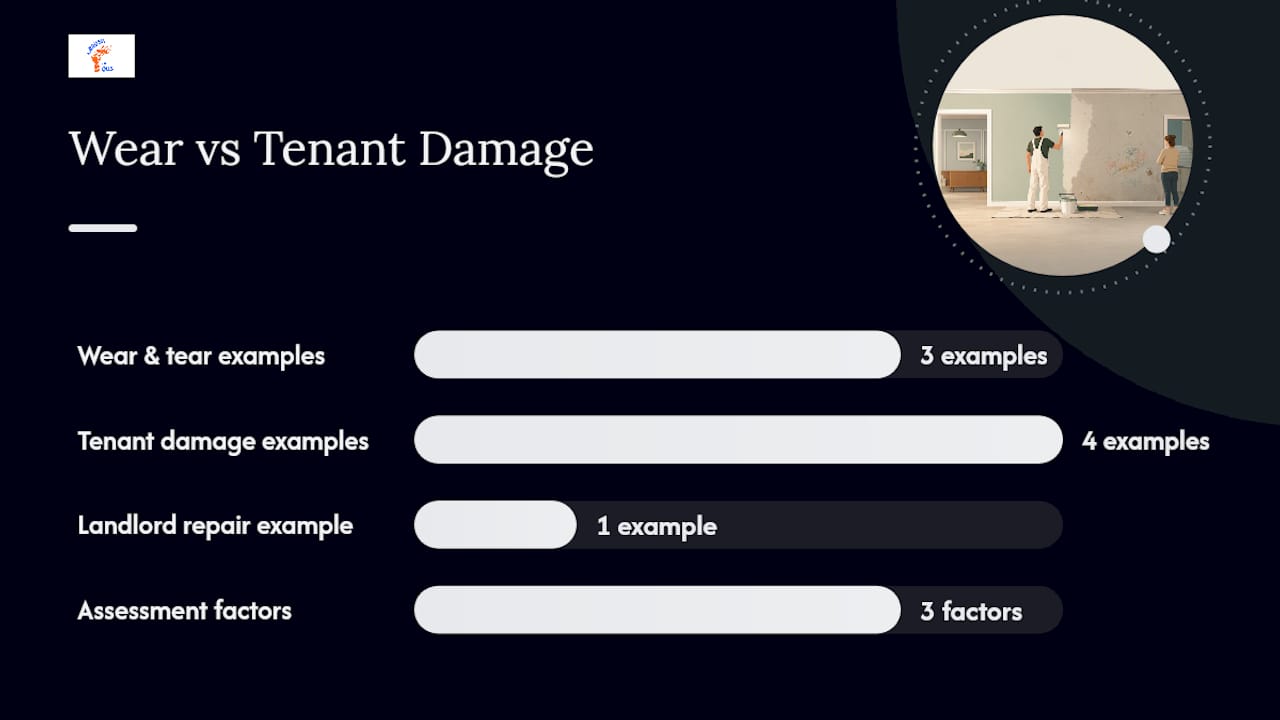
The assessment turns on the condition at move-in (documented in the inventory), the length of the tenancy, and the nature of the marks. A scuff at skirting-board height after a three-year tenancy is wear and tear. A fist-sized hole in the plasterboard is damage.
Issue | Likely responsibility | Reason |
Light scuffs on hallway walls | Landlord (wear and tear) | Normal movement through a busy corridor |
Sun-faded paintwork | Landlord (wear and tear) | Natural UV degradation over time |
Small nail holes from picture hooks | Landlord (wear and tear) | Reasonable domestic use |
Large holes from shelving fixings | Tenant (damage) | Exceeds reasonable use; requires filling and repainting |
Unauthorised colour change | Tenant (damage) | Breach of tenancy agreement |
Mould from condensation (poor ventilation by tenant) | Tenant (damage) | Tenant’s failure to ventilate adequately |
Mould from building defect (damp course failure) | Landlord (repair) | Structural cause, not tenant behaviour |
Crayon or drawings on walls | Tenant (damage) | Not ordinary domestic use |
When assessing a claim, deposit scheme adjudicators look at the move-in inventory, move-out photographs, and any contractor reports. Where a wall needs repainting because of both age and some tenant marks, the cost is often prorated: the landlord absorbs the portion attributable to age and the tenant pays for the damage element.
Pro Tip: At move-in, photograph every wall, ceiling, and skirting board in good light. Date-stamp the images or email them to yourself so the timestamp is independently verifiable. Do the same at move-out. Photographic evidence is consistently the deciding factor in deposit adjudications.
Can a landlord charge a tenant for repainting?
Yes, but only for damage that goes beyond fair wear and tear. Routine repainting between tenancies is a landlord’s management cost, not something that can be passed to a departing tenant simply because the walls look tired.
To make a lawful deduction from a deposit for repainting, follow these steps:
Identify the specific damage and document it with dated photographs and the move-in inventory comparison.
Obtain a cost estimate from a contractor. The estimate should be itemised: preparation, priming, and finishing are separate line items.
Prorate where appropriate. If the paintwork was five years old and the tenancy lasted two years, the landlord cannot charge the full cost of a fresh repaint. The deduction should reflect the damage element, not the full replacement.
Provide itemised evidence to the tenant before making any deduction. A bare statement that “repainting cost £X” is not sufficient.
Follow your deposit scheme’s rules. All deposits in England and Wales must be protected in a government-approved scheme: the Tenancy Deposit Scheme, Deposit Protection Service (DPS), or MyDeposits. Each scheme has a free dispute resolution service. If the tenant disputes a deduction, either party can refer it to the scheme’s adjudicator.
The adjudicator will look at the inventory, the photographs, the contractor invoice, and whether the deduction is proportionate. A landlord who cannot produce a move-in inventory will struggle to prove the damage was caused during the tenancy.
Pro Tip: Keep a repair log with dates, descriptions, and contractor invoices. A well-maintained log shows the property was cared for and makes prorating straightforward if a dispute arises.
How does permission to redecorate work?
Tenants need the landlord’s permission before redecorating. Shelter confirms that landlords can reasonably restrict colours, finishes, and contractors. Refusing permission is not automatically unreasonable; requiring a return to a neutral palette on exit is a standard and enforceable condition.
A landlord granting permission should do so in writing and set clear terms. Here is a short template landlords can adapt:
Reasonable conditions a landlord may impose:
A neutral colour palette (white, off-white, or magnolia) to protect future lettability.
Use of trade-quality paint rather than budget emulsions that cover poorly.
A licensed contractor for any property where lead paint may be present (generally pre-1960s stock).
A written agreement on whether the landlord will accept the new colour at move-out, removing the restoration obligation.
Document any agreed changes and confirm in writing whether the tenant is permitted to leave the new decoration in place at the end of the tenancy. That one step prevents a large proportion of move-out disputes.
What happens to painting at the end of a tenancy?
Move-out is when painting disputes crystallise. A thorough move-in and move-out process is the best protection for both sides.
Checklist for both landlords and tenants:
Move-in: complete a detailed inventory with photographs; note every pre-existing mark, scuff, or area of wear; both parties should sign and date the document.
Move-out: conduct a joint inspection where possible; compare the condition against the move-in inventory; photograph every discrepancy.
Meter readings, keys, and forwarding addresses should be recorded at the same time.
Pre-existing marks: note them explicitly in the inventory. “Small scuff above skirting, north wall of bedroom” is more useful than “walls in good condition.”
Landlords commonly repaint between tenancies as a commercial decision, particularly during a void period. That cost is a management expense unless specific damage caused by the tenant justifies a deduction. If a deduction is made, the landlord must notify the tenant within the timeframe set by the deposit scheme (typically within 10 days of the tenancy ending) and provide itemised evidence.
If a tenant disputes a deduction, they should raise it with the deposit scheme’s dispute service promptly. Most schemes require the dispute to be raised within a set window. Keep all correspondence, receipts, and photographs in one folder. For landlords preparing a property for the next tenancy, working with a property services provider for clearance and preparation can help ensure the space is ready before a painter arrives. Cleanout services for landlords are one way to manage that preparation efficiently.
When is painting a repair rather than a cosmetic choice?
The rule is straightforward: if the decoration follows or masks a repair issue, it is part of the repair obligation. If it is purely cosmetic, it is a management decision.
Where landlords must act:
Water ingress causing peeling or staining: fix the source first, then redecorate. Painting over a damp wall without treating the cause is not a repair; it is concealment.
Blown plaster: replastering and subsequent decoration are part of the same repair.
Mould linked to a building defect: where mould results from inadequate insulation, a failed damp course, or cold bridging, the landlord must address the cause and the resulting decoration.
Post-repair making-good: any contractor completing a repair should include making good the decoration as part of the scope. Treating it as an optional extra leads to disputes and repeat visits.
Where disability adaptations are involved, the picture is more nuanced. The Equality Act 2010 requires landlords to consider reasonable adjustments for disabled tenants. Shelter’s guidance explains when landlords are responsible for improvements that affect habitability, including adaptations. A disabled tenant requesting a change that involves redecorating (for example, high-contrast colour schemes to assist with visual impairment) should be considered on its merits. Refusing without good reason may engage Equality Act duties.
Treat post-repair decoration as part of the repair contract from the outset. It costs less, avoids callbacks, and removes any ambiguity about who is responsible for the finish.
How to hire a painter for a rental property: what landlords should know
Choosing the right contractor matters as much as the paint itself. A poor preparation job will fail within months, creating the very callbacks and deposit disputes you are trying to avoid.
Contractor checklist before you book:
Public liability insurance: minimum £1 million cover; ask for the certificate.
References from rental or commercial work: domestic decorators and rental-property decorators face different pressures; a contractor familiar with rental turnarounds understands the timeline.
Lead-safe practice: for properties built before approximately 1960, ask whether the contractor is trained in lead-safe working procedures. Disturbing lead paint without proper controls is a health risk.
Itemised quotes: preparation, priming, and finishing should be separate line items. A quote that says “paint two rooms, £X” tells you nothing about what is included.
Defects period: confirm how the contractor handles callbacks within 30 days of completion.
For landlords in Cornwall and the South West, Abrushwithgus offers domestic painting and decorating services for rental properties, including interior repaints between tenancies. The team is familiar with the practical demands of rental turnarounds: tight timelines, neutral finishes, and making good after repairs.
A typical two-room interior repaint between tenancies follows this sequence:
Stage | Activity | Typical duration |
Preparation | Fill holes, sand surfaces, mask edges, treat any damp spots | Half to one day |
Priming | Apply trade primer to bare plaster or repaired areas | Half day (plus drying time) |
First coat | Full emulsion coat, walls and ceiling | One day |
Second coat and finish | Final coat, cut-in edges, skirting boards | One day |
Snagging | Touch-ups, remove masking, final inspection | Two to three hours |

Quality expectations for a professional finish include proper surface preparation (no skipping the primer on repaired areas), trade-grade emulsions rather than retail budget paint, and a contractor who will return to address any snags within a reasonable period. Knowing the right questions to ask before you book saves time and avoids misunderstandings about scope.
Practical steps to avoid painting disputes
Most disputes are preventable. The following steps cost very little time and can save a significant amount of money and stress.
Agree everything in writing. Redecorating permissions, agreed colours, and restoration obligations should all be confirmed by email before any work begins.
Photograph at move-in. Every wall, ceiling, and floor covering, in good light, with a date stamp. Share the photos with the tenant and ask them to confirm receipt.
Report leaks and damp immediately. Tenants: send a written report (email is fine) the day you notice it. Landlords: respond and act promptly. Delay by either party complicates liability.
Keep repair receipts. Every contractor invoice, every materials receipt. These are your evidence if a deposit dispute reaches adjudication.
Use authorised contractors. For any work in older properties, confirm lead-safe credentials. For any work agreed with a tenant, confirm the contractor meets the standard set in the tenancy agreement.
Record any permission to repaint. If a tenant asks to change a colour and you agree, confirm in writing what was agreed and whether restoration is required at move-out.
Conduct a joint move-out inspection. Walk through the property together, compare against the move-in inventory, and note any discrepancies on the spot. It is far easier to agree on a scuff in person than to argue about a photograph six weeks later.
Pro Tip: A small pot of the original wall colour left in the property at the start of a tenancy makes touch-ups straightforward and reduces the likelihood of a full repaint being needed at move-out. Note the paint brand and colour code in the inventory.
A painter’s perspective on what actually goes wrong
The most common cause of a failed repaint in a rental property is not the paint. It is what happens before the paint goes on. Damp that has not been treated, plaster that has not fully dried, or a surface that has simply been wiped down and painted over without any preparation: these are the jobs that come back within six months with bubbling, peeling, or staining.
From a trade perspective, the landlord who treats painting as the last five minutes of a repair job, rather than a distinct stage with its own preparation requirements, is the one who ends up paying twice. Fix the damp course, let the plaster dry properly, prime the bare areas, and then paint. In that order, every time.
The same logic applies to deposit disputes. The landlords who avoid them are not the ones with the most aggressive tenancy agreements. They are the ones with a thorough move-in inventory, dated photographs, and a repair log that shows the property was maintained throughout the tenancy. Evidence is everything.
If you are a landlord in Cornwall or the South West and you are preparing a property between tenancies, or dealing with post-repair decoration, Abrushwithgus is worth a call. The team at A Brush With Gus understands rental turnarounds and can advise on scope, timeline, and finish standard before you commit to a quote.

Ready to get your rental property repainted to a professional standard? Abrushwithgus serves landlords and property managers across Cornwall and the South West. Whether you need an interior refresh between tenancies or post-repair making-good, the team offers domestic painting and decorating with itemised quotes and a clear scope of work. Get in touch for a no-obligation quote.
Sources
The following sources underpin the guidance in this article and are worth bookmarking for reference:
This article is general information, not a substitute for advice from a qualified lawyer. Consult a qualified legal professional about your own circumstances before acting on anything here.
Recommended
Comments