
Painter accreditation: what every homeowner needs to know
TL;DR:
Accreditation verifies a painter meets industry standards, ensuring professionalism and quality.
Trusted schemes include PDA, TrustMark, and Dulux, offering different levels of consumer protection.
Accreditation provides insurance, dispute resolution, and ongoing professional development benefits for homeowners.
Hiring a painter feels straightforward until something goes wrong. A botched finish, a dispute over damage, or discovering your decorator had no insurance can turn a simple decorating project into an expensive headache. Many homeowners in the South West assume that anyone who turns up with a van and a brush is qualified to work on their home. That assumption is costing people money, time, and stress. This guide breaks down exactly what painter accreditation means, how it differs from general qualifications, which schemes matter most in the UK, and how you can protect your home by knowing what to look for before you hire.
Table of Contents
Key Takeaways
Point | Details |
Accreditation ensures vetting | Professional painter accreditation means an independent body has verified skills, insurance, and standards. |
Scheme choice matters | Not all accreditations offer equal benefits; look for PDA, TrustMark, or recognised schemes for best coverage. |
Added homeowner protection | Using accredited painters gives access to insurance, mediation, and higher quality standards for peace of mind. |
Qualifications complement accreditation | NVQ or City & Guilds are valuable but should be combined with accreditation for full assurance. |
What is painter accreditation and why does it matter?
Painter accreditation is formal recognition that a painter or decorator meets a defined set of professional standards set by an industry body. It is not the same as having skills or completing a course. An accredited painter has been vetted, assessed, and approved by an organisation that holds them accountable to a code of practice. Think of it as the difference between someone who can cook and a chef who has passed a food hygiene inspection and holds a professional certification.
This distinction matters enormously for homeowners. Professional painting explained goes far beyond applying paint to a wall. It involves surface preparation, understanding materials, managing health and safety, and delivering a finish that lasts. Without accreditation, there is no independent body verifying that a painter meets any of these standards.
The premier trade body in the UK for this is the Painting & Decorating Association (PDA). Established in 1894, the PDA vets members for quality workmanship, requires proof of insurance, and demands adherence to a strict code of practice. Members are permitted to display the PDA logo, which serves as a visible professionalism mark that homeowners can look for before signing any contract.
“Hiring an unaccredited painter is like buying a car with no MOT history. It might be fine, or it might cost you far more than you bargained for.”
The top qualities of a good painter include reliability, technical skill, and professional accountability. Accreditation is the mechanism that verifies all three are present in a measurable way.
Key benefits of using an accredited painter include:
Insurance cover: Accredited painters carry public liability insurance, protecting your property if damage occurs.
Code of practice: Members commit to professional conduct standards and quality benchmarks.
Accountability: An independent body can step in if things go wrong.
Vetted skills: Accreditation bodies assess technical competence before granting membership.
Peace of mind: You have a named organisation to contact if a dispute arises.
The main painter accreditation schemes in the UK
With a clear definition in place, it is time to explore which accreditation schemes actually serve South West homeowners best. There are three principal schemes worth knowing about: the PDA, TrustMark, and Dulux Select Decorators.
The Painting & Decorating Association (PDA) is the trade body specifically focused on the painting and decorating sector. It vets members for technical competence, requires ongoing insurance, and enforces a code of conduct. The PDA is the go-to benchmark for domestic decorating work and is widely recognised across the UK.
TrustMark is the UK Government-endorsed quality scheme covering a broad range of tradespeople, including painters. Painters register through providers like Dulux Select Decorators and undergo rigorous assessment covering technical standards, specialist techniques such as airless spraying and gilding, and insurance compliance. It adds an extra layer of government backing that gives homeowners additional confidence.
Dulux Select Decorators is a scheme run by one of the UK’s most trusted paint brands. It focuses specifically on painting excellence and includes assessment of specialist techniques, customer service standards, and ongoing training requirements. Being a Dulux Select Decorator is a significant mark of quality for homeowners seeking premium finishes.
Knowing how to identify trusted painting contractors in your area means understanding which of these schemes a painter belongs to. You can find further information about scheme requirements on our blog.
Scheme | Government backed | Insurance required | Specialist skills | Consumer protection |
PDA | No | Yes | Some | Dispute mediation |
TrustMark | Yes | Yes | Yes | Appeals process |
Dulux Select | No | Yes | Yes (spraying, gilding) | Complaints process |
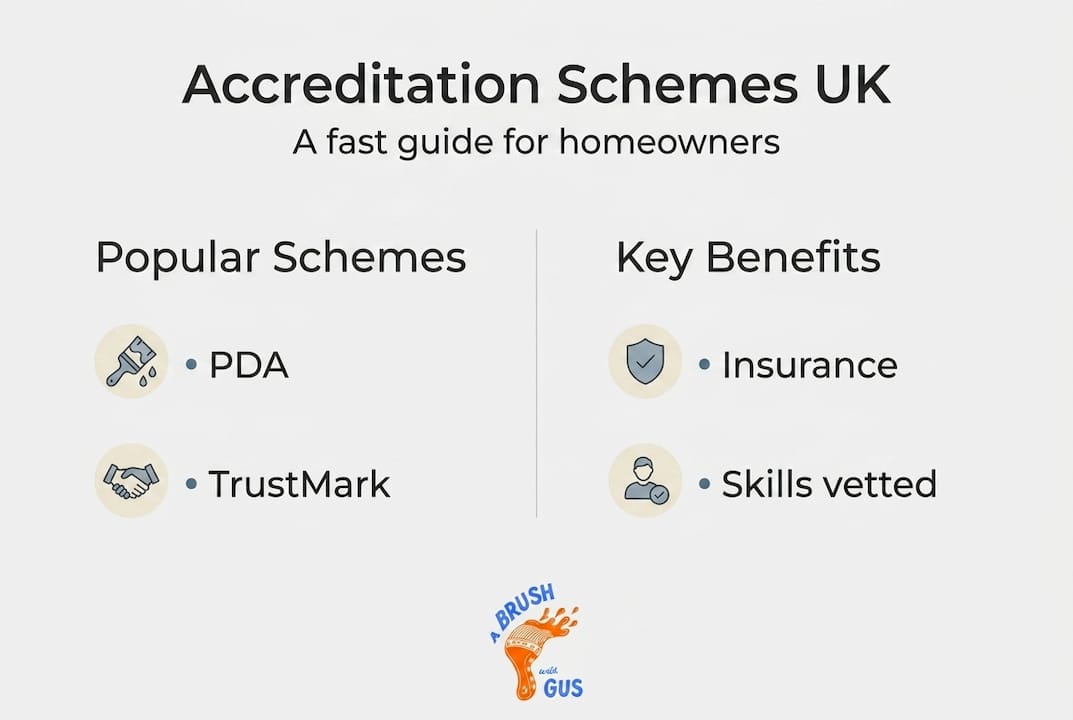
For most homeowners hiring for interior or exterior home projects, PDA membership is the minimum standard to look for. If you want an advanced specialist finish or require government-backed assurance, TrustMark registration is the strongest indicator of quality. Understanding how to hire a painter means using this information before you request a single quote.
How painter accreditation benefits your home project
After comparing the schemes, the practical question remains: what does accreditation actually mean for your project on a day-to-day basis? The answer goes well beyond a logo on a business card.
Insurance protection is arguably the most important benefit. If an uninsured painter damages your property, you are left chasing payment through the courts with no guarantee of recovery. An accredited painter carries public liability insurance that covers exactly these situations, giving you a direct route to financial redress without the stress of legal proceedings.
Health and safety compliance matters more than many homeowners realise. Regulations like COSHH (Control of Substances Hazardous to Health) require painters to manage solvents, paints, and chemicals responsibly. Accredited painters are trained in these regulations as part of their vetting. In older properties, this extends to asbestos awareness, which is a genuine risk in homes built before the mid-1980s. An accredited painter working on an older South West property will know when to stop work and call in a specialist, rather than disturbing hazardous materials unknowingly.
Dispute mediation is the safety net most homeowners never think about until they need it. The PDA acts as a mediator when disputes arise between homeowners and member painters, offering a structured resolution process without requiring legal action. This is the kind of protection that can save thousands of pounds and months of stress.
The benefits of professional painters extend to the quality of finish you receive, but accreditation goes further by guaranteeing accountability throughout the process. For exterior projects in the South West, where coastal weather and variable temperatures demand a particularly durable approach, this matters even more. You can learn about painting best practices specific to this region for context on why standards adherence is so important here.
Here is how to verify a painter’s accreditation before you commit:
Ask directly for their accreditation body name and membership number during your first conversation.
Visit the scheme website (PDA, TrustMark, or Dulux Select) and search for the painter’s name or company.
Check for the logo on their website, email signature, or physical materials. Reputable accreditation bodies allow verified members to display their mark.
Request proof of insurance and read the documentation rather than simply accepting a verbal assurance.
Check reviews on independent platforms alongside accreditation to get a complete picture of their track record.
Pro Tip: Do not rely solely on a painter telling you they are accredited. Verification takes five minutes online and could save you significant money and frustration if problems arise mid-project.
Accreditation versus qualifications: What’s the difference?
It is important to address a common point of confusion: not all qualified painters are accredited, and not all accredited painters hold formal qualifications. These two things measure different aspects of a painter’s competence, and the best decorators will have both.
Qualifications like NVQ (National Vocational Qualification) and City & Guilds certifications assess practical, technical competence through work-based assessment. NVQ Levels 1 to 3 in painting and decorating cover core skills including surface preparation, application techniques, and wallpapering. Level 2, for example, demonstrates competence across a broad range of standard decorating tasks. These qualifications are awarded by educational bodies and certify that a painter can do the work.
Accreditation, by contrast, certifies that a painter operates professionally. It covers insurance, conduct, complaints processes, and ongoing adherence to industry standards. A painter could be technically brilliant but still operate without insurance, ignore professional codes of conduct, or leave you with no recourse if something goes wrong.
Here is a clear breakdown:
NVQ/City & Guilds qualifications focus on: practical skills, surface preparation, application methods, and work-based learning outcomes.
PDA/TrustMark accreditation focuses on: professional standards, insurance compliance, consumer protection, and ongoing accountability.
The ideal painter has: both a recognised qualification and current accreditation, demonstrating technical skill and professional integrity.
For homeowners looking at specialist projects, understanding professional painting techniques helps you assess whether a painter’s qualifications genuinely match the work you need done. Airless spraying, for instance, is a specialist technique that requires specific training beyond a standard NVQ, and accreditation schemes like Dulux Select Decorators and TrustMark explicitly recognise and assess these advanced skills.
Pro Tip: When interviewing painters for a specialist project, ask specifically which qualifications and accreditations they hold and whether those credentials are relevant to the techniques your job requires. A painter qualified for standard brush work is not necessarily qualified to spray your UPVC windows or apply a gilded finish.
The two work best together. Qualifications give you technical confidence. Accreditation gives you professional assurance. Neither alone is sufficient for a complete picture of a painter’s suitability for your home.
A fresh perspective on painter accreditation: what most guides miss
Most articles about painter accreditation focus entirely on what accreditation is, listing schemes and ticking boxes. That is useful, but it misses something more important: the risk to your project is rarely about whether a painter can hold a brush. It is about whether they follow a process.
The real value of accreditation is not the logo. It is the discipline that comes from belonging to a body that holds you accountable. An accredited painter is not just technically vetted once. They are expected to maintain standards continuously, keep their insurance current, and stay updated on regulations and techniques. That ongoing accountability changes how a professional approaches every single job, including yours.
We have seen this in practice. When a painter knows their work may be reviewed by an accreditation body following a complaint, they approach every surface, every coat, and every edge differently. The standard is not set by how good a day they are having. It is set by a framework that exists whether they like it or not.
PDA and TrustMark schemes also reduce risk in ways that are genuinely hard to quantify. Insurance and vetting do not prevent every problem, but they transform the nature of problems when they do arise. A dispute with an unaccredited painter can drag on for months with no resolution mechanism. The same dispute with a PDA member is managed through a structured mediation process that protects both parties.
There is also the matter of specialist skills, which most homeowners underestimate. If you are investing in an exceptional finish from trusted painters, whether that is a precision spray finish on your exterior, a gilded feature wall, or a flawless eggshell on period joinery, the painter applying it needs more than competence. They need continuous professional development. Accreditation schemes that recognise specialist skills create an incentive for painters to keep training, investing in better techniques, and producing results that protect the long-term value of your home.
The South West’s older housing stock, coastal exposure, and varied architecture mean that specialist knowledge is not a luxury here. It is a practical necessity. Choosing an accredited painter is not about bureaucracy. It is about choosing someone who is invested in doing the job properly because their professional reputation depends on it.
Take the next step with accredited painters in the South West
Knowing what accreditation means is only useful if it guides your next decision. At A Brush With Gus, Gus and Rhys bring professional standards, genuine industry knowledge, and a commitment to quality that goes well beyond the basics.

Whether you need domestic painting services for your interiors, a durable and weather-resistant exterior home painting finish built for South West conditions, or a specialist professional spraying service for UPVC, fences, or rendered walls, you deserve to work with a team whose quality of work stands up to scrutiny. Get in touch for a no-obligation quote and start your next project with the confidence that comes from hiring right.
Frequently asked questions
How can I check if a painter is properly accredited?
Ask for their PDA, TrustMark, or Dulux Select Decorators membership and verify via the relevant body’s website. The PDA logo is a visible professionalism mark and member searches are available online.
Is painter accreditation the same as having qualifications?
No. NVQ and City & Guilds certifications confirm technical competence, while accreditation marks professional vetting, insurance compliance, and adherence to industry standards. Both together give the strongest assurance.
What protections do accredited painters offer that others might not?
Accredited painters provide insurance cover, adherence to a code of practice, and access to dispute mediation. The PDA offers mediation as a formal resolution route, meaning you have real recourse if a problem arises.
Are specialist techniques like airless spraying and gilding covered under accreditation?
Yes. The TrustMark scheme and Dulux Select Decorators explicitly assess specialist techniques including airless spraying and gilding, so homeowners can hire with confidence for advanced finishes.
Is painter accreditation required by law in the UK?
No, painter accreditation is not a legal requirement in the UK. However, it provides genuine reassurance through insurance, consumer protection, and professional standards that unaccredited painters simply cannot offer.
Recommended
Comments