
Role of decorators in business: what you need to know

TL;DR:
Professional decorators enhance brand perception by transforming commercial spaces through surface finishes and styling. They focus on visual elements, unlike interior designers who handle structural changes, making decorators a more cost-effective option for non-structural updates. Regular seasonal updates and effective project management by decorators boost customer experience and operational efficiency.
Professional decorators are defined as specialists who transform commercial spaces through surface-level visual changes, directly shaping how customers perceive a brand. The role of decorators in business extends well beyond paint and wallpaper. A skilled decorator acts as a silent brand ambassador, translating a company’s personality into colour, texture, and atmosphere. Businesses that invest in professional decoration gain a measurable edge in customer experience, staff morale, and brand recall. Abrushwithgus has seen this first-hand across commercial projects throughout the South West.
What is the role of decorators in business environments?
Decorators in commercial settings do far more than apply a fresh coat of paint. Their core function is to create a visually complete environment that reflects a business’s identity through cohesive colour palettes, furnishings, finishes, and styling. Every choice, from the warmth of a wall tone to the texture of a fabric panel, communicates something to the customer before a word is spoken. That communication is either intentional or accidental. Professional decorators make it intentional.

The formal scope of a painter and decorator covers both interior and exterior surfaces in commercial and industrial settings, preserving aesthetics and longevity across a property’s life. This dual function, decorative and protective, makes the role particularly valuable for businesses that rely on physical premises to attract and retain clients. A well-maintained exterior signals professionalism before a customer steps through the door.
How do decorators differ from interior designers in business projects?
This distinction matters enormously when a business is planning a commercial fit-out or refresh. Confusing the two roles leads to costly project scope errors that delay timelines and inflate budgets.
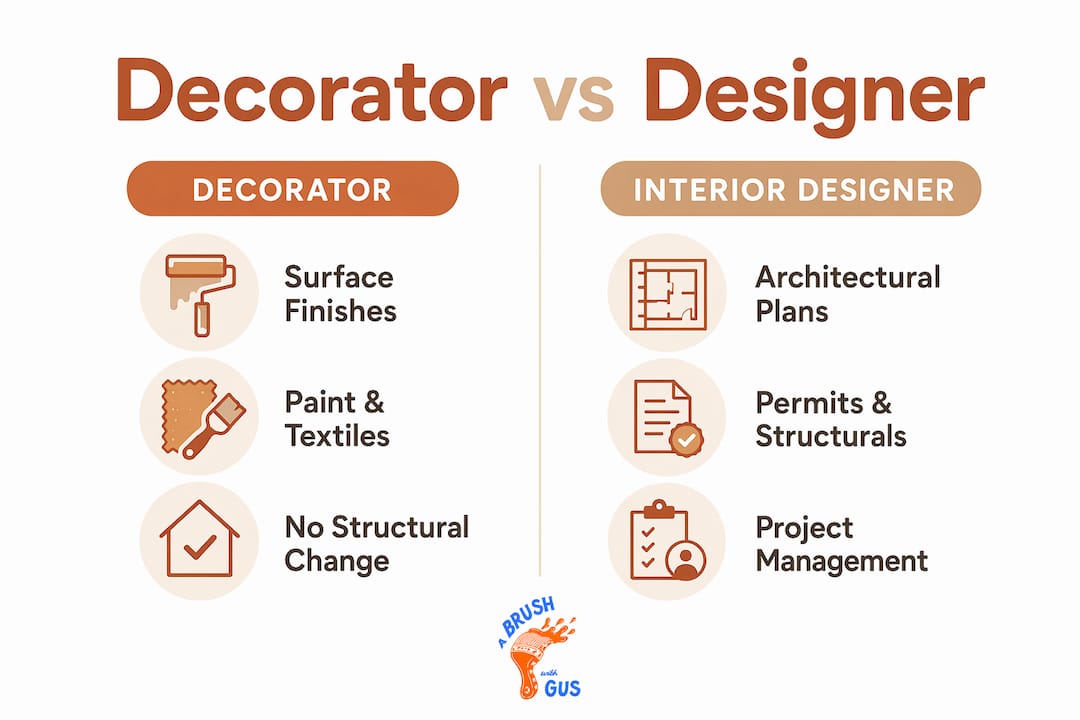
What decorators handle
Decorators focus exclusively on surface-level elements such as furnishings, finishes, textiles, paint, wallcoverings, and styling. They work within the existing architecture of a space. They do not require permits, cannot alter load-bearing walls, and do not engage with electrical or plumbing systems. Their value lies in transforming what is already there.
What interior designers handle
Interior designers operate at a structural and technical level. They produce architectural drawings, manage planning permissions, and coordinate with contractors on physical changes to a building. Their scope includes spatial planning, lighting systems, and compliance with building regulations. For a business that needs walls moved or a mezzanine added, an interior designer is the correct professional to engage.
The table below clarifies the practical split between the two roles.
Responsibility | Decorator | Interior designer |
Paint, wallcoverings, and finishes | Yes | Sometimes |
Furniture selection and styling | Yes | Yes |
Structural alterations | No | Yes |
Planning permissions and permits | No | Yes |
Colour and textile consultation | Yes | Yes |
Electrical and plumbing coordination | No | Yes |
Pro Tip: If your project involves no structural changes, a decorator is almost always the faster and more cost-effective choice. Engage an interior designer only when walls, ceilings, or building systems need to change.
Understanding decorator versus designer roles before signing any contract prevents expensive scope creep on commercial projects.
How do decorators enhance brand identity and customer experience?
The decorator shapes the emotional layer of a business space, completing the atmosphere that the building’s architecture only begins. Decorative choices create emotional connections and visual brand cues that influence how long customers stay, how much they spend, and whether they return. A hospitality venue with warm lighting, considered textiles, and a coherent colour palette feels welcoming in a way that a freshly painted but unstyled room never does.
Retail stores, offices, and hotel lobbies each use decoration differently, but the underlying principle is the same. Colour communicates mood. Art signals values. Lighting controls energy and focus. A law firm that uses deep navy and dark timber finishes projects authority. A children’s activity centre that uses bright primaries and playful murals projects energy and fun. Neither effect happens by accident.
Key decorative elements that directly affect brand perception include:
Colour palette: the single most immediate signal of brand personality in any space
Lighting: warm tones encourage relaxation; cool tones promote focus and alertness
Textiles and soft furnishings: communicate quality, comfort, and price point
Art and wall treatments: express values, culture, and creative identity
Signage integration: ties decoration to brand language and wayfinding
Scent and acoustic materials: often overlooked, but both are shaped by decorative choices
Businesses that treat decoration as a branding tool, rather than a maintenance task, consistently create more memorable customer experiences. Abrushwithgus approaches every commercial project with this principle at the centre of its work.
Why are seasonal updates a strategic use of professional decorators?
Decoration is not a one-time event. Businesses use decoration to stay relevant with evolving trends and seasonal marketing needs, and professional decorators make those updates efficient and cost-effective. A retail space refreshed for Christmas, a restaurant redecorated for a spring menu launch, or an office updated to reflect a rebrand all benefit from a decorator’s ability to work quickly within an existing structure.
The alternative, a structural renovation, is expensive, disruptive, and slow. Seasonal decoration achieves a comparable visual impact at a fraction of the cost and time. This makes it one of the most practical tools available to businesses managing tight budgets and high customer expectations.
A structured approach to seasonal updates typically follows this sequence:
Audit the existing space: identify which elements are fixed and which can be changed quickly
Define the seasonal or campaign brief: align the decoration plan with the marketing calendar
Source materials and bespoke items early: long lead times on custom pieces are the most common cause of delays
Schedule installation outside peak trading hours: protect revenue and customer experience during the transition
Review and photograph the finished space: create assets for social media and future planning
Pro Tip: Book your decorator at least six weeks before a seasonal campaign launch. Bespoke items and specialist finishes often carry four to eight week lead times, and rushing the final installation creates visible quality issues.
The commercial property decorating guide published by Abrushwithgus covers seasonal planning in detail for businesses operating in the South West.
How do decorators manage project logistics in commercial settings?
Effective decorators act as project managers, not just craftspeople. Logistical expertise ensures smooth execution and avoids operational downtime that costs businesses real money. A decorator working on a hotel lobby, for example, must coordinate paint deliveries, furniture arrivals, and installation teams across a window of time when the space is not in use. That requires scheduling precision that goes well beyond colour selection.
Project management by decorators includes tracking long lead times for bespoke items and coordinating complex deliveries to business sites. A single delayed delivery can hold up an entire installation, forcing a business to operate in a half-finished space. Experienced decorators build contingency time into every schedule and maintain supplier relationships that allow them to escalate issues quickly.
The practical coordination challenges decorators solve on commercial projects include:
Phasing work across multiple rooms so that parts of the business remain operational
Managing access restrictions in buildings with security or health and safety requirements
Sourcing alternative materials when a specified product is unavailable
Communicating progress to business owners without disrupting the working day
A well-managed decorating project protects a business from the reputational damage of opening a space that looks unfinished. Abrushwithgus manages this coordination as a standard part of every commercial contract, not as an optional extra.
Key takeaways
Professional decorators deliver measurable business value by combining brand communication, customer experience design, and project management into a single, cost-effective service.
Point | Details |
Decorators are brand communicators | Every finish, colour, and textile choice sends a signal to customers about your brand’s values. |
Decorators differ from designers | Decorators work within existing structures; interior designers handle structural and technical changes. |
Seasonal updates protect relevance | Regular decorative refreshes keep commercial spaces aligned with marketing campaigns and trends. |
Project management is part of the role | Experienced decorators coordinate sourcing, scheduling, and installation to protect business continuity. |
Early engagement prevents delays | Bespoke items carry long lead times; booking a decorator well in advance avoids last-minute quality issues. |
What I have learned from commercial decoration projects
Most businesses underestimate what a decorator actually does. They picture someone with a roller and a colour chart. What they get, when they hire well, is a professional who thinks about their brand, their customers, and their operational calendar all at once.
The biggest mistake I see is businesses treating decoration as the last item on a fit-out checklist, something to do after everything else is finished, with whatever budget remains. That approach produces spaces that look assembled rather than designed. The decoration is what customers actually see and feel. It is the layer that makes a space memorable or forgettable.
The businesses that get the most from their decorator are the ones who brief them early, share their brand guidelines, and treat the decoration as part of their marketing spend rather than their maintenance budget. When you frame it that way, the return on investment becomes obvious. A well-decorated space photographs better, retains customers longer, and generates more word-of-mouth than a plain one ever will.
One practical observation: exterior decoration is consistently undervalued. A freshly painted and well-maintained exterior is the first brand impression a customer receives. Businesses that invest inside but neglect the outside are leaving a significant first impression to chance.
— Angus
Professional decorating services from Abrushwithgus
The impact of a well-decorated commercial space is clear. Abrushwithgus delivers that impact for businesses and homeowners across the South West, combining quality workmanship with reliable project management.
Whether you need a full interior refresh, an exterior repaint, or a specialist finish for a commercial property, Abrushwithgus covers the full range. The team’s domestic decorating services and exterior home treatments are built around minimal disruption and high-standard results. Gus and Rhys bring the same attention to detail to every project, from a single room to a full commercial fit-out. Get in touch for a no-obligation quote and find out what a professional finish can do for your space.
FAQ
What does a decorator do in a business setting?
A decorator transforms commercial spaces through surface-level changes including paint, wallcoverings, textiles, and styling. Their work directly shapes customer perception and brand memorability without altering the building’s structure.
How is a decorator different from an interior designer?
Decorators work within existing architecture and require no permits, while interior designers handle structural changes, technical planning, and building compliance. Interior decorators cannot alter structural elements or building systems.
Why should a business hire a professional decorator rather than doing it in-house?
Professional decorators bring supplier networks, project management skills, and brand communication expertise that in-house teams rarely possess. They also coordinate deliveries and installation to minimise business disruption during the decoration process.
How often should a business refresh its decoration?
Most businesses benefit from a decorative review at least once a year, aligned with seasonal campaigns or brand updates. Regular refreshes keep spaces relevant and maintain the quality of finish that customers associate with a professional brand.
Can a decorator help with exterior commercial spaces?
Yes. Painters and decorators cover both interior and exterior surfaces, and exterior work is often the highest-impact investment a business can make. A well-maintained exterior is the first brand signal any customer receives.
Recommended
Comments